The summit and its main outcome
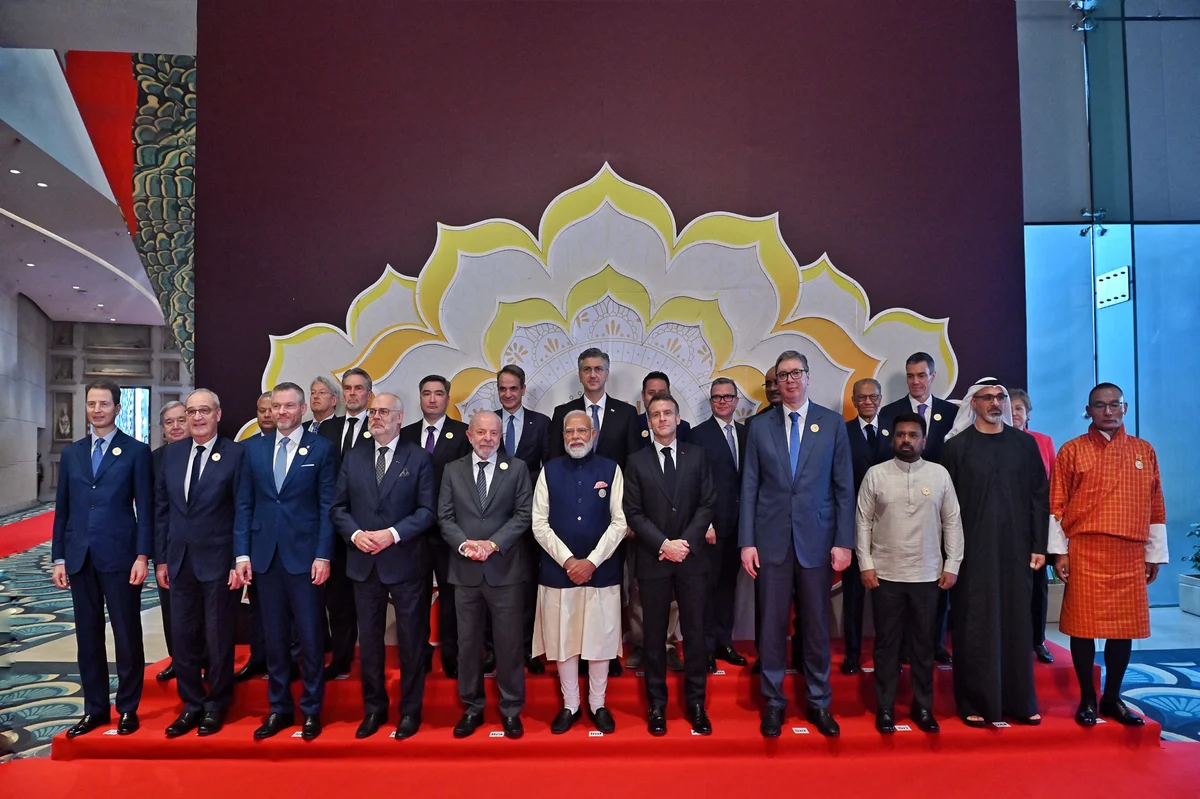
India held the AI Impact Summit at Bharat Mandapam in New Delhi from 16 to 21 February 2026, with the formal leaders’ opening on 19 February. The main proceedings produced the New Delhi Declaration on AI Impact, whose final official tally was 92 endorsers, and a separate set of voluntary commitments from 13 AI model providers and other participants.
IndiaAI Mission, within the Ministry of Electronics and Information Technology, presented the official programme around three organising sutras, People, Planet and Progress. Those themes applied across the gathering. The declaration subsequently set out seven areas of cooperation covering access to AI resources, economic growth and social good, trusted AI, science, social empowerment, skills and resilient systems. The ministry’s March retrospective counted 12 deliverables across the seven groups.
The event produced several kinds of records. The declaration annex identifies the countries and organisations associated with the government-led outcome. The frontier commitments announcement identifies the participants in a separate initiative involving companies and research representatives. The ministry’s retrospective brings those strands together with programme figures and investment expectations. For a question about who agreed to what, the individual records preserve distinctions that the headline totals can obscure.
- MeitY / IndiaAI Mission — organising framework
- MeitY — New Delhi Declaration on AI Impact, full annex
- MeitY — 24 February endorsement count update
- MeitY — 11 March final retrospective and outcome scope
- MeitY — Frontier AI Impact Commitments opening record
- Prime Minister’s Office — summit opening ceremony
Why the summit has several February dates
The wider programme was already underway when leaders assembled for the formal opening. Prime Minister Narendra Modi inaugurated the AI Impact Expo at Bharat Mandapam on 16 February. On 18 February, the Research Symposium on AI and its Impact took place on the third day of the broader gathering. Its programme covered AI across science, governance, industry and society. The Prime Minister’s Office dates the formal opening ceremony at Bharat Mandapam to 19 February.
| Date or scope | Record | Type | What the date verifies | Official source |
|---|---|---|---|---|
| 16–21 February 2026 | Bharat Mandapam programme | Programme window | The March retrospective uses these dates for the broad summit programme. | MeitY March retrospective |
| 16 February 2026 | AI Impact Expo opening | Programme event | The government opened the expo at Bharat Mandapam. | Official AI Impact Expo announcement |
| 18 February 2026 | Research Symposium on AI and its Impact | Programme event | Separate symposium on several research and policy applications. | MeitY Research Symposium record |
| 18–19 February 2026 | New Delhi Declaration on AI Impact | Declaration date | These are the declaration heading dates. | New Delhi Declaration full text |
| 19 February 2026 | Leaders’ opening ceremony | Programme event | Official ceremony at Bharat Mandapam. | Prime Minister’s Office ceremony record |
| 19 February 2026 | Frontier AI Impact Commitments | Company and institutional commitment | Separate initiative described in the MeitY opening record. | MeitY commitment announcement |
The declaration carries an 18–19 February heading and identifies 19 February in its preamble as the day leaders gathered. The ministry’s retrospective, issued on 11 March, uses 16–21 February for the wider programme. These dates describe different parts of the gathering. The date on an opening address belongs to the ceremony, the date range on the declaration belongs to the main proceedings, and the retrospective covers the Expo and the broader programme.
For an archive entry dated 18 February, the contemporaneous symposium statement provides a specific event name and places it within the wider gathering. For a caption about the formal leaders’ opening, use the Prime Minister’s Office ceremony record and its 19 February date. Early planning documents can establish the organising framework, while the completed-event records provide the chronology for sessions that actually took place.
Things to do in Delhi: one, two and three-day itinerariesIndia events calendar: announced festivals and tentative dates
- MeitY / IndiaAI Mission — organising framework
- MeitY — AI Impact Expo opened 16 February
- MeitY — Research Symposium on AI and its Impact
- Prime Minister’s Office — summit opening ceremony
- MeitY — New Delhi Declaration on AI Impact, full annex
- MeitY — 11 March final retrospective and outcome scope
- MeitY — Frontier AI Impact Commitments opening record
How the declaration reached 92 endorsements
The endorsement tally moved after the main proceedings. In its 24 February update, the ministry said the declaration had 88 endorsements as of 21 February and reached 91 after Bangladesh, Costa Rica and Guatemala joined. The annex on the original release page, which carries a 21 February publication date, was subsequently updated to 92 entries. The ministry’s 11 March retrospective also gives the total as 92.
| Record date | Count | What the official source says |
|---|---|---|
| 21 February 2026 | 88 | Number given retrospectively in the 24 February update. |
| 24 February 2026 | 91 | Follow-up names Bangladesh, Costa Rica and Guatemala as additional endorsements. |
| 11 March 2026 retrospective | 92 | Later official count. The updated annex has 90 countries plus the EU and IFAD. |
The updated annex contains 90 countries and two organisations. The European Union and the International Fund for Agricultural Development occupy positions 91 and 92 in the displayed list. Those positions show where the organisations appear in the annex. The dated follow-up provides the evidence for when the count rose to 91, and the March report establishes that the ministry was reporting 92 by then.
If you encounter a February headline saying 88 and a current copy of the declaration listing 92, check what each figure describes before correcting either one. A report about the position on 21 February should use the dated follow-up’s count of 88. An account of the final tally can use 92 with attribution to the updated annex or the March retrospective. For a particular country, check the name in the annex and use a dated update if the timing of its endorsement matters.
When a record is updated in place, the date above the text can remain the date of the original publication. The explicit 24 February comparison identifies the earlier totals. Use that dated record for 88 and 91, then the March retrospective and revised annex for 92. This also prevents a reader from counting companies in the Frontier initiative as endorsements by governments or international organisations.
What came out of the seven working groups
The New Delhi Declaration recorded voluntary international cooperation. Its outcomes included a charter, public resources, an institutional network, an inclusion alliance and guidance on infrastructure. These outputs address different decisions. A policy team looking at access to AI resources can start with the Charter for Democratic Diffusion. A researcher looking for examples of AI applications has a more direct route through the Global AI Impact Commons, which has a public operator page.
The two commons have distinct remits. The public Global AI Impact Commons identifies itself as the official deliverable of the AI for Economic Growth and Social Good working group. The ministry’s March retrospective describes the Trusted AI Commons in terms of 23 partner countries ahead of formal launch. The same retrospective records 21 countries plus UNICEF for the Alliance for Advancing Inclusion Through AI and 22 endorsing countries for a guidance note. Each count applies to its own initiative at the time of that report.
The ministry’s 2 March account gives the scale of the global commons at announcement as more than 80 stories across more than 30 countries. For someone choosing an example to cite or reuse, the public collection is a starting point. Open the individual case and check who supplied it, what results it documents and which materials carry a licence. A project description, a downloadable dataset and a published evaluation each support different claims about what was delivered.
| Outcome | What the record establishes |
|---|---|
| Charter for Democratic Diffusion | The declaration records a voluntary cooperation output on access to AI resources. |
| Global AI Impact Commons | The public operator identifies the resource as the working group’s official deliverable. |
| Trusted AI Commons | The March retrospective reports 23 partner countries ahead of formal launch. |
| AI for Science Institutions network | The declaration identifies a network as an AI-for-science outcome. |
| Alliance for Advancing Inclusion Through AI | The March retrospective lists 21 countries and UNICEF. |
| Resilient AI infrastructure playbook | The declaration records a playbook among its cooperation outputs on AI systems. |
| Equitable AI Transition Playbook | The 2 March outcomes account records its release with the International Labour Organization. |
Company commitments and the UN agenda
The New Delhi Frontier AI Impact Commitments were announced on 19 February. The official event record gives a headline count of 13 participants. It names representatives associated with Google or Alphabet and Google DeepMind, OpenAI, Anthropic, Microsoft, Amazon, Meta, Cohere, G42, Gnani.ai, Soket AI Labs, Sarvam AI and IIT Bombay. Use the official count for the initiative. The affiliations help identify who was represented, and several names in the record refer to related organisations.
The opening ceremony also hosted an address by United Nations Secretary-General António Guterres. The UN’s account confirms that he spoke at the formal opening and attended a separate science side event during a four-day India visit. He proposed a US$3 billion target for a Global Fund on AI. The UN Scientific Panel and global dialogue discussed during the visit arose from separate UN General Assembly actions. The UN’s account supplies the institutional context for each item.
To check a claim attributed to an organisation, start with the record that matches the action. A speaker’s proposal belongs in the account of the address. Participation in the frontier initiative belongs in the commitments announcement. Formal endorsement of the declaration is recorded in the annex. The ceremony brought speakers, officials and industry representatives into the same programme, so the session record is especially useful when a headline names an institution without specifying its role.
What the investment and GPU figures measure
The ministry’s March retrospective described expected investments exceeding US$250 billion. That wording puts the number in the category of investment expectations reported after the summit. For a claim about a particular investment, look for a dated disclosure from the organisation making it, with a stated amount, scope and schedule. A claim that capital has already been spent needs evidence of expenditure. The US$3 billion figure from Guterres’s address has its own scope as a proposed funding target.
| Published figure | Scope | How it was described |
|---|---|---|
| 13 | Frontier AI participation or commitments | Official retrospective’s provider count. Distinct from declaration endorsements. |
| 38,000+ GPUs | IndiaAI Mission capacity | Already provisioned in the 2 March government account. |
| Approximately 20,000 further GPUs | Additional capacity | Announced, with actual deployment a separate check. |
| US$250 billion-plus | Expected investment | Retrospective outlook, rather than realised investment. |
| US$3 billion | UN Global Fund on AI | Proposed target, as described in the UN account. |
| 250,946 | AI responsibility campaign | Guinness count of pledges received over 24 hours, 16–17 February. |
Compute capacity was reported in two parts. The ministry’s 2 March account said the IndiaAI Mission had provisioned more than 38,000 graphics processing units, or GPUs, and that approximately 20,000 additional GPUs had been announced. The first figure describes capacity provisioned under the mission at that reporting point. The second describes an intended expansion. Reporting the combined figure as available capacity would depend on subsequent evidence that the announced additions had entered service.
For a team weighing whether it can run a project on the platform, the relevant follow-up is a current capacity or service listing that identifies which accelerator types the team can request and under what terms. A ministry update may establish when expansion capacity entered service. A provider’s service listing can address the practical question of what a specific applicant can obtain. Keep the 2 March date attached when citing the historical provisioned figure.
How to read the attendance and campaign totals
The 11 March retrospective reported about 600,000 in-person attendances and more than 900,000 cumulative stream views. Preserve the ministry’s units when citing those figures. An attendance tally describes recorded attendance across the wider programme, while cumulative views describe viewing activity across streams. A claim about unique individuals would require a counting method that specifies how the event or platform handled repeat visits and repeat views.
A separate figure came from a campaign run by IndiaAI and Intel India in New Delhi. Guinness World Records recorded 250,946 pledges received in a 24-hour period from 16 to 17 February. Its record identifies the campaign, the counting window and the action counted. Use that figure to describe the volume of pledges in that period. Evaluating whether people subsequently changed how they used AI would require evidence collected after the campaign.
If you need to choose a figure for a chart about the Expo and surrounding programme, use the retrospective’s attendance measure and label it with the programme dates. To show the campaign’s scale, use the Guinness total and its 24-hour window in a separate row. A chart about the summit’s reach can display attendance and stream views side by side with their units intact. Combining the totals would give the chart a single number with no consistent unit.
Sources
- MeitY / IndiaAI Mission — organising framework
- MeitY — AI Impact Expo opened 16 February
- MeitY — Research Symposium on AI and its Impact
- Prime Minister’s Office — summit opening ceremony
- MeitY — New Delhi Declaration on AI Impact, full annex
- MeitY — 24 February endorsement count update
- MeitY — 11 March final retrospective and outcome scope
- MeitY — Frontier AI Impact Commitments opening record
- MeitY — 2 March outcomes and planned compute
- Global AI Impact Commons — public outcome implementation
- United Nations in India — Guterres visit and summit address
- Guinness World Records — AI responsibility pledges
- Open documentary image — world leaders at the summit on 19 February
