Putin’s latest visit to India
Vladimir Putin’s latest documented visit to India was on 11–13 September 2026, when he attended the 18th BRICS Summit in New Delhi. His latest documented bilateral State visit was on 4–5 December 2025 for the 23rd India–Russia Annual Summit, also in New Delhi.
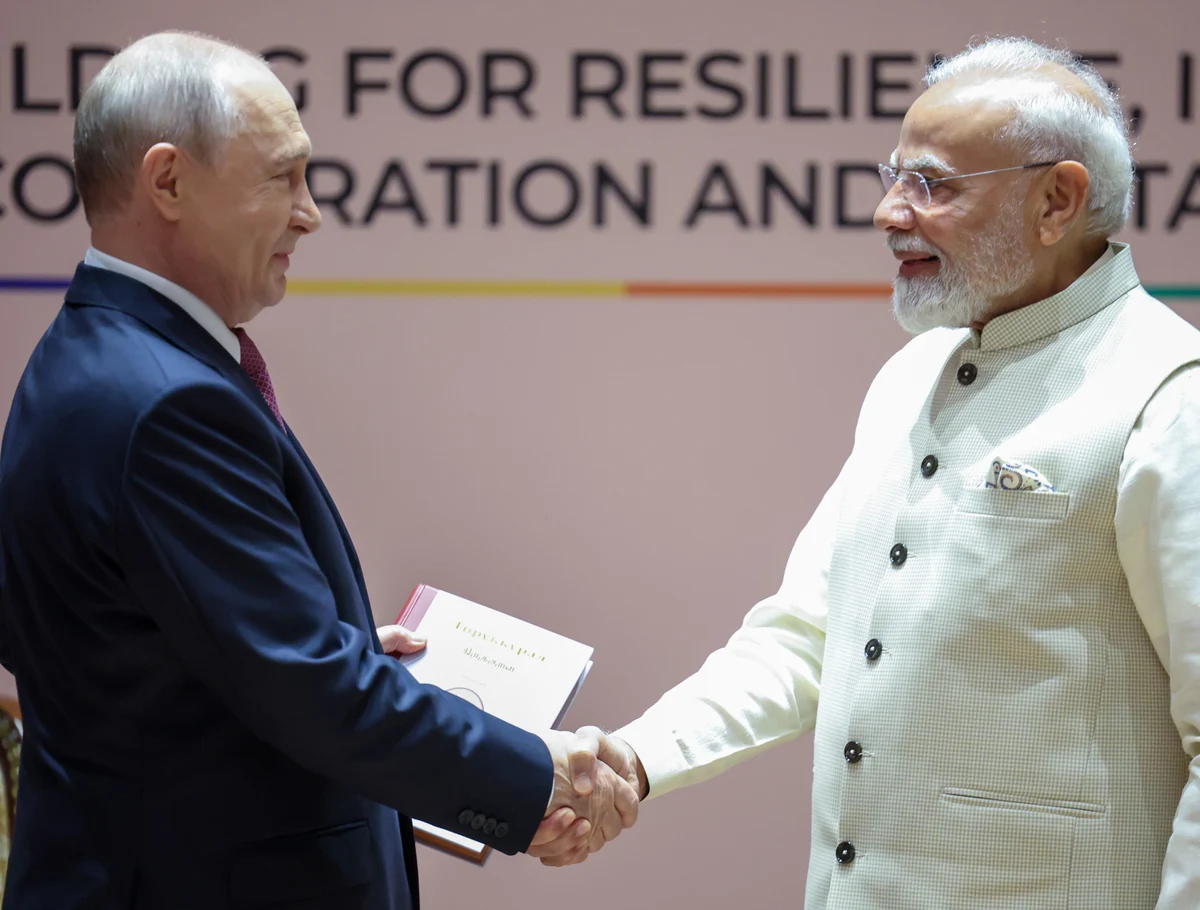
India’s Prime Minister’s Office records Putin and Prime Minister Narendra Modi meeting in person on 11 September on the margins of BRICS. The two leaders also visited INNOPROM India, which ran from 9 to 11 September. The official meeting record places Putin in New Delhi on the 11th, and public broadcaster DD India dates his departure from the city to 13 September. Those records establish the documented span of the trip.
The leaders discussed economic and energy cooperation, space, skills and ties between people in the two countries. Those subjects belong to the account of the bilateral conversation. The New Delhi Declaration, dated 12 September, belongs to the multilateral summit. A reader looking for what Modi and Putin discussed should use the meeting release, while a reader looking for the collective BRICS position should use the declaration.
The dates also answer different questions about the same trip. The 11th is the date of the confirmed bilateral meeting, the 12th is the date on the BRICS declaration, and the 13th is the date reported for Putin’s departure. The opening date of the trade exhibition describes the exhibition’s schedule. Its full run gives no basis for placing Putin at the venue on each of those days.
The December 2025 State visit
The joint statement issued on 5 December 2025 formally identifies 4–5 December as a State visit by Putin for the 23rd India–Russia Annual Summit. The distinction comes from the statement’s description of the trip. The release date marks publication of the joint account, and the two-day range gives the dates to use when referring to the visit itself.
The statement welcomed a programme for economic cooperation through 2030 and recorded bilateral work in energy, trade and transport connections. The 2030 date is the programme’s horizon. It gives readers a way to identify the document and follow subsequent developments. For questions about whether a particular project was carried out or a trade measure took effect, the relevant evidence would be a later implementation record for that measure.
The leaders also marked 25 years since the Declaration on Strategic Partnership signed during Putin’s first State visit in October 2000. The 2025 statement connects that anniversary to the earlier trip, and India’s foreign ministry annual report supplies the first visit’s range of 2–5 October. The anniversary refers to the strategic partnership declaration. The ordinal in the summit’s title identifies its place in the bilateral summit series. Both are useful search terms when looking for the original documents.
Timeline of documented visits
The chronology includes trips made as Russia’s president and one documented trip made as its prime minister. It also includes visits associated with BRICS and visits associated with the numbered India–Russia Annual Summit. The event column identifies the official business or public occasion that helps locate each record. A summit’s number identifies the meeting in a series. Counting those numbers would give a different result from counting Putin’s own trips to India.
The dates have different levels of precision. The Goa row uses the confirmed date of Putin’s bilateral talks and gives the summit’s two-day span separately. The 2002 row has a visit range from the signed declaration and a city attached to the document’s date. Entries that give India as the location reflect the geographic detail established for those rows. The table records the trips supported by the cited documents, so a year without an entry leaves the question of any other trip open.
Use the timeline’s date, place and event together when identifying an older reference. A mention of Republic Day points to January 2007. A mention of the 13th Annual Summit points to December 2012. An account that gives only the month or a broad subject such as trade needs a second clue. New Delhi recurs across several entries, and economic cooperation appears in records from different phases of the relationship.
- Prime Minister of India: 23rd India–Russia Annual Summit
- Indian Prime Minister's Office dated September 2026 in-person BRICS meeting
- DD India public broadcaster confirmation of the September 2026 trip conclusion
- Indian Prime Minister's Office record of the 21st Annual Summit
- India–Russia joint statement for the 19th Annual Summit
- Indian Prime Minister's Office statement during the completed 2016 Goa meeting
- India MEA 2014–15 annual report and 15th Annual Summit date
- India Foreign Relations 2012, document 538 on the 13th Annual Summit
- India MEA 2010 foreign-relations archive on the Prime Minister of Russia's working visit
- Government of India archive for the January 2007 official visit
- Ministry of External Affairs 2004–05 annual report
- India MEA treaty archive for Putin's December 2002 State visit
- India MEA 2000–01 annual report on Putin's first State visit
Working visits, annual summits and BRICS meetings
A visit’s designation describes the trip, while the summit title identifies the event the leaders attended. The 6 December 2021 trip offers a clear example. The Prime Minister’s Office calls it a working visit by Putin as president, and the occasion was the 21st India–Russia Annual Summit. The official account names trade, energy, science and technology, intellectual property, outer space, cultural exchange and education among the fields covered by agreements or memoranda associated with the visit.
A multilateral trip can contain substantial one-to-one talks. In Goa on 15 October 2016, Modi welcomed Putin and reported that they had completed bilateral talks before the BRICS proceedings. Economic cooperation and a proposed science and technology commission appeared among the public themes. The 8th BRICS Summit ran on 15–16 October. The prime minister’s statement gives a date for the bilateral encounter within that wider event.
Location matters as much as the participants. The October 2018 joint statement places the 19th Annual Bilateral Summit in New Delhi on 4–5 October and separately refers to the informal summit held in Sochi, Russia, on 21 May that year. The 2026 PMO release similarly places the leaders’ previous encounter on 31 August in Bishkek, Kyrgyzstan. Each document gives a way to distinguish an encounter involving India’s prime minister from a trip by Putin to India. The foreign ministry’s bilateral brief provides another starting point for checking the geography of meetings.
- Prime Minister of India: 23rd India–Russia Annual Summit
- Ministry of External Affairs: India–Russia Relations
- Indian Prime Minister's Office dated September 2026 in-person BRICS meeting
- Indian Prime Minister's Office record of the 21st Annual Summit
- India–Russia joint statement for the 19th Annual Summit
- Indian Prime Minister's Office statement during the completed 2016 Goa meeting
The first State visit and the early summit years
Putin’s first State visit took place on 2–5 October 2000 during Atal Bihari Vajpayee’s premiership. India’s Ministry of External Affairs records that the two countries signed the Declaration on Strategic Partnership during the visit. The annual report supports the trip range and the connection to the declaration. A reference that needs the precise signing day would require the dated instrument or another contemporaneous official record that specifies it.
The December 2002 State visit produced records that are easy to confuse by title. The signed declaration on economic, scientific and technological cooperation is dated 4 December in New Delhi and gives the visit as 3–5 December. Vajpayee’s Lok Sabha statement also documents a separate Delhi Declaration on Further Consolidation of Strategic Partnership from that visit. The signature block anchors the date of the economic and scientific document. The parliamentary record helps identify the separate declaration on the broader relationship.
The foreign ministry’s 2004–05 annual report records a visit on 3–5 December 2004 in the period of the fifth annual bilateral summit, during Manmohan Singh’s premiership. The January 2007 record adds a different kind of identifying detail. Putin visited New Delhi at Singh’s invitation on 25–26 January and was chief guest at Republic Day on the 26th. The ceremonial date is the strongest clue when identifying that visit from a reference to the parade, while the joint record supplies the full two-day range.
Putin’s 2010 trip as prime minister
Putin came to New Delhi on 11–12 March 2010 on a working visit as Russia’s prime minister. Dmitry Medvedev was Russia’s president and attended a separate annual summit in India that December. A search for Russian visits to India in 2010 can therefore surface two relevant records. For a timeline of Putin’s travel, the dated March record belongs under his name and should carry his office at the time.
The record for 24 December 2012 places Putin in New Delhi as president for an official visit and the 13th Annual Summit with Manmohan Singh. Putin also met Indian President Pranab Mukherjee. That detail can help identify a photograph or archival caption from the trip. The two meetings belong to the same documented visit, and the signed summit statement provides the date and official capacity for the timeline entry.
The 2014 record shows why the date attached to an annual summit can be narrower than the visit dates. The foreign ministry’s annual report gives 10–11 December for the New Delhi trip, and the government’s summit statement dates the 15th Annual Summit to 11 December. Use the single date for a reference to the summit proceedings and the range for an entry about Putin’s visit.
How to verify a newer visit
To check whether a newer trip has taken place, look for a dated Prime Minister’s Office or Ministry of External Affairs release that places Putin at a completed event in an Indian city. Read the verbs and the location in the release itself. An invitation establishes who was invited and where an event is expected. A statement reporting completed talks in New Delhi establishes that the two leaders met there on the stated date.
The September 2026 release illustrates that distinction within a single document. It records the completed Modi–Putin meeting in New Delhi and also records an invitation to Modi to attend the 24th bilateral annual summit in Russia. The invitation concerns travel by India’s prime minister. It supplies neither a date for another Putin trip to India nor a completed event to enter in the India chronology.
When a report supplies just one day, compare it with any dated arrival or departure coverage before extending the range. Public broadcaster coverage can establish the end of a visit, as it does for the September 2026 trip. A joint statement can establish the official designation and sometimes gives the full range directly, as it does for December 2025. If the available release only confirms a meeting, keep the entry at that date until another record supports the additional days.
Sources
- Prime Minister of India: 23rd India–Russia Annual Summit
- Ministry of External Affairs: India–Russia Relations
- Indian Prime Minister's Office dated September 2026 in-person BRICS meeting
- DD India public broadcaster confirmation of the September 2026 trip conclusion
- Indian Prime Minister's Office record of the 21st Annual Summit
- India–Russia joint statement for the 19th Annual Summit
- Indian Prime Minister's Office statement during the completed 2016 Goa meeting
- India MEA 2014–15 annual report and 15th Annual Summit date
- India Foreign Relations 2012, document 538 on the 13th Annual Summit
- India MEA 2010 foreign-relations archive on the Prime Minister of Russia's working visit
- Government of India archive for the January 2007 official visit
- Ministry of External Affairs 2004–05 annual report
- India MEA treaty archive for Putin's December 2002 State visit
- India MEA 2000–01 annual report on Putin's first State visit
- PMO official photograph, New Delhi BRICS bilateral meeting on 11 September 2026
