How India’s fighter programmes fit together
India’s fighter aircraft history includes the HF-24 Marut’s 1961 first flight, the MiG-21’s service from 1963 to its 2025 retirement, the development and induction of Tejas, and the Indian Air Force’s formal induction of Rafale in 2020. To read the newer entries, distinguish the Tejas Mk1A flight and supply contract, the Navy’s signed Rafale-Marine agreement, the Air Force’s February 2026 Rafale procurement approval, and AMCA’s 2025 development decision.
The Indian Air Force’s own chronology starts earlier. The Ministry of Defence places its establishment on 8 October 1932 and its first flight on 1 April 1933. The service dropped the Royal prefix when India became a republic in January 1950. Those dates belong to the institution. The dates in the table belong to particular aircraft, variants, procurement actions or development programmes.
An aircraft name alone is a poor guide to which event a source describes. Tejas appears in development, production, handover and squadron records. Rafale is shared across several Indian procurement records, including one for a different service. Reading the name alongside the date and the event lets you use the table as a starting point for a narrower question.
| Aircraft or proposal | Date | Documented milestone |
|---|---|---|
| HF-24 Marut | June 1961 | First flight in HAL’s historical timeline |
| MiG-21 | 1963 and 26 September 2025 | Initial IAF induction and later decommissioning ceremony |
| LCA Tejas | 4 January 2001 | First Technology Demonstrator flight |
| LCA Tejas | 30 September 2014 and 17 January 2015 | First series production aircraft flight and subsequent handover |
| IAF Tejas squadron | 1 July 2016 | Entry of the first squadron |
| IAF Rafale | 23 September 2016 and 10 September 2020 | Indian–French agreement and later formal induction |
| Tejas Mk1A | 28 March 2024 and 25 September 2025 | Variant flying milestone and subsequent supply contract |
| Navy Rafale-Marine | 28 April 2025 | Agreement with France signed |
| AMCA | 2025 | Decision to advance development through industry partnership |
| IAF Rafale proposal | 12 February 2026 | Defence Acquisition Council accorded Acceptance of Necessity |
- Ministry of Defence historical note on the Indian Air Force
- HAL manufacturer historical timeline for the HF-24 and Tejas
- Ministry of Defence original Tejas research and handover chronology
- HAL annual report FY2025–26, subsequent Tejas Mk1A contract
- Ministry of Defence formal IAF Rafale induction, 10 September 2020
- Ministry of Defence separate Indo-French Naval Rafale agreement, 28 April 2025
- Ministry of Defence February 2026 Acceptance of Necessity record
- Ministry of Defence IAF MiG-21 retirement milestone
- Press Information Bureau: 2025 AMCA Execution Decision
HF-24 Marut and the manufacturer’s timeline
HAL’s historical timeline dates the first flight of the HF-24 Marut to June 1961. That milestone answers when the aircraft first flew. A service chronology would require its own dated record of entry into service, just as a production chronology would require records tied to manufacture or delivery. Keeping the month and year attached to the flight makes the Marut entry usable alongside the later first-flight dates for Tejas.
The manufacturer’s name has a separate history. Hindustan Aircraft Limited was incorporated on 23 December 1940. Its amalgamation with Aeronautics India Limited on 1 October 1964 created Hindustan Aeronautics Limited. The corporate timeline explains how today’s HAL can document a 1961 aircraft in its institutional history. A caption that needs the period company name can use that corporate record alongside the aircraft chronology.
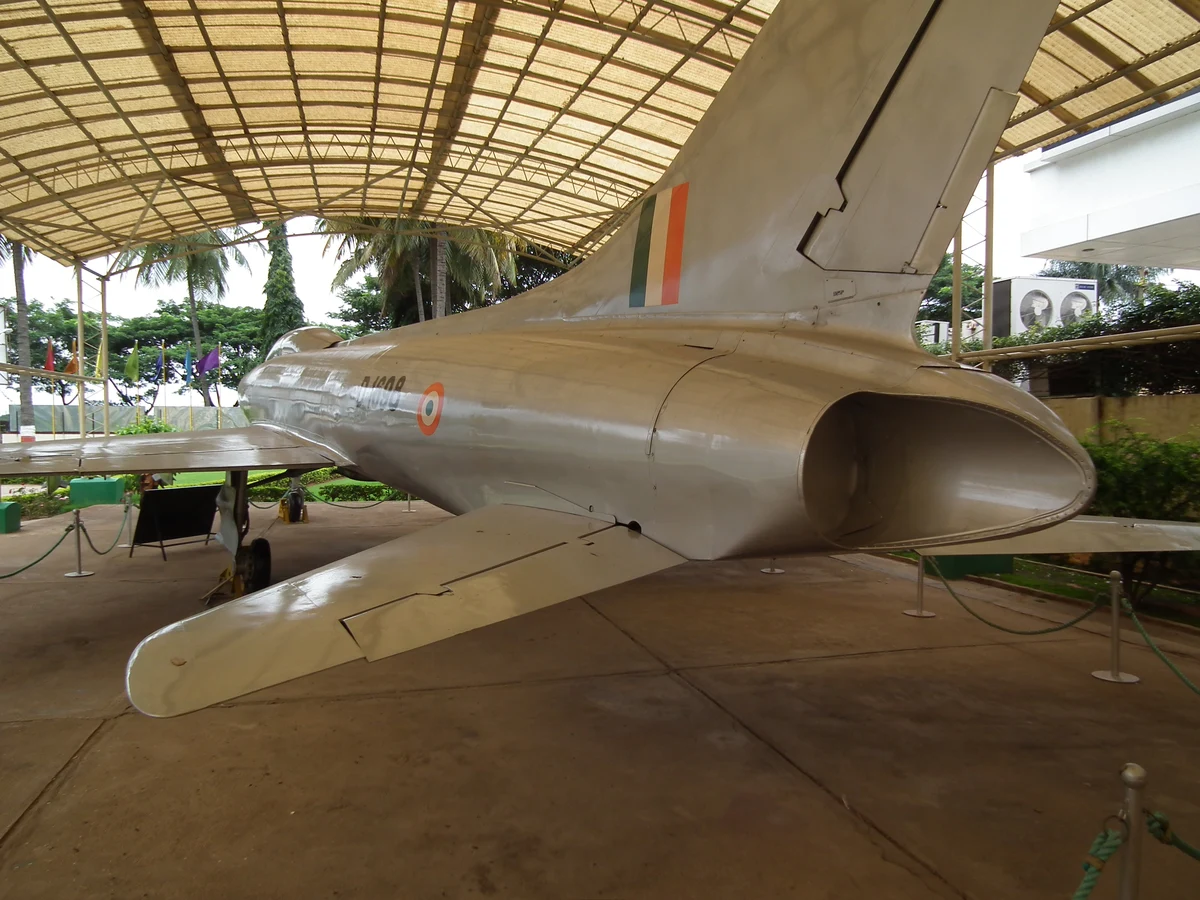
HAL’s Heritage Centre & Aerospace Museum, established in 2001, lists the Marut in its static collection. In the archival photograph taken on 1 September 2011, the aircraft is an HF-24 trainer on display. That makes the photo evidence for the identity and setting of the exhibit at the time of the photograph. For a caption, keep the trainer designation and the photograph date with the exhibit, and use the manufacturer’s timeline for the first flight of the Marut programme.
MiG-21 from induction to decommissioning
The Ministry of Defence dates initial Indian Air Force induction of the MiG-21 to 1963 and records the decommissioning ceremony on 26 September 2025. These are the opening and closing markers supplied by the official account. A service span expressed as 1963 to 2025 is defensible at year precision. Calculating an exact duration to the day would require a day and month for the initial induction.
If you are updating a timeline that still carries a projected retirement year, replace the projection with the dated decommissioning event. A projection answers what was expected when it was published. The ceremony record answers when the confirmed event took place. Use the full MiG-21 designation in that entry so the date stays attached to the aircraft named by the ministry. Any other MiG family or individual variant history needs its own evidence.
The Marut and the MiG-21 both appear in HAL’s museum inventory, which gives readers a place to compare how the two aircraft are presented in a historical collection. The inventory establishes that the museum lists both as static exhibits. For a history note, pair that source with HAL’s Marut flight record or the ministry’s MiG-21 service record according to the claim you want to make. The exhibits and the service dates answer separate questions.
Tejas from engineering sanction to squadron entry
The Ministry of Defence’s Light Combat Aircraft chronology records sanction for full-scale engineering in April 1993 and identifies the Aeronautical Development Agency, or ADA, as the LCA development team organisation. On 4 January 2001 the first Technology Demonstrator flew. HAL’s historical timeline gives the same flight date and identifies the aircraft as a demonstrator. The aircraft description matters because the programme later reached another first flight with a different airframe.
The first series production aircraft flew on 30 September 2014 and was handed over to the Indian Air Force on 17 January 2015. The flight and the handover concern the same series production milestone aircraft at different stages. The first IAF Tejas squadron entered on 1 July 2016, as recorded in the government’s contemporaneous induction material. HAL’s handover date and the government’s squadron date can therefore sit side by side in a chronology.
Suppose you are preparing an anniversary entry for Tejas joining its first Air Force squadron. Use 1 July 2016 and make the squadron the subject of the entry. If the anniversary is for the first flight of the LCA Technology Demonstrator, use 4 January 2001 and keep the demonstrator designation in the caption. A general heading such as ‘Tejas begins’ would leave the reader to guess which of those milestones the entry commemorates.
Tejas Mk1A flight, contract and delivery plan
For Tejas Mk1A, Akashvani’s dated report records the variant’s flying milestone on 28 March 2024. HAL’s annual report for FY2025–26 records a Ministry of Defence contract dated 25 September 2025 for Mk1A supply to the Indian Air Force. Give the variant its full name when citing either date. The Mk1A flying milestone and the original Tejas Technology Demonstrator flight belong to different entries in a programme history.
The ministry’s announcement on 25 September 2025 gave a planned delivery window of 2027–28 onward for the aircraft under that particular contract. The date is useful when describing the schedule announced at signing. Keep the contract date and the word ‘planned’ with the window, especially in a table where the surrounding explanation may be read separately. Other Mk1A aircraft require dates tied to their own procurement or delivery records.
For a question about whether Mk1A deliveries have begun, look for a subsequent dated announcement that identifies the variant, the recipient and the delivery event. If it identifies a contract, match that identifier or signing date to the contract being discussed. A ministry release describing formal induction would support a further status update at the scope stated in the release. The evidence here establishes a variant flight, a signed supply contract and that contract’s announced delivery plan.
Rafale in three separate Indian records
The Indian–French agreement for the Indian Air Force Rafale programme was signed on 23 September 2016, a date recorded in the government’s 2017 review. The Ministry of Defence recorded formal induction into the IAF on 10 September 2020. For a timeline of the original Air Force programme, both dates are useful. The first is the agreement milestone and the second is the service’s formal induction milestone.
On 28 April 2025 the government announced a separate agreement with France for the Indian Navy’s Rafale-Marine purchase. Keep the service and the aircraft designation in the entry so it remains intelligible when read alongside the 2020 Air Force milestone. For a Navy acceptance or induction date, use a dated announcement that identifies the Navy and describes that event. The April release supports an entry for the signed purchase agreement.
On 12 February 2026 the Defence Acquisition Council accorded Acceptance of Necessity for an Indian Air Force multi-role fighter aircraft proposal naming Rafale. That wording records an administrative procurement approval. If a headline says India ‘approved Rafales,’ check whether the underlying document names the council and gives this date. If the claim is that India signed a further agreement, look for a subsequent government announcement of signing that identifies the proposal. The reviewed records verify the February approval and leave any later agreement for that proposal unconfirmed.
AMCA and what a development decision establishes
The 2025 announcement for the Advanced Medium Combat Aircraft, or AMCA, records a decision to advance the development programme through industry partnership. In a public reference table, ‘development decision’ is the event supported by that announcement. The decision identifies the approach to advancing the work. A dated record of a prototype flight, a production arrangement or formal service induction would describe a later event with its own evidence.
Tejas illustrates why the event label matters when reading an AMCA update. Its public chronology gives separate dates for engineering sanction, demonstrator flight, series aircraft flight and handover. Those entries provide a vocabulary for reading programme records. They supply no AMCA dates. Each AMCA milestone has to come from material that identifies AMCA itself and specifies the action that occurred.
If a later announcement identifies an industry participant, read what the participant was selected or engaged to do before changing the status line. Participation in development and a commitment to supply aircraft are different actions, even when the same organisations appear in the coverage. Use the exact stage described in the dated announcement and add it as a new milestone. That preserves the 2025 decision as part of the programme’s history while making the subsequent development legible.
How to verify a new milestone
Start a fresh check with the full aircraft or variant name, the service involved and the event you are trying to date. Look for the Ministry of Defence announcement through the Press Information Bureau for government agreements, procurement decisions, induction or retirement. HAL’s timeline and annual reporting give manufacturer records for the flights, handovers and contracts they describe. When the two organisations cover the same event, compare the aircraft identification and the event wording as well as the date.
Read past the headline and find the sentence that states what took place. A review published after an event may give the original date, as the 2017 government review does for the 2016 Rafale agreement. A release published at signing may also contain a delivery plan for future years, as the September 2025 Mk1A announcement does. Record the event date separately from the publication date and preserve any language about what was scheduled or anticipated.
When a new release covers only part of a programme, give the update that same scope. A delivery reported for a named recipient or contract belongs with that recipient or contract. Keep earlier milestones in the row history so readers can see where the new event fits. When a fresh search yields only a restatement of the existing plan, retain the plan’s original date and wording.
India’s AMCA programme, public milestones and development statusIndia’s aircraft carriers, commissioned ships and historical timeline
- Ministry of Defence original Tejas research and handover chronology
- HAL annual report FY2025–26, subsequent Tejas Mk1A contract
- Ministry of Defence formal IAF Rafale induction, 10 September 2020
- Ministry of Defence separate Indo-French Naval Rafale agreement, 28 April 2025
- Ministry of Defence February 2026 Acceptance of Necessity record
- Ministry of Defence IAF MiG-21 retirement milestone
- Press Information Bureau: 2025 AMCA Execution Decision
Sources
- Ministry of Defence historical note on the Indian Air Force
- HAL manufacturer historical timeline for the HF-24 and Tejas
- Ministry of Defence original Tejas research and handover chronology
- HAL annual report FY2025–26, subsequent Tejas Mk1A contract
- Ministry of Defence formal IAF Rafale induction, 10 September 2020
- Ministry of Defence separate Indo-French Naval Rafale agreement, 28 April 2025
- Ministry of Defence February 2026 Acceptance of Necessity record
- Ministry of Defence IAF MiG-21 retirement milestone
- HAL Heritage Centre & Aerospace Museum archival display inventory
- Licensed archival HF-24 trainer museum exhibit and existing Rafale photo
- Press Information Bureau: 2016 Tejas Induction
- Press Information Bureau: 2025 AMCA Execution Decision
- Press Information Bureau: February 2026 Defence Acquisition Council Record
