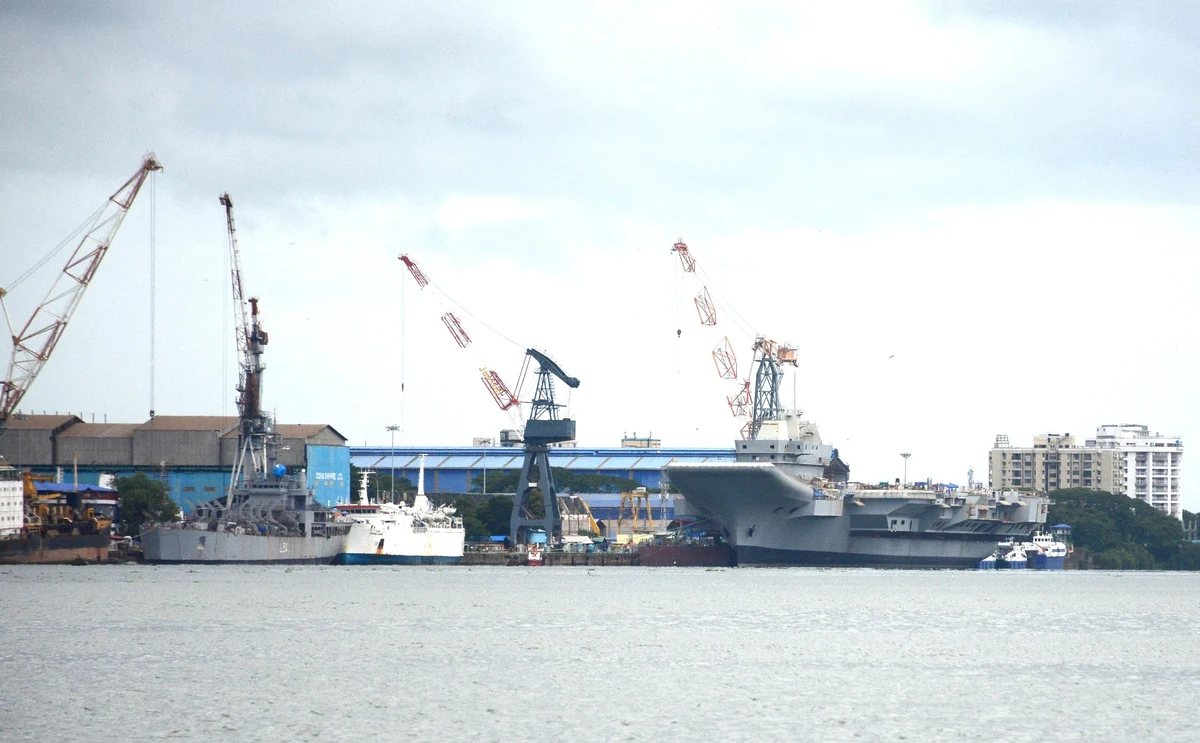
How many aircraft carriers does India have?
India has two commissioned aircraft carriers, INS Vikramaditya and INS Vikrant, according to the public commissioning records reviewed for this page. Vikramaditya was commissioned on 16 November 2013, and the Vikrant in today’s count entered service on 2 September 2022.
The number describes the Indian Navy’s commissioned inventory. A ship can retain its commission while undergoing maintenance or spending time in port, so the inventory alone cannot establish how many carriers are available on a particular day. The public documents used here identify ships and record formal entry into or departure from service. They give readers a basis for answering a fleet-history question without making claims about readiness or activity.
The Press Information Bureau’s 29 April 2025 backgrounder is the clearest single reference for the two names together. The commissioning records are better references for the individual dates. Those sources serve different purposes. A fleet backgrounder gives a snapshot of which ships the government lists together, while a commissioning announcement fixes a permanent event in the history of one ship. Someone preparing a dated reference can use the backgrounder for the count and the individual releases to explain how that inventory came about.
The present pair also puts a useful limit on what the phrase ‘India’s carriers’ can mean. A question asked in the present tense generally calls for the two commissioned names. A question about every carrier India has commissioned calls for a longer list, and the answer changes again if someone is counting ship names across that history. Vikrant appears twice because the Navy gave the name to two different vessels.
Four hulls in the commissioning record
| Ship | Indian commissioning | End of Indian commission or inventory status | Identification |
|---|---|---|---|
| INS Vikrant, original | 4 March 1961 | Decommissioned 31 January 1997 | Launched as Hercules |
| INS Viraat | 12 May 1987 | Decommissioned 6 March 2017 | Former HMS Hermes |
| INS Vikramaditya | 16 November 2013 | Named in the two-carrier inventory | Separate commissioning record from either Vikrant |
| INS Vikrant, modern | 2 September 2022 | Named in the two-carrier inventory | Designed by the Indian Navy’s Warship Design Bureau and built by Cochin Shipyard Limited |
The chronology records four commissioned hulls under three Indian ship names. It also shows where two careers overlap. Viraat joined the Indian Navy in May 1987, while the original Vikrant remained in commission until January 1997. When Vikramaditya joined in November 2013, Viraat still had more than three years of its Indian commission ahead of it. Writing the ships in a single succession can hide both periods of overlap.
Reading across the dates also reveals a gap between pairs. After Viraat’s March 2017 retirement and before the modern Vikrant’s September 2022 commissioning, Vikramaditya was the sole commissioned carrier in this chronology. That statement applies to formal service status throughout the interval. The modern Vikrant had already been launched by then, which explains how accounts of its construction can run alongside accounts of a one-carrier commissioned fleet.
For a timeline keyed to calendar years, an event’s month and day can change the answer. A caption about the end of 2013, for instance, can list Viraat and Vikramaditya as commissioned. A caption about the beginning of the same year would give a different result because Vikramaditya entered service in November. Where the exact point in a year matters, use the dated milestones in the table to define the interval.
- PIB 29 April 2025 public backgrounder identifies two commissioned carriers
- PIB historical review, original Vikrant and Viraat
- Ministry of Defence Viraat decommissioning release
- Ministry of Defence 2014 dedication record for INS Vikramaditya
- Ministry of Defence modern Vikrant commissioning record
- Press Information Bureau: Historical Summary of the Two Vikrants
- Press Information Bureau: INS Vikramaditya Commissioning Notice
The original Vikrant and its Mumbai memorial
India’s first aircraft carrier began its recorded history under the name Hercules, which it carried at launch in September 1945. India purchased the ship in 1957 and commissioned it as Vikrant on 4 March 1961. These dates identify three events in a single hull’s history. The launch marks the ship’s earlier identity, the purchase marks its acquisition by India, and the commissioning marks the beginning of its Indian Navy service.
Another official date for the original is 3 November 1961. The Ministry of Defence’s memorial release uses that date for the ship’s Mumbai arrival and formal induction. The historical review gives 4 March for its commissioning. If an archive caption describes the carrier arriving in Mumbai, the November date belongs with that event. A fleet chronology takes the March date. Keeping the verbs attached to the dates lets both records stand without treating them as conflicting accounts.
The Navy decommissioned the original Vikrant on 31 January 1997. Its public history continued after that. The government documented a maritime-museum proposal in 1998, and the ministry’s memorial account says the retired vessel served as a floating museum until 2012. A written government reply records approval for disposal in June 2013. That approval dates an administrative decision, and the record cited here leaves the timing of physical disposal open.
On 10 June 2022 the ministry recorded the dedication of a scale model of the original Vikrant at Regal Circle in Mumbai. The model commemorates the earlier carrier. The floating museum was the retired ship itself. For readers sorting search results, the object and date together resolve the reference. A museum account describes the original hull during its retirement, while the 2022 dedication describes the public memorial model.
Vikramaditya’s commissioning and dedication
INS Vikramaditya entered Indian Navy service on 16 November 2013. Its dedication to the nation followed on 14 June 2014. The Ministry of Defence records both events, and the original commissioning notice provides a separate contemporary reference for the November date. An account that starts Vikramaditya’s service in June 2014 assigns the dedication date to the wrong milestone.
The distinction matters when an article is built around a public ceremony. A report on the June 2014 dedication can accurately center that event while describing Vikramaditya as a ship the Navy had already commissioned. For a fleet history, the earlier date establishes when the ship became part of the commissioned inventory. It also places Vikramaditya and Viraat together in the record months before the dedication took place.
Vikramaditya has its own entry in the current count and its own place in the historical sequence. Official references to India’s first carrier or its first carrier designed and built domestically concern the two ships called Vikrant. Neither description provides a shortcut to dating Vikramaditya, whose commissioning notice remains the direct reference. For a short caption where the three similar-looking names could be confused, spelling out Vikramaditya and using the November 2013 date gives the reader an unambiguous historical identifier.
How the modern Vikrant went from construction to commission
The modern INS Vikrant is India’s first domestically designed and built aircraft carrier. The Indian Navy’s Warship Design Bureau designed it, and Cochin Shipyard Limited built it. The 1961 Vikrant was India’s first aircraft carrier overall. The 2022 ship took its name from that earlier carrier, so the qualifying words in each claim tell the reader which vessel earned the distinction.
The public construction sequence begins with keel laying in February 2009. The ship launched in August 2013 and began sea trials in August 2021. Cochin Shipyard handed it over to the Indian Navy on 28 July 2022. Its commissioning followed in Kochi on 2 September 2022. The shipbuilder’s handover record and the ministry’s ceremony announcement each provide a precise date for the event their institution documented.
The shipbuilder uses IAC-1 and Project 71 for the same carrier that entered service as Vikrant. Those identifiers are useful when reading a document from the construction period because the project may be more prominent than the eventual commissioned name. They also help connect a shipyard document about delivery to a Navy or ministry document about commissioning. Each identifies one hull at a different stage of its history.
The August 2013 launch makes an especially useful check on calendar confusion. A construction chronology can list a Vikrant event in 2013, the year Vikramaditya entered service. In a service chronology, the modern Vikrant belongs in 2022. If a record supplies only the year and uses a loose verb such as ‘introduced,’ look for an event description in the underlying source before assigning the date to the fleet timeline.
| Milestone | Date or year | Source scope |
|---|---|---|
| Launch | 2013 | Public construction chronology |
| Handover from Cochin Shipyard | 28 July 2022 | Shipyard delivery announcement |
| Commissioning | 2 September 2022 | Ministry of Defence public ceremony |
- Cochin Shipyard's exact delivery record for the modern Vikrant
- Ministry of Defence modern Vikrant commissioning record
- PIB 2025 backgrounder on the modern Vikrant build chronology
- Press Information Bureau: 2022 Commissioning of INS Vikrant
- Press Information Bureau: Historical Summary of the Two Vikrants
How to verify the fleet count as it changes
Start with the 29 April 2025 government inventory and look for later commissioning or decommissioning announcements from the Indian Navy or the Ministry of Defence. Read the announcement for the date of the event and the name of the ship. A release can be published after the event it describes, and a recent backgrounder can recount a ceremony from years earlier. Record the effective event date when deciding whether it changes the count.
An additional domestically built carrier appears as a vision in a 2025 government backgrounder. For an inventory update, the evidence to look for is a later public record of a named carrier’s commissioning. Development or construction milestones, if announced, can be recorded in a project timeline with the wording the relevant institution uses. The modern Vikrant’s documented handover and later commissioning show why each milestone needs its own date.
Apply the same test to departures. Viraat’s decommissioning release gives the event that removes it from the commissioned count. A later reference to a retired ship can add information to its history, while the end of its commission stays anchored to the dated retirement record. When an official overview and a ship-specific release cover different periods, use the individual event to update the interval and retain the overview as evidence of the fleet on its own publication date.
Indian fighter aircraft history, Marut, MiG-21, Tejas and RafaleIndia’s AMCA programme, public milestones and development status
- PIB 29 April 2025 public backgrounder identifies two commissioned carriers
- Ministry of Defence Viraat decommissioning release
- Cochin Shipyard's exact delivery record for the modern Vikrant
- Ministry of Defence modern Vikrant commissioning record
- PIB 2025 backgrounder on the modern Vikrant build chronology
- Press Information Bureau: INS Vikramaditya Commissioning Notice
Sources
- PIB 29 April 2025 public backgrounder identifies two commissioned carriers
- PIB historical review, original Vikrant and Viraat
- Ministry of Defence exact original Vikrant memorial date and final floating museum period
- Ministry of Defence Viraat decommissioning release
- Ministry of Defence 2014 dedication record for INS Vikramaditya
- Cochin Shipyard's exact delivery record for the modern Vikrant
- Ministry of Defence modern Vikrant commissioning record
- PIB 2025 backgrounder on the modern Vikrant build chronology
- Licensed archive image of the modern Vikrant before commissioning
- Press Information Bureau: 2022 Commissioning of INS Vikrant
- Press Information Bureau: Historical Summary of the Two Vikrants
- Press Information Bureau: INS Vikramaditya Commissioning Notice
