Choose your route and trip length
Choose five days for a first India Golden Triangle trip through Delhi, Agra and Jaipur, or seven if you want a full sightseeing day in each city with more room for transfers. From Delhi, start with Delhi–Agra–Jaipur if it gives you a workable Taj Mahal visit, and reverse the order to Delhi–Jaipur–Agra if your Agra day would otherwise be Friday, when the monument closes to public visitors.
Count the days you can actually use. Four calendar days with a late arrival and an early departure give you two full days between flights. If you have four usable days, the circuit can work as a short visit with one priority in each city and a schedule built around transfers. With five, you can assign Agra its own sightseeing day and still give both Delhi and Jaipur meaningful time. With seven, you have room to recover a missed visit or divide a city into smaller outings.
Write down your arrival city, departure city and every overnight before comparing trains or cars. A return flight from Delhi adds a final intercity leg. If your onward booking starts in Jaipur or Agra, price and schedule the itinerary with that endpoint. For a fixed round trip from Delhi, decide first where you need to sleep before departure. That decision tells you how much of the final day is genuinely available for sightseeing.
| Usable days | Planning pattern | Booking detail to resolve first |
|---|---|---|
| 4 | One priority per city, with sightseeing fitted around transfers | Find a non-Friday Agra visit and confirm how you will reach your departure city |
| 5 | Dedicated Agra sightseeing day and separate time for Delhi and Jaipur | Compare where each route order puts the Agra overnight and final transfer |
| 7 | Full sightseeing days in each city with room around the intercity legs | Choose where an extra night will help most given your arrival and departure |
Compare Delhi–Agra–Jaipur with the reverse
Delhi–Agra–Jaipur puts the Taj Mahal early in the trip. Choose it when you can reach Agra the previous evening or when your arrival in Agra leaves a comfortable window for admission. An overnight suits a visit planned around sunrise because you can settle into the city before that morning. Put the morning visit ahead of hotel checkout and onward travel, and ask the hotel what luggage storage it offers if you expect to leave later that day.
Delhi–Jaipur–Agra gives you a second way to place a non-Friday Taj Mahal visit. It also makes sense when you want to finish in Agra or when the onward options you find from Agra suit your departure. If you must go back to Delhi, compare the final Agra–Delhi and Jaipur–Delhi legs on the dates you would actually travel. Include the journey from your hotel to the station or pickup point and from your arrival point to your next hotel or airport.
Example for a fixed weekend itinerary. If your first usable sightseeing day is Thursday in Delhi, scheduling Jaipur on Friday and Agra on Saturday takes the Friday closure out of the Taj Mahal plan. You still need to decide whether Saturday can accommodate both the Jaipur–Agra transfer and a comfortable visit. If the available transport leaves too little time, travel to Agra after Friday sightseeing or reserve Sunday for the monument and fit the onward leg around it.
Compare trains, a car and a mixed itinerary
Compare trains by station pair and door-to-door time. For each leg, record the departure and arrival stations exactly as the operator lists them. Then add the time to get from your accommodation to the departure station, a buffer for boarding and the onward ride from the arrival station. A departure that looks convenient in a search result may give you little useful time if the morning starts with a long station transfer or the arrival interrupts your only sightseeing window.
A prearranged car gives you more control over hotel pickup and drop-off, which can matter if several people share luggage or if you want to keep a transfer day simple. Ask for the pickup location, expected journey duration for your chosen departure time and a written list of what the quote includes. Confirm the exact drop-off if you plan to go straight to a site. Keep a time-sensitive visit separate from the expected arrival if a delay would cost you the only opening you can use.
Example for a mixed itinerary. A group with a convenient Delhi–Agra train and an awkward onward departure to Jaipur could take the train for the first leg and arrange a car for the second. Compare the two bookings together, including the local rides each one requires. Check the travel date, availability and booking status directly before arranging a pickup around a train. IRCTC describes online Foreign Tourist Quota booking for eligible passport holders, including eligible nonresident Indians, under Services. Check which booking option applies to your own documents.
Fit sightseeing around the Taj Mahal and Agra Fort
The Taj Mahal is closed on Fridays. On normal visiting days, Uttar Pradesh Tourism lists site hours from 30 minutes before sunrise to 30 minutes before sunset. The ticket-counter hours are different. The published window opens one hour before sunrise and ends 45 minutes before sunset. Check the operating day and the current ticketing instructions before planning a sunrise visit or arriving close to sunset.
Agra Fort gives you a second substantial visit in the city. The sixteenth-century Mughal complex stands near the Taj Mahal gardens and contains palaces and other structures within red sandstone walls. If both are priorities, give each a distinct part of the day, with time between them to leave the first site, get to the next entrance and eat. Verify the fort’s admission details separately. A comfortable plan also makes space for returning to your hotel for bags before an onward departure.
Example for one night in Agra. Arrive the afternoon before your non-Friday Taj Mahal visit. If Agra Fort is open and your arrival allows enough time, see it that afternoon. Keep the next morning for the Taj Mahal, then collect your bags and travel onward later. If you arrive too late for the fort, decide whether to move your onward transport or give the Taj Mahal the available time. That choice is easier to make while your bookings still allow changes.
Plan Delhi and Jaipur sightseeing by area
In Delhi, the Ministry of Tourism’s Golden Triangle itinerary highlights both Rashtrapati Bhavan and Red Fort. On a transfer day, choose one as the main outing and check the trip from your accommodation to the relevant entrance. If you want to enter Rashtrapati Bhavan, establish which part you intend to visit and check its booking arrangements. For a dedicated Delhi day, lay out the two stops with a meal break and enough time to reach the second entrance during its published admission window.
In Jaipur, use the walled city’s planned grid to shape a walk around squares, historic market fronts and craft streets. Sawai Jai Singh II founded the city in 1727, and its plan made room for bazaars and trade. Pick a short stretch and check where you can start and end it. You can build in a market stop or focus on the architecture, then arrange transport around the time and distance you are comfortable walking.
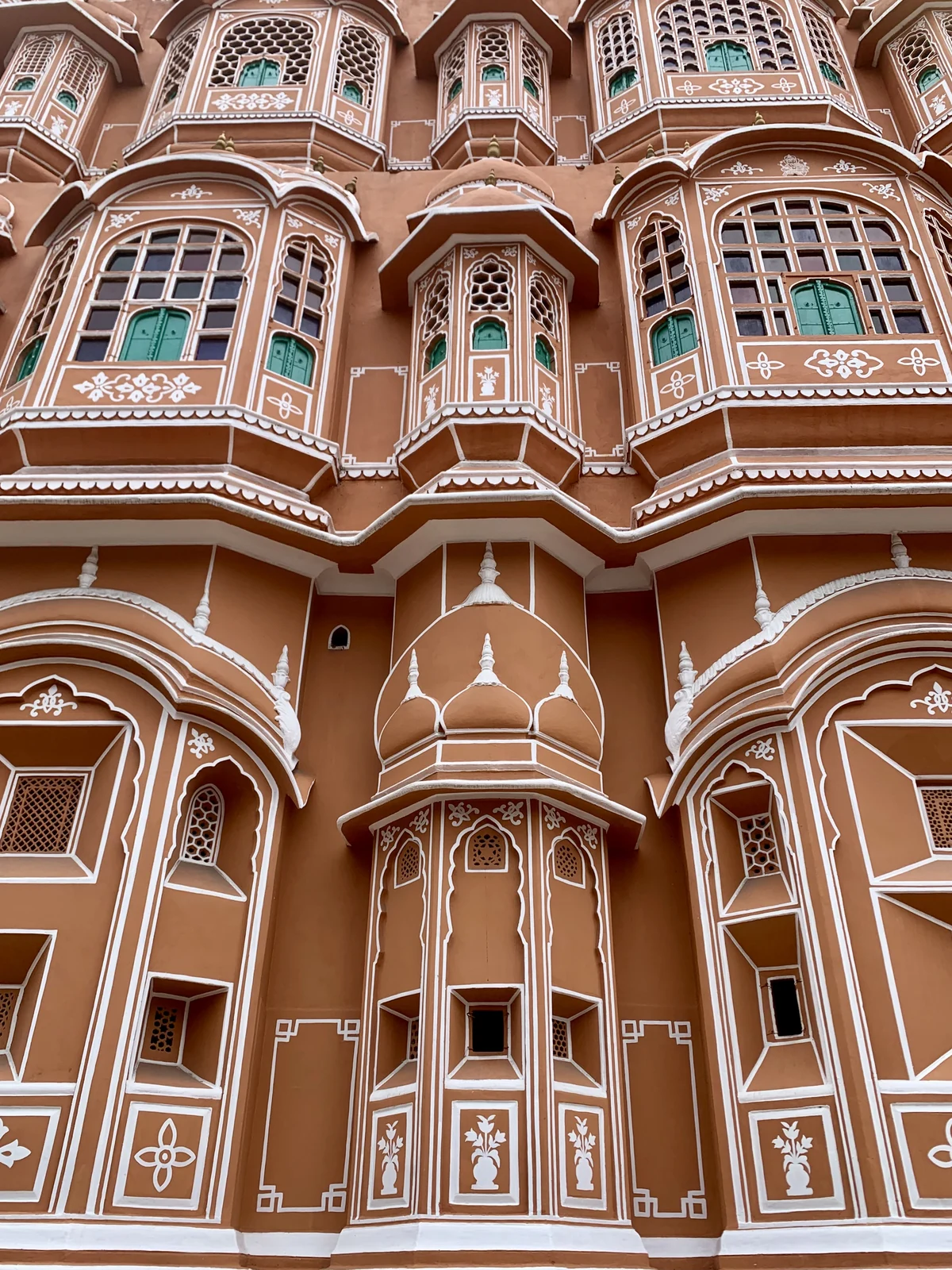
Hawa Mahal and Jantar Mantar give that part of a Jaipur day two different focal points. Hawa Mahal’s latticed windows let royal women watch street festivities from inside. At Jantar Mantar, the instruments date from 1728 to 1734 according to the tourism guide. Decide whether you want a street view of Hawa Mahal or time inside, then verify the openings for the visits you choose. If you need step-free access or a nearby drop-off, confirm those details for each entrance before settling on a walking route.
The Rashtrapati Bhavan visitor portal lists separate Delhi circuits for the main building, the museum and Amrit Udyan. Select the exact circuit before relying on a booking or entrance. In Jaipur, consult the City Palace Museum operator for the current day-tour hours, admission and gallery closures. Holding space for one ticketed stop on either side of a transfer day makes the route easier to adjust.
What is the capital of India? New Delhi explainedJaipur, the Pink City
Three worked schedules for four, five and seven days
Example with four usable days and an onward departure from Jaipur. Spend day one in Delhi and sleep there. On day two, travel to Agra and visit Agra Fort if the arrival and admission window fit. Use day three for the Taj Mahal and transfer to Jaipur afterward. Give day four to one Jaipur outing, such as a walled-city walk with time at Jantar Mantar if it is open. Place day three on a non-Friday and check how much time your onward departure leaves on day four.
Example with five days and a Delhi return. On day one, pick one Delhi sight and stay in the city. On day two, move to Jaipur and use the remaining time for a short outing. Give day three to Jaipur, then move to Agra on day four. Visit the fort on arrival if you have time. On day five, visit the Taj Mahal and return to Delhi. This pattern suits a departure after the five-day itinerary or an onward booking that allows enough time for both the visit and the return journey.
Example with seven days and a Delhi return. Leave day one open for arrival and put a full Delhi visit on day two. Move to Agra on day three, give day four to the Taj Mahal and Agra Fort, and continue to Jaipur on day five. Use day six for the old city and day seven for the return to Delhi. If day four falls on Friday, check whether reversing the circuit would solve it. You can also use the transfer day for one monument if the actual admission and transport windows fit.
Check airport connections and confirm the final bookings
If your trip starts with an international arrival at Delhi and continues by domestic flight, build the connection around your actual departure terminal. Delhi Airport directs international arrivals through immigration, baggage collection and customs at Terminal 3. Its guidance directs Terminal 3 domestic transfer passengers to yellow wayfinding after customs. A Terminal 1 or 2 departure may require a terminal change, for which the airport lists a free interterminal bus and cabs. Check the terminal on your airline booking and review the airport’s current guidance before relying on a connection.
Before committing to bookings that are hard to change, read your itinerary back in date order. Verify the Taj Mahal’s Friday closure against the calendar and check the official ticket windows. Look up each train again for the exact date and station pair, and confirm any car pickup with the operator. Finish by checking the time you need to be at the airport or station for your last departure. If the preceding sightseeing relies on everything running to time, move that visit earlier or sleep in the departure city.
How to plan a trip to IndiaIndia e-Arrival Card guide and traveller checklistFlights to India from the USA
Sources
- Ministry of Tourism | Traversing the Golden Triangle
- Uttar Pradesh Tourism | Taj Mahal ticketing
- UNESCO World Heritage Centre | Jaipur City, Rajasthan
- Incredible India | Jaipur
- Delhi Airport | International to domestic transfer
- UNESCO | Agra Fort
- IRCTC | Foreign Tourist Quota
- Uttar Pradesh Tourism | Taj Mahal visiting hours and ticket counter times
- City Palace Museum, Jaipur | Visitor information
- President’s Secretariat | Rashtrapati Bhavan visitor circuits