Convert time between Dubai and India
India is 1 hour and 30 minutes ahead of Dubai.
Short geography explainer + map
Locate Dubai in the UAE, see how it relates to India, compare DXB with DWC and convert between Dubai and India local time.
India is 1 hour and 30 minutes ahead of Dubai.
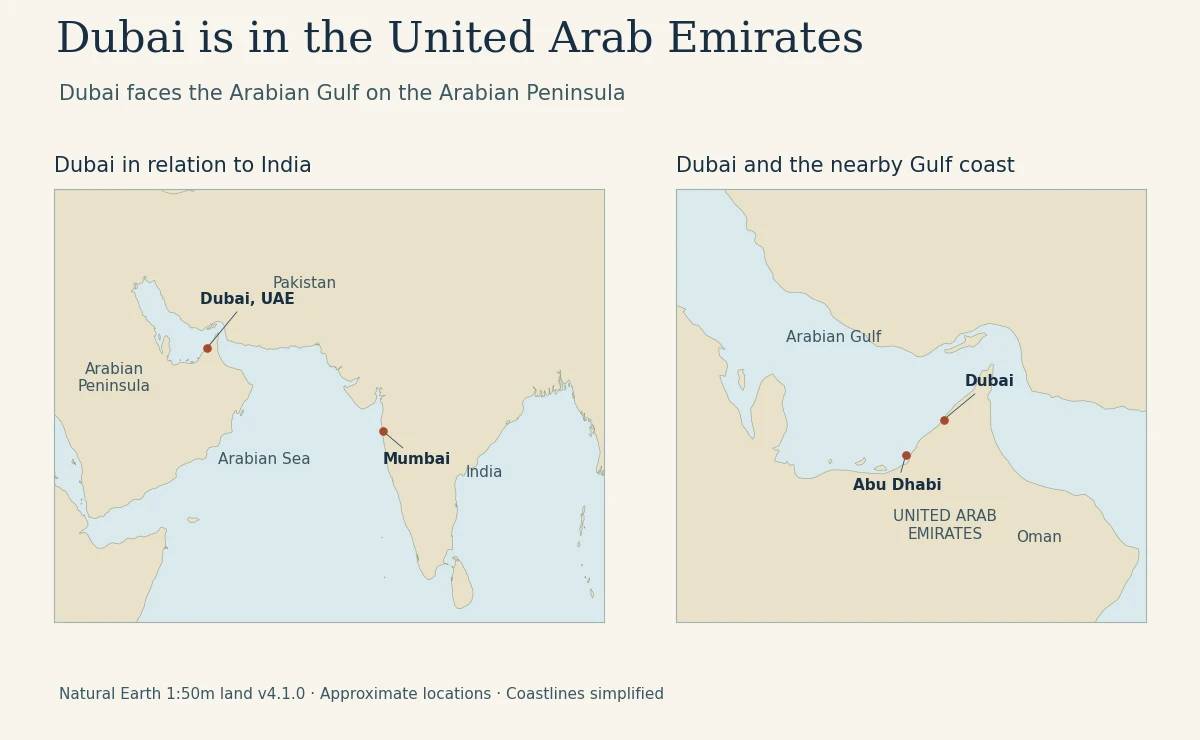
Dubai is in the United Arab Emirates (UAE), a country in Western Asia. It lies west of India, on the Arabian Gulf coast of the southeastern Arabian Peninsula.
Dubai names both a city and the emirate that contains it. The emirate is one of seven that make up the UAE. When someone asks where Dubai is in India, the missing piece is the country name. Dubai city is in the emirate of Dubai, and the country for both is the United Arab Emirates. The UAE government’s profile gives the emirate an area of about 4,114 square kilometres. That figure describes the emirate as a whole.
The shorter search “Dubai India” can also be read as a search for travel between two places. The geographic question applies to Dubai itself, while the travel question depends on which Indian city you have in mind. Dubai’s tourism office lists routes to and from Indian cities and provides separate immigration information. If you came to look up a trip, adding the Indian city gives you a more useful search than a country name alone.
You may also see Abu Dhabi on a UAE map or itinerary. Abu Dhabi city is the federal capital, and Abu Dhabi is also the name of an emirate. Dubai and Abu Dhabi are separate cities within the same country. This distinction matters when a booking, invitation or event listing gives you a city to locate. A country search puts both in view. A city search takes you to the one you need.
Start with the Arabian Peninsula. On a north-up regional map, Dubai sits on its southeastern side, with India farther east. At that scale, the UAE’s neighbours help anchor its position. Saudi Arabia borders it to the west and south, Oman to the southeast, and the Arabian Gulf lies to the north and northwest. The Dubai marker belongs on the UAE’s Gulf coast. These reference points explain the location even when the UAE occupies only a small part of the map.
The Arabian Gulf label identifies the water beside Dubai. A map framed to show India as well should extend far enough east to show the regional separation clearly. Once you can see both places at once, switch to a closer view for the question you have. A map of the UAE helps place Dubai among the other emirates. A city map is the useful scale for finding a venue or seeing where an airport sits relative to your destination.
A regional illustration based on Natural Earth’s generalized physical land data simplifies the coastline. Its city markers can show the relative positions of places, and a line connecting two markers can represent a travel connection. For a flight search, confirm the service with the airline. A regional illustration cannot establish which airport a flight uses, whether the flight operates on your date or the path it will take. For emirate limits or an exact address, use a map or listing with the relevant local detail.
Indian Ocean map: seas, coasts and islands around IndiaIndia map with states, capitals and major cities
Choose United Arab Emirates in the country field for a Dubai address. If a form asks for both city and emirate, a location in Dubai city can have Dubai in both fields. The entries refer to two geographic levels. The city is the place within the emirate, and the emirate is the member of the UAE federation. If the form supplies a country menu, look for the full name or its abbreviation, UAE.
Suppose an event invitation gives a venue name and says only “Dubai, UAE,” while a booking form asks for a country, a city and a more specific address. The invitation gives you enough to choose the country and identify the city as listed. For the remaining field, use the venue’s own address listing or ask the organizer. A city name covers too much ground to identify a building or to confirm where you should arrive.
The UAE was established in December 1971. Ras Al Khaimah joined in February 1972, bringing the federation to its current seven emirates. Along with Dubai and Abu Dhabi, they are Sharjah, Ajman, Umm Al Quwain, Ras Al Khaimah and Fujairah. These are names you may encounter when choosing a region inside the UAE on a form. If the city or emirate on your booking differs from the one in the venue address, resolve that discrepancy before using the booking to plan your local journey.
Dubai Airports recorded 95.2 million guests at Dubai International (DXB) in 2025. About 11.9 million passengers travelled to or from the India country market, which ranked first among the destination countries listed by the airport operator. That gives a concrete reason for Dubai and India to appear together in travel searches. The figure is tied to a named airport and year, so keep both details when quoting it or comparing it with another report.
The same report’s destination table gives 2.4 million for Mumbai and 2.2 million for New Delhi. Those entries show two Indian cities with substantial traffic in the airport’s published breakdown. Read the country figure as a market total and the city figures as individual destination entries. Adding Mumbai and New Delhi gives the traffic reported for those two entries together. The country figure covers a wider set of passengers.
Airport traffic measures travel activity. The report cannot tell you how many Indian nationals live in Dubai or how many distinct travellers made the journeys counted during the year. It also cannot tell you what flights are available today. For the latest annual comparison, check the reporting year, airport and table definitions in the operator’s current fact file. For a trip you intend to take, start with the route information and verify the date and service with the airline.
Dubai International uses the code DXB and has Terminals 1, 2 and 3. Dubai World Central–Al Maktoum International uses DWC. Dubai Airports puts the two airports approximately 60 kilometres apart in its transfer guidance. Check the three-letter code on each segment, especially if the search results shorten both airport names to Dubai or you are comparing tickets on different booking screens.
| Code or combination | What to verify |
|---|---|
| DXB | Dubai International. Check the terminal on each ticket or segment. |
| DWC | Dubai World Central–Al Maktoum International. Confirm this airport when planning ground transport. |
| DXB and DWC | Two separate airports. Check UAE entry formalities, baggage collection and ground transfer arrangements. |
| AUH | Check that the itinerary identifies Abu Dhabi and verify the airport before arranging onward travel. |
Suppose a booking shows a flight from Mumbai arriving at DXB and an onward flight leaving from DWC. Dubai Airports describes the airport change as a landside transfer involving entry formalities and baggage collection. Before buying, check the departure airport, whether you can enter the UAE on your passport and itinerary, how you would travel between the airports, and when you need to reach the second one. The approximate distance is a geographic reference. The time you need also depends on the steps before and after the drive.
If both segments show DXB, use the terminal details and the airport operator’s current transfer guidance for that combination. Check with the airline how baggage is handled for your booking and whether you need to complete any formalities during the connection. A route listing can identify a city pair worth investigating. The itinerary you are considering provides the airport codes and segment details you need to assess the actual transfer.
Dubai uses the UAE’s time, UTC+4. India uses Indian Standard Time, UTC+5:30, so India is one hour and 30 minutes ahead of Dubai. Add one hour and 30 minutes to a Dubai time to express it in India. Subtract the same amount from an India time to express it in Dubai. If an invitation or confirmation simply says “local time,” check which city the sender or booking screen is using before converting.
If a Dubai office offers a video call at 11:30 p.m. Dubai time, the call falls at 1:00 a.m. in India on the following day. The time conversion changes the calendar date in this case. When entering a late call manually, check both the hour and the date. If a calendar invitation already displays the event in your local time zone, compare its original time zone and date so that you apply the offset only once.
Dubai uses the UAE dirham, coded AED. India uses the Indian rupee, coded INR. When comparing a Dubai hotel quote with a price shown on an India-facing booking screen, check which code is attached to each amount. An India departure city or an Indian audience does not determine the currency of the quote. If you need a current conversion, check the rate and currency shown by the service you would use at the time of the transaction.
Enter the city’s local date and time in the converter to account for midnight in either direction. For example, a 00:30 India time call takes place at 23:00 on the previous calendar date in Dubai. If the time appears on a flight itinerary, check which airport’s clock it belongs to before entering it. The result converts clock time and date independently of a flight’s scheduled duration.
Begin a route search with the Indian city, the Dubai airport you want to use and a travel date. Visit Dubai’s travel information for Indian travellers gives route context and treats immigration as a separate question. Use the airline’s current schedule or booking display to see whether the service is offered on your date. Read the airport codes on the itinerary itself, since a city name in a search menu can hide details that matter when you arrive or connect.
For entry or transit, consult the UAE government’s visa and Emirates ID service index and open the government instructions that match your situation. Check the passport you will travel on and the itinerary you are considering. Pay particular attention to any segment that requires passing through UAE entry formalities. A tourism page aimed at travellers departing from India provides route context for that audience, while the official instructions address eligibility for the traveller and journey.
Recheck the details close to travel and after any itinerary change. Compare the airport codes and dates on the updated confirmation with the ones you used when checking the rules. If a ground transfer is involved, use the airport operator’s current guidance for the airport pair and confirm the practical arrangements for your arrival time. Read any eligibility information against the current government instructions, and ask the airline to confirm how its ticket handles the connection and baggage.
Dubai to India flights, nonstop routes and airport terminals