What India ink means
India ink is a name for black carbon-based ink, commonly made with finely divided carbon such as lampblack and a binder. English sellers advertised it as Indian ink by the 1670s, Chinese ink sticks helped shape the medium known by that name in Western art, and the origin of the English label remains uncertain.
The Museum of Fine Arts, Boston, lists India ink, Indian ink and Chinese ink among the names used for carbon-based black inks in its CAMEO conservation database. That grouping is useful for reading a museum record or searching a historical catalogue. Each term can lead to descriptions of inks whose black colour comes from carbon. The wording of any individual entry may also reflect the terms in common use when a work was catalogued.
The technical distinction is in how the colour sits in the liquid. The US Bureau of Standards describes an Indian or Chinese drawing ink made with lampblack and glue. Its carbon is a finely divided pigment held in suspension. The circular distinguishes that arrangement from inks whose colouring components are dissolved or chemically combined. This explains why a description such as black drawing ink leaves an important question open. It tells you the colour and intended use, while the carbon classification tells you something about the material that produces the colour.
The English name raises several questions with different answers. A shop advertisement can date the use of a phrase. An identified ink stick can establish where a particular object came from. A technical description can tell you which ingredients a type of ink commonly contains. For the broad meaning of India ink, the carbon classification is the useful starting point. For the history of the name, the London advertisements offer a dated record.
Indian ink in London in 1675 and 1680
In 1675, London print seller Arthur Tooker offered Indian inks in an advertisement transcribed in a Durham University thesis. A second notice, from John Garrett in 1680, offered Indian ink for drawing in Albert Durer Revived. The two notices put the term in the vocabulary of English print sellers in the late seventeenth century. Garrett’s description also gives a specific use that a customer could recognise.
Garrett’s notice is the more informative of the two if the question is what customers were buying the ink to do. Tooker’s is the earlier example in the evidence and records the term in the plural. That wording leaves the number and character of the products unclear. Garrett gives a purpose, while the advertisement as described here leaves the formulation, physical form and maker unspecified.
An advertisement records the terms in which a seller presented goods to potential customers. It can establish that the words Indian ink were already usable as a commercial description in London by the date of publication. To identify where either seller’s supply was made would take another kind of record, such as an invoice identifying a maker or a shipment that can be traced to the seller’s stock.
The same distinction matters when dating the name itself. The 1675 notice establishes that the expression was in English commercial use by that year. Determining when someone coined it would require earlier evidence and a way to connect that wording to its adoption. For a dated caption or historical note, the precise claim is that Indian inks were advertised in London in 1675, with a drawing use specified in a separate advertisement five years later.
Chinese ink sticks in Europe and the Canton trade
In 1683, an archival record placed three Chinese ink sticks at the Jesuit house in Antwerp. Thijs Weststeijn documents the reference in his research on Chinese calligraphy materials in early modern Europe. It provides a close chronological parallel to the London advertisements. Within a span of eight years, the records show English sellers using the term Indian ink and a European institution holding objects specifically identified as Chinese ink sticks.
Those records were made in different places for different purposes. The Antwerp reference helps establish the presence of Chinese materials in Europe at the time. The London notices establish a commercial expression used in England. Connecting the Antwerp sticks, or a particular Chinese shipment, to the stock of Tooker or Garrett would require evidence linking the suppliers, objects or transactions.
Tammy Hong’s research traces Chinese ink sticks imported directly from China and relates them to the ink described as India ink in Western art history. Hong argues that the Western liquid medium drew on these imported solid inks. Her work places part of that history in the context of the Canton System, dated 1757 to 1842. This provides a documented Chinese-to-European trade context for understanding the circulation of the material into the nineteenth century.
The dates determine how far that account can go. The London advertisements and the Antwerp reference all precede the Canton System by decades. The later trading system can help explain how Chinese ink sticks circulated during its own period. An explanation of the seventeenth-century English name would need evidence from the earlier trade or from writers who recorded how the term came into use.
- Durham University Thesis: Seventeenth-Century London Print-Seller Advertisements
- Tammy Hong: Original Research on Chinese Ink Sticks in the European Trade
- Tammy Hong: Research Paper on Chinese Ink Stick Materialities
- Utrecht University: Thijs Weststeijn's Research on Chinese Calligraphy in Early Modern Europe
How a solid ink cake becomes liquid ink
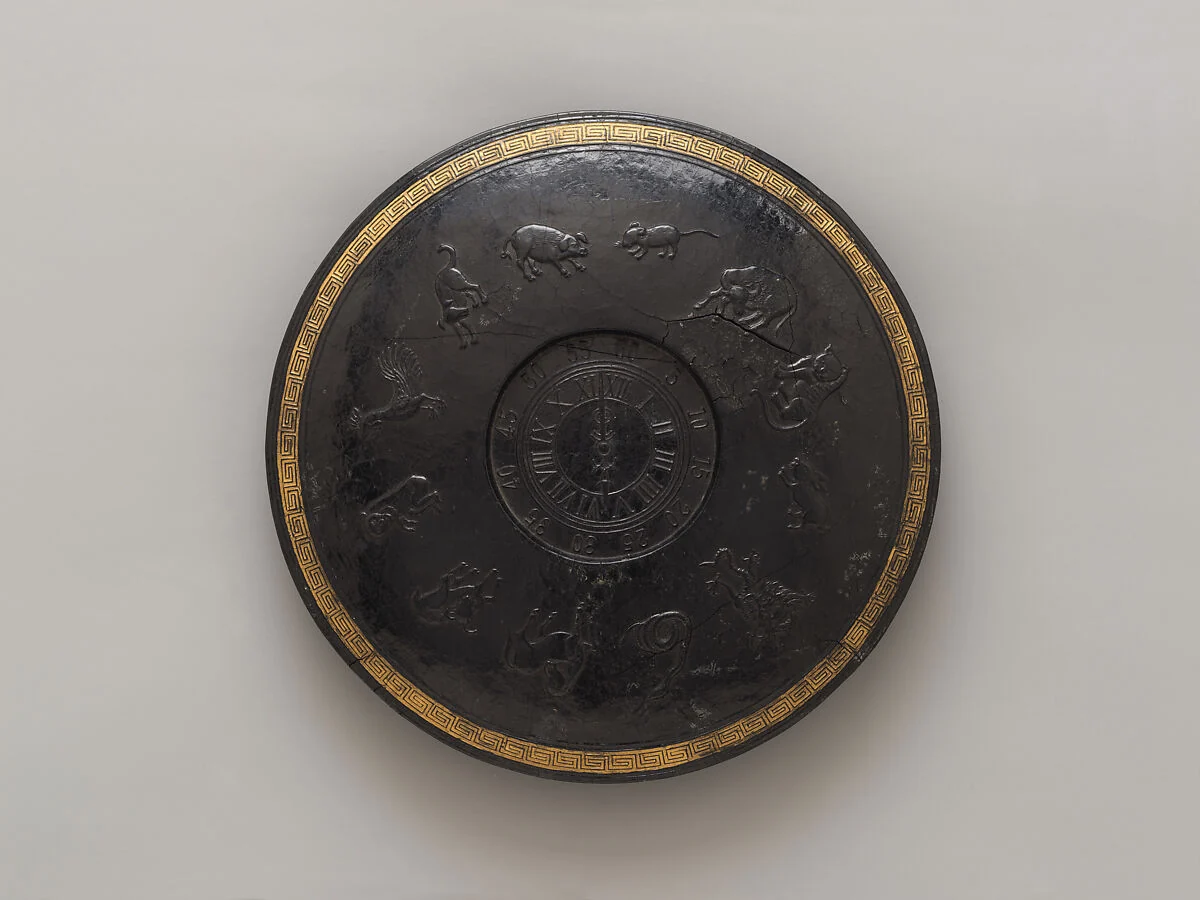
A Qing-era ink cake in the Metropolitan Museum of Art shows what a solid Chinese ink could look like. The object is moulded and decorated with zodiac imagery and a Western-style clock face. The catalogue identifies the piece as an ink cake, which gives the decoration a material context. The design is part of an object made to hold the ingredients of ink in solid form.
The museum describes carbon collected from burnt resinous wood or vegetable oil and mixed with animal glue. Grinding the solid ink with water on an inkstone turns it into a usable liquid. In this process, the cake holds the pigment together until some of it is ground off. The resulting liquid carries fine particles of black carbon. That account fits the distinction the Bureau of Standards draws between suspended pigment and dissolved colouring matter.
The change of form helps explain how a trade history about imported sticks can also be a history of a liquid drawing medium. A solid ink object and a description of liquid ink can refer to stages in the use of related material. When comparing historical descriptions, look for whether a writer is describing the object sold, the liquid prepared for use, or the marks on a finished work. Each description captures a different stage.
The Met’s example also shows the value of an object record for checking a claim about manufacture. The catalogue ties a surviving piece to a period and describes how ink of this kind was used. Its clock face can be described as Western-style on the authority of that record. An account of where the cake travelled or who commissioned it would need evidence specific to the object.
The Met identifies the pictured cake as Chinese, from the late 19th or early 20th century. Its date is much later than the London advertisements. Use it as a documented example of the material format and a chance to see how a maker decorated the object. It cannot identify the ink advertised in 1675 or explain how the phrase India ink was first coined.
What historical Indian recipes tell us
The history of ink in India has its own material evidence. A study published by the International Dunhuang Programme reports that a thirteenth-century Indian source names lampblack, vitriol and gallnut. The study distinguishes recipes of this kind from the Chinese carbon-and-animal-glue formulations it discusses. Lampblack appears in both accounts, making carbon a point of comparison even where the other recorded ingredients differ.
That recipe matters because a short description such as carbon ink can obscure how much a historical formulation contains. The International Dunhuang Programme’s manuscript research, which includes Sanskrit fragments, compares formulations and corrosion with recipes from several regions. Carbon can coexist with other ingredients. Identifying the black pigment therefore answers one question about a manuscript, while determining which additional substances are present takes further evidence.
A recipe and a manuscript also provide evidence at different levels. A written recipe records ingredients in a particular textual tradition. A study of a manuscript concerns the material on that object. To associate a particular manuscript with the recipe naming vitriol and gallnut, a reader would need an analysis of that ink or other evidence linking the object to the recorded formulation. The presence of lampblack alone would leave several possible recipes in play.
For the Indian connection, the strongest claim is specific. A thirteenth-century Indian source records a formulation that includes lampblack, vitriol and gallnut. This gives the article a documented Indian ink tradition alongside the Chinese material and English sales records. It also shows why a country name in a commercial term is a poor guide to the full range of inks recorded in that country.
How to read a label or verify an origin claim
Nineteenth-century British sellers used labels such as Nankin India Ink and Chinese ink for ink sticks, as Hong discusses in a Washington Conservation Guild interview. Nankin India Ink is a particularly clear example of how a trade label could carry more than one geographic cue. Preserve the seller’s original wording when transcribing such a label. Any statement about the maker or manufacturing location can then be checked against the object record or trading documents.
Suppose you are captioning a packet described in a period advertisement as Nankin India Ink, and the seller’s wording is the only identification you have. The evidence supports writing that the packet was advertised under that name. If a collection later identifies a maker through a mark on the packet, the caption can add that attribution with its source. The original sales wording still belongs in the caption because it tells readers how the goods were presented at the time.
| Question | Evidence to look for | What it can establish |
|---|---|---|
| When was the name in use? | A dated advertisement or other contemporary text | The wording in circulation at a known place and time |
| Where was a particular stick made? | An attributed object record, maker’s mark or manufacturing record | The provenance of a specific item, if the attribution is supported |
| What route did the ink take? | Shipping, merchant or acquisition records tied to the goods | A documented movement between places |
| What did the ink contain? | A contemporaneous recipe or a conservation analysis of the item | The recorded formulation or the substances identified in the sample |
For a museum object whose attribution may change, find the current collection entry by its object title or accession number. Read the date, place, materials and provenance fields separately, and keep any qualification the cataloguer uses. If the claim concerns how the ink was made, check whether the accompanying description is a general account of the technique or reports analysis of that specific piece. A general account can explain the medium, while an object-specific analysis can support claims about the item itself.
- Museum of Fine Arts Boston: Carbon-Based Ink
- US Bureau of Standards: Inks, Circular 95
- Durham University Thesis: Seventeenth-Century London Print-Seller Advertisements
- Tammy Hong: Research Paper on Chinese Ink Stick Materialities
- Utrecht University: Thijs Weststeijn's Research on Chinese Calligraphy in Early Modern Europe
- Metropolitan Museum of Art: Ink Cake with Cyclical Imagery
- International Dunhuang Programme: Manuscript Ink Study
- Washington Conservation Guild: Conservator Q&A on Chinese Ink Sticks in Britain
Sources
- Museum of Fine Arts Boston: Carbon-Based Ink
- International Dunhuang Programme: A Study in the Manufacture of Old Asian Inks
- US Bureau of Standards: Inks, Circular 95
- Durham University Thesis: Seventeenth-Century London Print-Seller Advertisements
- Tammy Hong: Original Research on Chinese Ink Sticks in the European Trade
- Tammy Hong: Research Paper on Chinese Ink Stick Materialities
- Utrecht University: Thijs Weststeijn's Research on Chinese Calligraphy in Early Modern Europe
- Metropolitan Museum of Art: Ink Cake with Cyclical Imagery
- International Dunhuang Programme: Manuscript Ink Study
- Washington Conservation Guild: Conservator Q&A on Chinese Ink Sticks in Britain