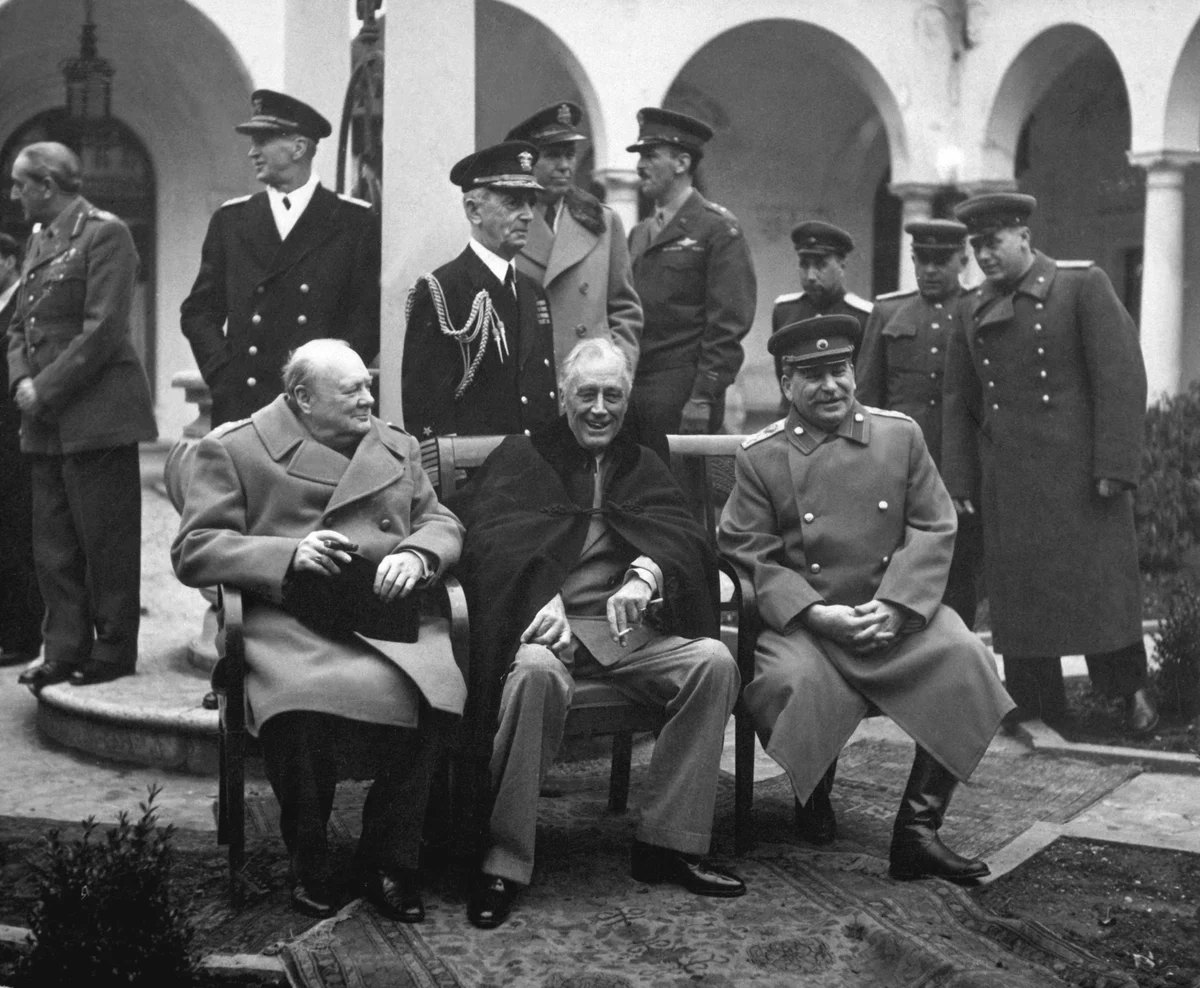
Churchill and the decision to transfer power
Winston Churchill opposed the Attlee government’s decision to set a deadline for ending British rule in India. In the House of Commons on 6 March 1947, he argued that a fixed date could reduce the incentive for a constitutional agreement and leave minorities and public services without workable arrangements. He spoke as Leader of the Opposition. Clement Attlee was prime minister, and it was Attlee’s Labour government that announced the deadline, developed the subsequent transfer plan and brought the Indian Independence Bill before Parliament.
There are two dates to keep in view. On 20 February 1947, Attlee announced that Britain intended to transfer power by June 1948 at the latest. In July the Indian Independence Act gave 15 August 1947 as the appointed day on which the two independent Dominions of India and Pakistan would come into being. The February statement and the enacted July statute come from different stages of the process. A claim about Churchill’s reaction in February or March needs to use the earlier deadline he was debating.
Keep the wartime office separate from the postwar parliamentary role. Churchill was prime minister during the Bengal famine of 1943. His government faced decisions about food supply and scarce shipping during the war. He spoke from the opposition benches in the March 1947 debate over the transfer. These two records both inform an account of his relationship with India, and each needs its own documents, dates and responsibilities.
Key dates from the February announcement to August
Attlee’s February statement still expressed the hope that a constitution could be worked out by Indian participants. It also addressed what would happen if the effort failed to produce a broadly representative constitutional arrangement. The government wanted a latest date for the end of direct British responsibility. The movement towards partition and the shortened timetable took shape later, as the plan discussed in Parliament on 3 June shows.
An Indian response is available within days of the announcement. Jawaharlal Nehru’s signed statement of 22 February welcomed the date’s certainty and urged Indians to address their disagreements and take responsibility for what followed. The archive traces its contemporary publication to the National Herald. Pairing that statement with the Commons debate puts an Indian political response alongside the competing positions within the British Parliament.
The June statement described the failure to reach a shared constitution-making plan and set out ways for affected provinces to decide whether to partition. The July Bill then gave those arrangements a legal form. Read sections 1 to 4 of the enacted statute for the appointed day and the associated provincial and territorial provisions. For political negotiations and the consequences of Partition, the statute is one part of a much broader historical record.
| Date | Record | What it establishes |
|---|---|---|
| 20 February 1947 | Attlee’s transfer announcement | June 1948 at the latest was the government’s announced timetable. |
| 22 February 1947 | Nehru’s published response | Nehru welcomed the certainty of a date and urged Indians to address internal disputes. |
| 5 March 1947 | Commons debate, first day | Opposition amendment from Sir John Anderson and a defence of the deadline from Sir Stafford Cripps. |
| 6 March 1947 | Commons debate, second day | Churchill criticised the timetable. Attlee defended a latest date for withdrawal. |
| 3 June 1947 | Government statement to Parliament | Revised transfer plan and procedures relating to partition. |
| 10 July 1947 | Commons second reading | Attlee presented the Bill and Harold Macmillan spoke for the opposition in Churchill’s absence. |
| 18 July 1947 | Royal assent | The legislation giving effect to independence became law. |
| 15 August 1947 | Section 1 appointed day | The statute established the two independent Dominions on this day. |
Modern India after independence: a timeline from 1947India Independence Day on 15 August
- UK House of Commons, India (Government Policy), 6 March 1947
- UK House of Commons, India (Government Policy), 5 March 1947
- UK House of Commons Library, A Political Introduction to India, source extract of Attlee's 20 February 1947 statement
- Jawaharlal Nehru, On the Policy of the British Government, 22 February 1947
- UK House of Lords, Indian Policy, 3 June 1947
- UK House of Commons, Indian Independence Bill second reading, 10 July 1947
- Indian Independence Act 1947, original enacted text
What Churchill argued in Parliament
Start with both days of debate. On 5 March, Sir John Anderson moved the opposition amendment. It accepted progress towards self-government and objected to fixing an outside date before arrangements for minorities, services and the transition had been settled. Stafford Cripps defended setting a latest date for British responsibility and described the trouble with leaving the decision indefinitely open. Churchill made his own substantive speech on the second day, 6 March.
Churchill worried that a deadline would diminish incentives to reach agreement and lead to disorder after withdrawal. He also pressed the government on minority safeguards, how services serving multiple areas would operate and what Britain would still be obliged to do. In the same debate, Attlee argued that British authority could not go on indefinitely while waiting for an agreed constitution. He pointed to support for self-government among Indians as a reason to act.
In that March speech, Churchill accepted a share of responsibility for the wartime coalition’s 1940 offer made through Viceroy Linlithgow. The record documents a conditional willingness to contemplate postwar Dominion Status alongside Churchill’s objections to the specific 1947 deadline. During the Bill’s July second reading, Harold Macmillan recalled the wartime coalition’s agreement on offering postwar self-government through the 1942 Cripps Mission. That retrospective was Macmillan’s parliamentary statement, made while speaking for the opposition in Churchill’s absence.
These statements answer different questions. The March speech supports an account of Churchill’s objections to the timetable and the conditions under which the government planned to transfer responsibility. The earlier offers help explain how Churchill’s wartime coalition conceived an eventual constitutional change. The July Act establishes the actual legal outcome. A concise chronology can cite all three without treating either wartime proposals or predictions made in debate as completed transfers.
Bengal famine of 1943: what the evidence supports
The Bengal famine happened during Churchill’s wartime premiership. The contemporary legislative record and the Government of India’s later inquiry give different views of the emergency. On 12 October 1943, India Secretary Leo Amery acknowledged requests from Calcutta’s municipal authorities about grain imports and mentioned the loss of rice imports from Burma and stock withheld through hoarding. On 4 November, Amery again described the food situation, relief and the distinction between supplies moved within India and grain brought from overseas. Those statements are the government’s accounts to Parliament, with the contemporary limitations that implies.
The Central Legislative Assembly in India supplies another contemporary record. On 9 November, K. C. Neogy asked about suspension of shipments and pressed for evidence on district food supplies and relief. Food Member Jwala Prasad Srivastava reported that around 160,000 tons of Australian wheat had reached Indian ports from November 1942 to April 1943, below the amount requested. He described the Indian government agreeing at the time to forgo further shipments and cited shipping problems, competing demand from Ceylon and expected harvest conditions. See printed pages 77 to 79 for the questions and the scope of the response.
Notice the geographic unit in the Assembly record. Wheat reaching Indian ports is an India-wide figure. To know how much reached households in Bengal, you also need allocations, inland distribution, prices and who could afford to buy it. The Famine Inquiry Commission’s report on Bengal examined those interacting questions after the emergency. Its conclusion that official mortality figures understated deaths also illustrates why an early estimate in correspondence and a retrospective death toll answer different questions.
For an assessment of political responsibility, ask what decisions are personally attributable, which institutions controlled shipping and allocation, and what alternatives were available at the particular date. The published records establish that requests and constraints were discussed while suffering was severe, and that the response was contested. The Assembly evidence gives you a named minister’s reported sequence. To attribute a particular Cabinet refusal to Churchill personally, look for the dated decision and supporting minutes.
- UK House of Commons, Food Situation, 12 October 1943
- UK House of Commons, India food situation, 4 November 1943
- Central Legislative Assembly debates, 9 November 1943, Parliament of India archive
- Famine Inquiry Commission, Report on Bengal (1945), University of North Bengal archive
- Census of India 1951, appendix reproducing the 1945 inquiry text
Churchill’s request for ships in April 1944
One document directly records a personal intervention by Churchill. On 29 April 1944, he asked U.S. President Franklin D. Roosevelt for extra shipping capacity to move Australian wheat to India. The U.S. Department of State’s published record labels the text as a paraphrase and reports that the request followed a warning from Viceroy Wavell. The message distinguished roughly 350,000 tons of grain provided for in plans for the first nine months of 1944 from the roughly one million tons Wavell thought India would need to import that year.
Secretary of State Cordell Hull then forwarded a proposed reply declining the shipping request because of existing American commitments. The published diplomatic file includes the draft and lets a reader distinguish a proposed reply from a record of receipt. The archival study by M. S. Venkataramani reconstructs the U.S. response and describes the negative decision reported at the end of May. A July message from British minister Ronald Campbell further distinguished shipping arrangements from capacity actually made available.
These records trace an April 1944 request, its handling and the effort to move additional wheat to Indian ports. To evaluate decisions at the height of the 1943 famine, work back to the contemporary Indian and British records and the 1945 inquiry. A dated request is evidence that an official sought a particular action at that stage. The distinction among requesting, committing and delivering aid is especially important when trying to calculate the effect of relief.
- Churchill to Roosevelt, 29 April 1944, U.S. diplomatic papers
- Secretary Hull to President Roosevelt, with draft reply on shipping, U.S. diplomatic papers
- British Minister Ronald Campbell to Secretary Hull, 20 July 1944
- M. S. Venkataramani, Bengal Famine of 1943: The American Response (1973), PMML digitized book
How to check a quotation or viral claim
If a claim is about what Churchill said in Parliament, find the correct sitting and identify the speaker above the passage. The second day in March contains Churchill’s speech, and the July second reading contains Macmillan’s remarks for the opposition. A passage copied from the July record needs its speaker’s name even when it describes what Churchill’s coalition previously did. The distinction matters most in short social posts, where a paraphrase can easily become a purported direct quotation.
For a famine claim, retain the date, place, type of record and unit of every figure before comparing it with another source. For example, the November Assembly testimony describes wheat to Indian ports. The April diplomatic record describes a programme for 1944 and a further request for shipping. The retrospective inquiry addresses the famine in Bengal. The documents describe different stages and quantities. A calculation that treats them all as deliveries to Bengal will produce an unsupported result.
For a compact reading route, begin with Attlee’s February extract, read Nehru’s response, open Churchill’s second-day speech and finish with section 1 of the July Act. For the famine, begin with the Assembly’s pages 77 to 79, then open the official inquiry and Churchill’s dated shipping request. That sequence preserves authorship and helps you compare events, proposals and recorded decisions in their original contexts.
- UK House of Commons, India (Government Policy), 6 March 1947
- UK House of Commons Library, A Political Introduction to India, source extract of Attlee's 20 February 1947 statement
- Jawaharlal Nehru, On the Policy of the British Government, 22 February 1947
- UK House of Commons, Indian Independence Bill second reading, 10 July 1947
- Indian Independence Act 1947, original enacted text
- Central Legislative Assembly debates, 9 November 1943, Parliament of India archive
- Famine Inquiry Commission, Report on Bengal (1945), University of North Bengal archive
- Churchill to Roosevelt, 29 April 1944, U.S. diplomatic papers
Sources
- UK House of Commons, India (Government Policy), 6 March 1947
- UK House of Commons, India (Government Policy), 5 March 1947
- UK House of Commons Library, A Political Introduction to India, source extract of Attlee's 20 February 1947 statement
- Jawaharlal Nehru, On the Policy of the British Government, 22 February 1947
- UK House of Lords, Indian Policy, 3 June 1947
- UK House of Commons, Indian Independence Bill second reading, 10 July 1947
- Indian Independence Act 1947, original enacted text
- UK House of Commons, Food Situation, 12 October 1943
- UK House of Commons, India food situation, 4 November 1943
- Central Legislative Assembly debates, 9 November 1943, Parliament of India archive
- Famine Inquiry Commission, Report on Bengal (1945), University of North Bengal archive
- Census of India 1951, appendix reproducing the 1945 inquiry text
- Churchill to Roosevelt, 29 April 1944, U.S. diplomatic papers
- Secretary Hull to President Roosevelt, with draft reply on shipping, U.S. diplomatic papers
- British Minister Ronald Campbell to Secretary Hull, 20 July 1944
- M. S. Venkataramani, Bengal Famine of 1943: The American Response (1973), PMML digitized book
- Archival visual, Churchill at Yalta, 9 February 1945
