What the term refers to
Historians use Greater India as a modern label for past cultural connections between the Indian subcontinent and other parts of Asia, especially Southeast Asia, and for the twentieth-century intellectual project that gave those connections a common name. The label establishes neither an ancient state nor a shared border or a modern territorial claim.
The distinction matters because the same phrase can direct attention to two different periods. One is the period of the objects, buildings and inscriptions under discussion. The other is the period in which scholars assembled those materials into an account of India’s place in Asia. Someone looking at the Buddhist monument of Borobudur is dealing with eighth- and ninth-century Java. Someone examining why scholars grouped Borobudur with sites elsewhere in Southeast Asia is asking a question about the history of scholarship.
The wider category can help locate comparisons. At Mỹ Sơn, the evidence concerns religious architecture and patronage in Champa. At Sambor Prei Kuk, it includes a capital of Chenla and distinctive temple forms. At Borobudur, it includes a Buddhist monument of the Syailendra period. Naming each setting keeps the comparison tied to particular places, periods and political communities. It also leaves room for those communities to have made different choices about the traditions they used.
A geology article can use Greater India in a separate technical sense for part of the Indian plate considered in research on the India–Asia collision. The subject matter tells you which usage is in play. A discussion of plate reconstruction calls for geological evidence, while a discussion of Sanskrit inscriptions or the Greater India Society calls for historical sources.
- Cambridge University Press: Visions of Greater India, Original Historical Study
- UNESCO World Heritage Centre — Mỹ Sơn Sanctuary, Viet Nam
- UNESCO World Heritage Centre — Sambor Prei Kuk, Ancient Ishanapura, Cambodia
- UNESCO World Heritage Centre — Borobudur Temple Compounds, Indonesia
- Natural Earth — public domain map data terms
How the Greater India Society used the name
Kalidas Nag’s Greater India appeared in Calcutta in 1926 as Bulletin I of the Greater India Society. A contemporary Royal Asiatic Society review records the city, year and length of 44 pages. That publication gives the term a documented setting in organised scholarship. It tells us what Nag and the society put into circulation in the twentieth century. The vocabulary that people in medieval Java or Champa used to describe their own communities has to be established from evidence for those places and periods.
A second publication shows how the society pursued the subject through regional studies. Bijan Raj Chatterjee’s India and Java, Part I (History) appeared in a second revised and enlarged edition in Calcutta in 1935. Its foreword describes it as the revised Greater India Society Bulletin No. 5. The digitised copy held by the Indira Gandhi National Centre for the Arts carries accession number 14723. For a reference to that edition, the title page supplies the publication year and the accession number identifies the archived copy.
The 2023 study Visions of Greater India places this work amid twentieth-century anti-colonial thought, nationalism and international scholarly exchange. It traces a Calcutta-centred network that connected South Asian authors with scholars in Paris and Leiden. The history of the term therefore includes both the political significance scholars attached to India’s past and the international relationships through which they studied it. A society bulletin is primary evidence for that intellectual project. Its historical claims about an earlier polity still need to be weighed against the evidence it cites.
Mỹ Sơn and the languages of Champa
Mỹ Sơn, in present-day Quảng Nam, Viet Nam, was a ceremonial and political centre of Champa. UNESCO discusses the region’s material development from the fourth to the thirteenth centuries and identifies Cham adaptations of Hindu art and architectural influences from the Indian subcontinent. That span supplies context for the site as a whole. A claim about the age of any particular tower needs evidence for that building or group, since the surviving groups belong to different periods.
The pedestal inscription catalogued as C. 97 gets closer to an individual act. In the published translation by Dominic Goodall and Arlo Griffiths, Vikrāntavarman installs a sheath for the liṅga of Vāmeśvara. The inscription records a named royal patron, a specific religious act and the use of Sanskrit and Śaiva vocabulary to commemorate it. Those details let a reader discuss how royal patronage worked at the site without having to infer it from the appearance of the towers.
A separate Mỹ Sơn inscription, the doorjamb catalogued as C. 86, is in Old Cham. The two records come from different objects and dates. Read together, they document more than one written language at Mỹ Sơn and give a concrete reason to check which object a statement about language refers to. A claim about what people spoke in everyday life would require evidence beyond the choice of language on a pedestal or a doorjamb. The inscription identifiers also let readers check the language and translation directly in the DHARMA edition.
| Record | Date or period | What it establishes |
|---|---|---|
| Greater India Society Bulletin I | 1926 | A twentieth-century named use of the phrase in Calcutta |
| India and Java, Bulletin No. 5, Part I | 1935 revised edition | A documented publication in the Society’s research series |
| Mỹ Sơn pedestal inscription C. 97 | Historic Champa | Named local royal patron and use of Sanskrit in an inscription |
| Mỹ Sơn doorjamb inscription C. 86 | Historic Champa | A separate object recorded in Old Cham |
Ishanapura and a Vishnu sculpture from the Mekong Delta
Sambor Prei Kuk, in present-day Kampong Thom, Cambodia, is identified with Ishanapura, a capital of Chenla in the late sixth and early seventh centuries. Its octagonal temples and carved architectural decoration give readers specific forms to look for when comparing buildings. UNESCO’s account situates them in a setting of regional exchange and local architectural development. The older nomination material treats connections with India and Champa separately, a distinction worth keeping when asking which relationship best explains a particular feature.
A stone sculpture in the Metropolitan Museum of Art brings a different kind of evidence into the comparison. Standing Four-Armed Vishnu, object 1992.53, comes from the Mekong Delta area of present-day Viet Nam and is dated to the second half of the seventh century. The conch, disc and surviving mace support its identification as Vishnu. The museum describes stylistic links to Indian sculpture and places the work in the local setting of the pre-Angkor Zhenla kingdom.
The capital and the sculpture answer questions at different scales. The identification of Ishanapura locates a political centre. The museum’s reading explains how the sculpture’s surviving attributes and style connect it to a wider artistic tradition. A resemblance between works can motivate a closer comparison of dates and features. Establishing a sculpture’s workshop, findspot or journey would require a different record. Here the museum gives a regional provenance, which is the appropriate level of precision for a reference entry.
What Borobudur’s design can tell us
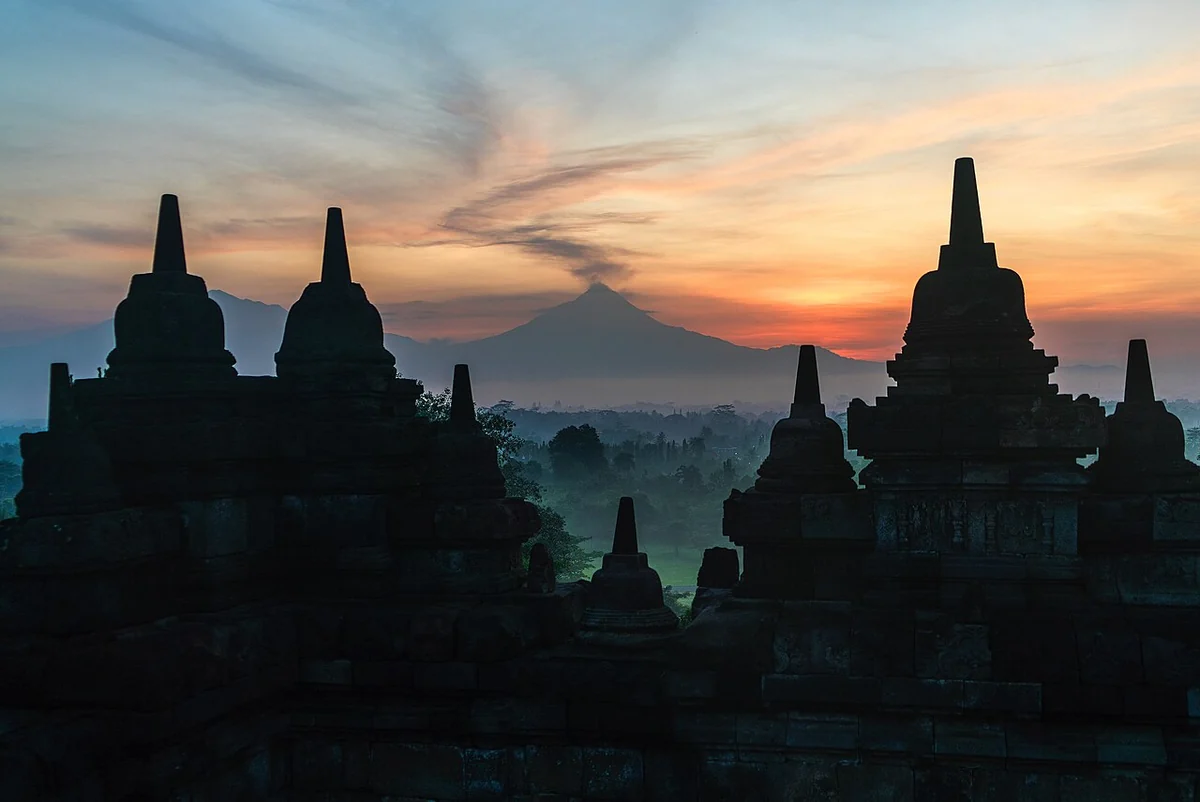
Borobudur stands in the Kedu Valley of Central Java, Indonesia. UNESCO dates it to the eighth and ninth centuries, in the Syailendra period, and interprets its base, square terraces and circular platforms through Buddhist concepts of the cosmos. The design gives the comparison a specific subject. It shows how a wider religious tradition informed the organisation of a monument built in Java, down to the arrangement of terraces and platforms.
Put Borobudur beside Mỹ Sơn as a question about architecture and the category starts to earn its keep. A comparison can ask what each site’s layout and buildings reveal about religious practice and patronage. The Buddhist cosmological interpretation belongs to Borobudur. Evidence for a named patron commemorating a Śaiva installation belongs to a particular inscription at Mỹ Sơn. Knowing which observation comes from the layout and which comes from a text helps a reader see how far each comparison can go.
Chatterjee’s 1935 study is relevant for a reader investigating how Java figured in Greater India Society scholarship. UNESCO’s account of Borobudur addresses the dating and interpretation of the monument. The sources can sit beside one another in a bibliography, but each answers a different question. The society publication documents the historical vocabulary of the scholars who used it. The monument’s setting and design supply evidence about Java during the Syailendra period.
How to read a Greater India reference map
Read each marker as the location of a particular historical site. Present-day country names help you find the sites, and labels such as Champa, Chenla and the Syailendra period put them in historical context. A coastline or relief base gives enough orientation for this comparison. Shading whole countries or drawing a perimeter around the pins would imply a geographic extent the evidence does not establish. Arrows would imply a direction of movement that the site locations alone cannot supply.
| Reference | Present-day location | Historical context | Evidence to compare |
|---|---|---|---|
| Mỹ Sơn Sanctuary | Quảng Nam, Viet Nam · 15.7738° N, 108.1092° E | Champa · regional material development from the fourth to thirteenth centuries | Ceremonial centre and Cham adaptations in temple architecture |
| Sambor Prei Kuk | Kampong Thom, Cambodia · 12.8725° N, 105.0431° E | Ishanapura, a capital of Chenla in the late sixth and early seventh centuries | Octagonal temples and carved architectural decoration |
| Main Borobudur temple | Central Java, Indonesia · 7.6078° S, 110.2039° E | Syailendra period · eighth and ninth centuries | Terraces and platforms interpreted through Buddhist cosmology |
| Standing Four-Armed Vishnu | Mekong Delta area, Viet Nam · regional provenance | Pre-Angkor Zhenla · second half of the seventh century | Iconography and stylistic comparison |
If a map of Borobudur opens at a different point from the coordinates in the table, check which component the marker represents. The World Heritage property includes companion temples at Mendut and Pawon. UNESCO’s property maps identify the main Borobudur temple as component 592-001. For Sambor Prei Kuk, check the map attached to the currently inscribed property before using a point from older nomination material. The map and nomination can serve different purposes even when they refer to the same site.
Keep the dates attached to the event they describe. Mỹ Sơn’s UNESCO inscription in 1999 and Sambor Prei Kuk’s inscription in 2017 belong to the history of World Heritage recognition. Centuries belong beside the relevant building phase, polity or object date. If a listing or map label changes, look up the property by name or by its UNESCO identifier, 949 for Mỹ Sơn, 1532 for Sambor Prei Kuk and 592 for the Borobudur Temple Compounds.
Ancient India maps: Indus sites and Ashokan edictsHistory of India: a timeline from Harappan cities to the Republic
- UNESCO World Heritage Centre — Mỹ Sơn Sanctuary, Viet Nam
- UNESCO World Heritage Centre — Sambor Prei Kuk, Ancient Ishanapura, Cambodia
- UNESCO World Heritage Centre — Borobudur Temple Compounds, Indonesia
- Metropolitan Museum of Art — Standing Four-Armed Vishnu, object 1992.53
- Natural Earth — public domain map data terms
How to check claims about influence and rule
When a description calls a place part of Greater India, look for the verb that would make the claim testable. Did a patron commission an object, did builders adapt a form, did a writer use Sanskrit, or did a ruler exercise authority? Each verb points to a different record. An edited inscription can identify a patron and a dedication. A monument can show an architectural choice. A claim to jurisdiction requires evidence that identifies the governing authority, the place and the period for which it exercised power.
Suppose a caption uses the Mekong Delta Vishnu to say that a dynasty in India ruled the area in the seventh century. The museum entry supports a more specific caption about a sculpture of Vishnu in a local Zhenla setting, with stylistic links to Indian sculpture. To retain a claim about rule, the writer would need independent evidence of jurisdiction, such as a record of administration that can be tied to the named authority and the area. The sculpture’s date and attributes establish the starting point for the art-historical claim.
Apply the same care to an account of transmission. A resemblance in architecture, a shared religious vocabulary and a patron’s choice of language each document a connection at a particular level. A proposed route or intermediary needs evidence that links the places and dates involved. Where a source supplies only a broader relationship, keep the wording at that scale. For a catalogue detail that could be revised, search by the object or inscription number and check the current record for its dating, provenance, reading or translation.
- Cambridge University Press: Visions of Greater India, Original Historical Study
- UNESCO World Heritage Centre — Mỹ Sơn Sanctuary, Viet Nam
- DHARMA Campā epigraphy — pedestal inscription C. 97 at Mỹ Sơn
- UNESCO World Heritage Centre — Sambor Prei Kuk, Ancient Ishanapura, Cambodia
- UNESCO World Heritage Centre — Borobudur Temple Compounds, Indonesia
- Metropolitan Museum of Art — Standing Four-Armed Vishnu, object 1992.53
Sources
- Indira Gandhi National Centre for the Arts: Greater India Society Bulletin Facsimile
- Cambridge University Press: Visions of Greater India, Original Historical Study
- Kalidas Nag — Greater India Society Bulletin I, Calcutta, 1926 facsimile catalogue
- UNESCO World Heritage Centre — Mỹ Sơn Sanctuary, Viet Nam
- DHARMA Campā epigraphy — pedestal inscription C. 97 at Mỹ Sơn
- UNESCO World Heritage Centre — Sambor Prei Kuk, Ancient Ishanapura, Cambodia
- UNESCO World Heritage Centre — Borobudur Temple Compounds, Indonesia
- Metropolitan Museum of Art — Standing Four-Armed Vishnu, object 1992.53
- Natural Earth — public domain map data terms
- Wikimedia Commons — Sunrise over Borobudur, photograph by Christopher Michel
