What changed when Victoria became Empress of India
Empress of India was the imperial title Queen Victoria added to her royal style on 28 April 1876 to recognise the British Crown’s assumption of government from the East India Company in 1858. The title changed how Victoria was formally designated, and Viceroy Lord Lytton publicly marked its assumption at Delhi on 1 January 1877.
Royal style means the formal wording used to designate a monarch. The 1876 proclamation retained Victoria’s existing style as Queen and Defender of the Faith and added Empress of India, with Indiae Imperatrix as the Latin form. Victoria was already sovereign in her own right. The same person now bore both the royal and imperial designations, and the added words explicitly associated her office with the government of India.
The date you use depends on what you are trying to establish. An account of the Crown takeover belongs with the 1858 Act. A biography dating the addition to Victoria’s formal style should use the April 1876 proclamation. A caption for the gathering at Delhi belongs with January 1877. The sources for those dates record different actions by different authorities.
| Date | Event | Record to consult |
|---|---|---|
| 2 August 1858 | Government of India Act transferred Company government to the Crown | Government of India Act 1858, sections 1–2 |
| 27 April 1876 | Royal assent to the Act authorising a change to the royal style | Royal Titles Act 1876 |
| 28 April 1876 | Victoria proclaimed the addition of Empress of India | The London Gazette, issue 24319 |
| 1 January 1877 | Imperial Assemblage marked the assumption of the title at Delhi | J. Talboys Wheeler’s contemporary account |
| 15 August 1947 | Appointed day for the new dominions | Indian Independence Act 1947, section 1 |
| 22 June 1948 | George VI formally omitted Emperor of India | The London Gazette, issue 38330 |
- The London Gazette: Royal Proclamation, April 1876
- Government of India Act 1858, original as enacted
- Royal Titles Act 1876, original as enacted
- Library of Congress — J. Talboys Wheeler's 1877 account of the Imperial Assemblage at Delhi
- Royal Collection Trust — Jodhpur Loyal Address, 1877, RCIN catalogue RA VIC/ADDJ/1713
- London Gazette issue 38330, page 3647 — 22 June 1948 omission of the title
What the Crown took over in 1858
The Government of India Act, dated 2 August 1858, ended the East India Company’s exercise of government. Sections 1 and 2 vested its Indian territories and governmental powers in the Crown and provided for those powers to be exercised in the monarch’s name. To understand the geographical scope of that transfer, follow the Act’s wording about territories in the Company’s possession or under its government. The enactment dealt with the territories and powers the Company had held.
The public announcement followed at Allahabad on 1 November 1858, when the governor-general published the Crown’s proclamation to the princes, chiefs and people of India. It announced direct Crown government and spoke separately to princes and chiefs. The Crown said it accepted the treaties and engagements the Company had made with Indian princes. That commitment shows how the Crown publicly described its obligations at the point of transfer. Establishing how officials handled a particular obligation later would require records of the treaty and the decision in question.
Read together, the Act and the Allahabad proclamation explain how the Crown could govern in Victoria’s name while continuing to deal with Indian rulers through distinct arrangements. The title adopted eighteen years later applied the name India to Victoria’s imperial designation. To work out how Crown authority operated in any specific territory, start with that territory’s position under Company government or its arrangements with the Company, then trace what the Crown inherited.
How Parliament authorised the title and Victoria adopted it
The Royal Titles Act received royal assent on 27 April 1876. Its formal citation is 39 & 40 Vict. c. 10. The Act authorised Victoria to add to the royal style by proclamation under the Great Seal in recognition of the earlier transfer of government. Parliament supplied the legal authority. Victoria used it the next day in a proclamation dated at Windsor, which appeared in that day’s London Gazette and set out the English and Latin wording.
The proclamation also dealt with the practicalities of using the expanded style. It exempted certain instruments operating only within the United Kingdom and kept existing lawful coinage current. The latter provision mattered because coins already in use carried earlier forms of the monarch’s designation. Someone dating a Victorian coin therefore needs the object’s own date and catalogue record. The absence of imperial wording alone cannot place its use before April 1876.
The enacted statute and the Gazette answer two common questions about the wording. To establish where the authority came from, read the Act as enacted. To quote the title as it entered Victoria’s style, use the proclamation and distinguish the English Empress of India from the Latin Indiae Imperatrix. If an archive catalogue dates a reproduction or later printing differently, check the date printed in the proclamation and the date on the original Gazette issue.
Why the choice of words mattered in Parliament
At the Commons second reading on 16 March 1876, Benjamin Disraeli made a territorial and political case for the proposed imperial style. William Gladstone and other critics questioned how the language would describe the constitutional relationship, including the degree of sovereignty exercised over different areas. The Lords committee on 3 April considered how Indian princely rulers might react to alternative wording. The recorded exchanges show that the designation raised questions about how Britain described its position to audiences in both countries.
Historian L. A. Knight traces Disraeli’s search for a more geographically limited formulation than a contemplated empress title that included Britain and Ireland. Knight also discusses assurances that the United Kingdom would be unaffected. The final wording gave the imperial designation a territorial reference by naming India, while the existing royal designation continued. The distinction mattered to the drafting because ministers had to explain what the new words implied for Victoria’s position in Britain as well as in India.
Hansard lets a reader check who made a particular claim and at which stage of the bill. A minister’s assurance records the case made for the proposal. An objection records how a critic understood its possible consequences. A peer’s prediction about a ruler’s response records an expectation in Westminster. Evidence of how an Indian court actually responded comes from records associated with that court, such as an address prepared for the gathering at Delhi.
What happened at the Delhi Imperial Assemblage
Viceroy Lord Lytton hosted the public announcement at Delhi on 1 January 1877. The occasion is often called the Delhi Durbar, and J. Talboys Wheeler’s contemporary account calls it the Imperial Assemblage. Victoria did not visit India. The event gave Lytton an occasion to present the assumption of her title publicly in India after it had already been added to her style in Britain. Library of Congress material on the gathering also gives the form Qaisar-i Hind.
Knight interprets Lytton’s planning as an effort to cultivate relationships with Indian princes and strengthen executive authority. That reading helps explain why the ceremony deserves attention alongside the legislative record. The Gazette can establish the date and terms of the proclamation. The arrangements for the assemblage show how the viceroy sought to give that formal decision a public and political presence among rulers whose relationships with the Crown varied.
One surviving object makes that participation concrete. Jaswant Singh II, Maharaja of Jodhpur, commissioned his court poet Kaviraj Murardan to write a loyal address. The manuscript uses Devanagari and Roman scripts and is catalogued by the Royal Collection Trust as RA VIC/ADDJ/1713. Its commissioning and presentation document how one court chose to participate in the occasion. A comparison of attitudes across princely states would need evidence from several courts, ideally including material prepared outside the public ceremony.
- The London Gazette: Royal Proclamation, April 1876
- L. A. Knight — The Royal Titles Act and India, original archival scholarship
- Library of Congress — J. Talboys Wheeler's 1877 account of the Imperial Assemblage at Delhi
- Royal Collection Trust — Jodhpur Loyal Address, 1877, RCIN catalogue RA VIC/ADDJ/1713
Victoria’s title and the later Delhi durbars
Victoria was queen regnant, meaning that she held the sovereign office in her own right. The imperial addition was to her own formal style. A queen consort at a later durbar held a different constitutional position as the sovereign’s spouse. This distinction matters when a description focuses on the woman depicted or uses an imperial designation without explaining whose accession or title the ceremony marked.
The Royal Collection distinguishes Victoria’s ceremony in 1877 from the 1903 event for Edward VII and the December 1911 durbar attended by George V and Queen Mary. George V was the first monarch to attend an Imperial Durbar in person. If a caption identifies a sovereign at the event, check the year and names against the institutional catalogue. An image of George V alongside Queen Mary belongs to a different occasion from Lytton’s assemblage for Victoria.
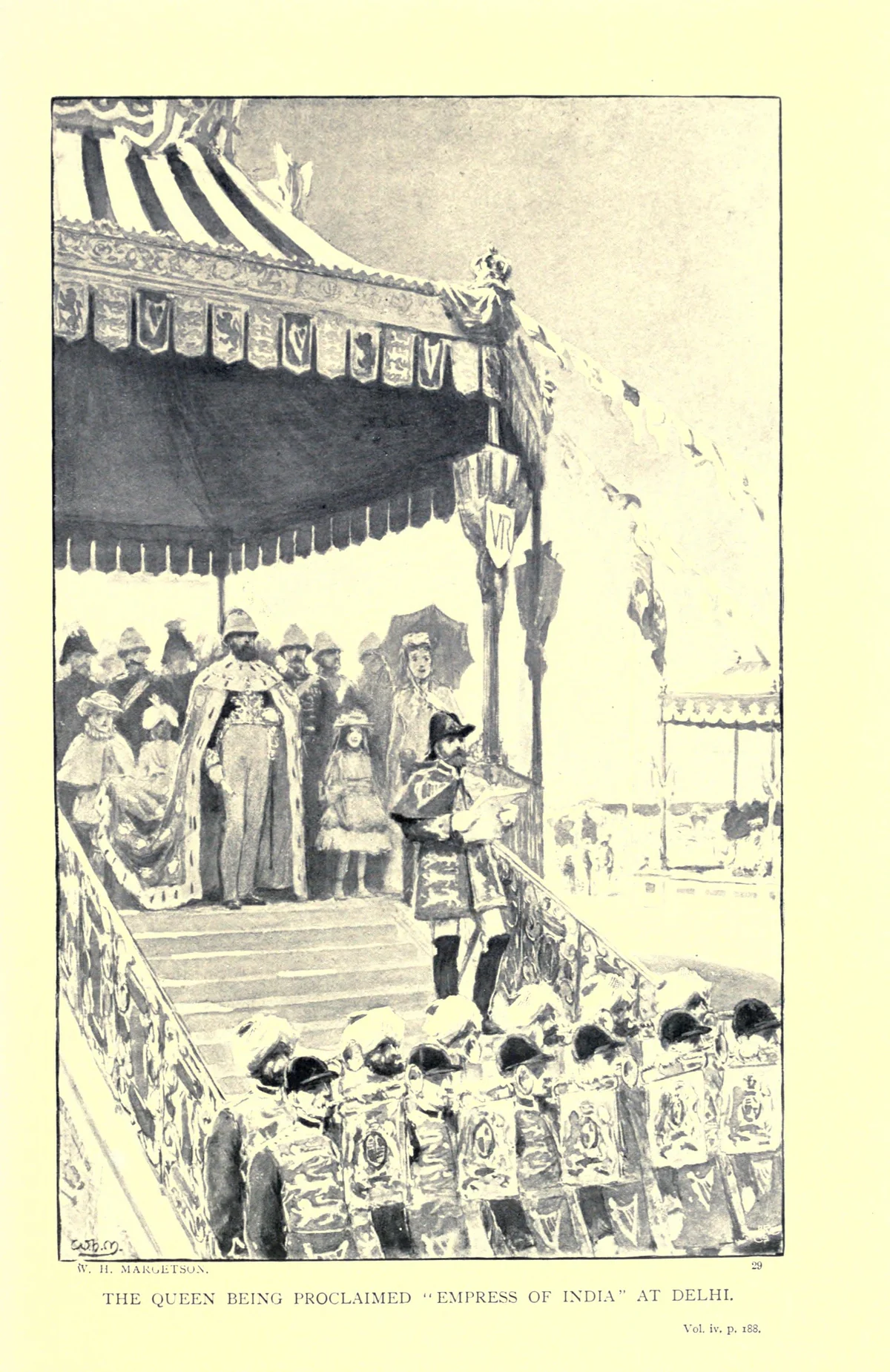
An illustration also has a date of production or publication as well as a date for the event it depicts. William Henry Margetson’s illustration of the 1877 Delhi proclamation appeared in a volume of Edgar Sanderson’s history published in 1897–98. A caption can give both dates to make clear that the image was published about two decades after the event. The original volume’s publication details and the image attribution are the records to check when later reproductions shorten or omit that information.
| Date | Imperial reign | Who attended or presided |
|---|---|---|
| 1 January 1877 | Victoria | Viceroy Lord Lytton presided. Victoria did not travel to India. |
| 1 January 1903 | Edward VII | Delhi event during the wider 1902–03 programme. |
| 12 December 1911 | George V | George V and Queen Mary were present. |
- Library of Congress — J. Talboys Wheeler's 1877 account of the Imperial Assemblage at Delhi
- Royal Collection Trust — Jodhpur Loyal Address, 1877, RCIN catalogue RA VIC/ADDJ/1713
- Wikimedia Commons — W. H. Margetson's later illustration of the Delhi proclamation
- British Library photograph catalogue for the 1903 Delhi Durbar
- Queen Mary’s Royal Collection album for 12 December 1911
When the imperial title left the royal style
The Indian Independence Act 1947 set 15 August 1947 as the appointed day for the new dominions. Section 7(2) gave Parliament’s assent to the removal of the corresponding masculine title from the royal style. George VI’s proclamation, dated at Buckingham Palace and published in The London Gazette on 22 June 1948, formally omitted Emperor of India and its Latin form, Indiae Imperator. The date of independence and the date of formal omission answer separate questions.
For a document dated between August 1947 and June 1948 that still calls George VI Emperor of India, the sequence explains why the wording could persist in formal use after independence. Read the title as evidence of how the document styles the monarch, and use the Independence Act to establish the constitutional timing. Check the document’s own issue date as well, particularly if the copy you are reading was catalogued or reproduced later.
The removal notice can be located by Gazette issue 38330, page 3647. In the original issue, check the date and the two forms being omitted. For the statutory background, consult sections 1 and 7(2) of the Independence Act as enacted. That pairing establishes when the dominions came into being and when the associated imperial wording was taken out of the royal style, even if a catalogue entry or a short timeline gives only the year.
Modern India after independence: a timeline from 1947India before and after Partition: 1947 maps of Punjab and Bengal
Sources
- UK Legislation: Royal Titles Act 1876
- The London Gazette: Royal Proclamation, April 1876
- Government of India Act 1858, original as enacted
- British Library and Qatar Digital Library — original 1858 proclamation to the princes, chiefs and people of India
- Royal Titles Act 1876, original as enacted
- UK Parliament Hansard — Royal Titles Bill second-reading debate, 16 March 1876
- L. A. Knight — The Royal Titles Act and India, original archival scholarship
- Library of Congress — J. Talboys Wheeler's 1877 account of the Imperial Assemblage at Delhi
- Royal Collection Trust — Jodhpur Loyal Address, 1877, RCIN catalogue RA VIC/ADDJ/1713
- London Gazette issue 38330, page 3647 — 22 June 1948 omission of the title
- Wikimedia Commons — W. H. Margetson's later illustration of the Delhi proclamation
- British Library photograph catalogue for the 1903 Delhi Durbar
- Queen Mary’s Royal Collection album for 12 December 1911
