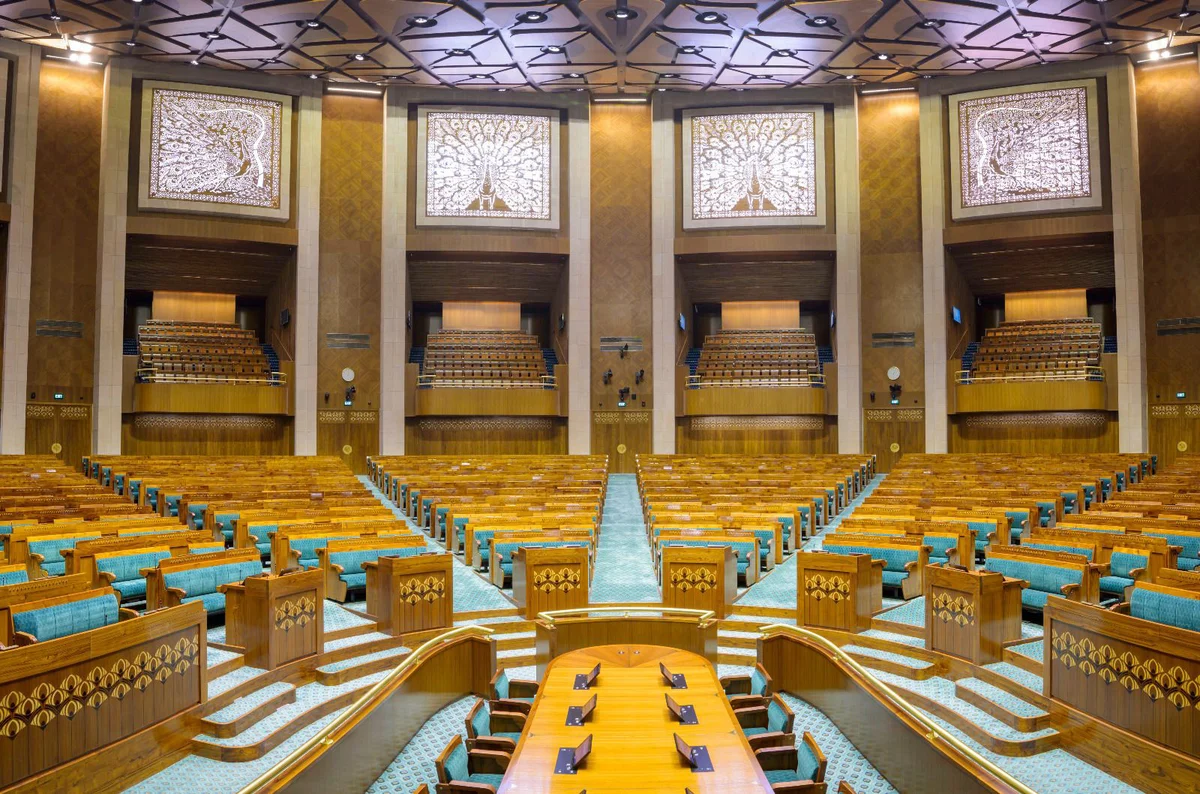
India’s type of government
India is a democratic republic with a parliamentary system. Article 1 describes it as a Union of States. The President is head of state, while the Prime Minister leads the Council of Ministers that advises the President and is collectively responsible to the Lok Sabha. Parliament includes the President and two Houses. State governments have their own responsibilities under the Constitution.
The word parliamentary describes how executive government is organised. It helps explain why an account of who governs India refers both to the President and to a ministry led by the Prime Minister. The two offices have different places in the constitutional structure. A question about the office named in a constitutional provision and a question about who leads executive government call for different details, even when they concern the same public decision.
The Constitution deals with the Union executive, Parliament and the Supreme Court in separate chapters. Those chapters give a reader three places to start. Look to the executive provisions for relations between the President and ministers, to the parliamentary provisions for the composition of Parliament, and to the Court provisions for questions about the Court itself. The relevant provision depends on what the institution is doing in the account you are reading.
A reader preparing a short introduction to India for a class can answer the system question with parliamentary government under the Constitution. If the assignment then asks why India has a President and a Prime Minister, the answer needs a second step. Identify the President’s constitutional office, identify the Prime Minister’s leadership of the ministry, and use Article 74 for the relationship between the President and the Council of Ministers.
A republic has a public office of head of state. Under Article 54, India’s President is elected indirectly through an electoral college. Voters choose their Lok Sabha representatives in a national general election. The formation of a government and the appointment of a prime minister follow separate constitutional steps. Those distinctions help when a news report uses “government” for the ministry, the Parliament or the full constitutional system.
The President and ministerial advice
Article 74 is the starting point for understanding ministerial advice to the President. It places the Council of Ministers in that relationship, with the Prime Minister at its head. This matters when a report names the President in connection with an executive action. The report may be identifying the office associated with the formal act. A fuller account can also identify the role the ministry played, where the applicable provision and the public record establish it.
Advice has a specific constitutional setting here. In ordinary conversation, advice can mean a suggestion someone is free to set aside. To explain its effect under the Constitution, check the operative language of Article 74 and read any proviso that applies. If the question concerns a particular presidential act, read the provision governing that act as well. Article 74 supplies the general relationship, while the provision for the act can supply conditions relevant to the specific case.
Suppose a news report says the President took a formal step but gives only the name of the office and the date. A reader can record the reported act and then look for the provision under which it was taken. To explain the ministry’s involvement, the reader would need a source describing that involvement or a constitutional provision that establishes the applicable process. The identity of the office in the headline leaves those details open.
Article 74 provides for the Prime Minister-led Council to aid and advise the President. The President may ask the Council to reconsider its advice and must act in accordance with the advice after reconsideration. Article 74(2) prevents courts from inquiring into whether ministers gave advice or what advice they gave. Its wording concerns the advice itself. For a claim about a particular presidential action, identify the power and governing provision separately.
The Prime Minister and the Council of Ministers
The Prime Minister heads the Council of Ministers. Article 74 identifies the Council as the body that aids and advises the President. Keep both levels visible when describing executive government. The Prime Minister is an office held by one person, while the Council is a body headed by that officeholder. Naming the Prime Minister can answer who leads the ministry. Naming the Council answers which body Article 74 places in the advisory relationship.
In public discussion, the word government may refer to the ministry in office or, more broadly, to public institutions. The verb often helps settle the meaning. A statement that the government announced a policy usually directs attention to the executive. A statement about a measure being considered in Parliament directs attention to the parliamentary proceedings. If a report uses Cabinet, Council of Ministers or ministry, preserve the term used in the underlying record when attributing a specific action.
Imagine two descriptions of the same policy announcement. One attributes the announcement to the Prime Minister. The other calls it a decision of the Council of Ministers. The first description identifies who announced the policy. The second makes a claim about the body that made the decision and needs a record that supports that attribution. Article 74 helps identify the Council’s constitutional role, and the announcement record helps establish what happened on the occasion.
Article 75 gives the President the appointment of the Prime Minister and provides for other ministers to be appointed on the Prime Minister’s advice. The Council is collectively responsible to the Lok Sabha. The Secretariat identifies Rule 198 as the procedure for a no-confidence motion in the Council as a body. The PMO gives the current portfolio list, which can change without altering those constitutional provisions.
When is India’s next general election, and how is the PM chosen?What is SIR in India? Electoral roll revision and the November 2026 schedule
What counts as Parliament
Article 79 says Parliament consists of the President and two Houses. The Houses are the Council of States, commonly called the Rajya Sabha, and the House of the People, commonly called the Lok Sabha. Bicameral describes the two-House structure. The President’s inclusion is part of the constitutional composition of Parliament. The names of the two Houses identify the bodies to look up when a report concerns proceedings in a particular chamber.
Article 79 answers a composition question. Questions about what happened to a particular bill require a record of the stage it reached and the provisions governing that stage. A report may describe the action of one House and use Parliament as a general label in its headline. Read down to the sentence that names the body, the measure and the action taken. The official record for that House can then help establish precisely what the report describes.
Suppose a bulletin says that a bill passed the Lok Sabha. The specific event to look up is passage in that House. A reader preparing a timeline can enter that event under the name of the House and then verify any later action separately. If another bulletin names the Rajya Sabha or mentions a presidential step, each item deserves its own entry with its own source. This keeps a sequence of events readable when the measure’s status changes between reports.
Article 79 makes Parliament the President, the Council of States and the House of the People. Articles 80 and 81 then address the composition of the Rajya Sabha and Lok Sabha respectively. The President’s place in the definition of Parliament is distinct from membership of either House. Use Digital Sansad for the current members or vacancy list and the legislation tracker when a question is about which stage a bill has reached.
Constitutional roles at a glance
Use the table to identify the institution named in a question and choose a starting point in the Constitution. The President appears in two places because the page covers two relationships. Article 74 concerns the relationship with the Council of Ministers. Article 79 includes the President in the composition of Parliament. An explainer can show both connections while keeping the President’s office and the two parliamentary Houses clearly labelled.
| Institution or issue | Articles | Function or source of authority |
|---|---|---|
| President | 52–54 and 74 | Office, Union executive power, indirect election and ministerial advice |
| Prime Minister and Council of Ministers | 74–75 | Advice, appointment and collective responsibility to the Lok Sabha |
| Parliament | 79–81 | President and two Houses, with separate composition provisions |
| Law-making subjects for Parliament and states | 246 and Seventh Schedule | Union, State and Concurrent List subjects |
| Supreme Court | 124 and 131–136 | Establishment of the Court and several routes for jurisdiction and appeals |
| Fundamental rights enforcement | 32 | Constitutional remedies before the Supreme Court |
A role and a procedure call for different levels of detail. If you want to know why the Council appears in an explanation of the President’s role, Article 74 gives you the constitutional connection. If you want to know how an officeholder was appointed or how a particular decision took effect, start with the provision for that appointment or decision. The institution’s name helps you narrow the search, and the provision that governs the action supplies the details.
If a chart labels one box Parliament and draws a line to a box marked President, a reader may wonder what that line represents. A label such as composition under Article 79 gives the connection a specific meaning. A second line between the Council of Ministers and the President can be labelled advice under Article 74. Explicit labels help readers follow the two relationships without treating every line as a chain of command.
Article 246 and the Seventh Schedule help answer which legislature can make laws on a subject. The schedule is divided into Union, State and Concurrent lists. Reading the list gives you the starting allocation. The text and any constitutionally specified exceptions determine the answer for a particular provision. To check who administers a service today, also identify the implementing authority for the law or programme.
- Legislative Department, Constitution of India, 20 May 2026 edition
- Supreme Court of India, official jurisdiction guide
- Lok Sabha Secretariat, frequently asked questions
- President’s Secretariat, institutional role and source for current details
- Prime Minister’s Office, portfolio directory
- Digital Sansad, official Lok Sabha roster and vacancies
- Digital Sansad, official Rajya Sabha portal
Where the Supreme Court fits
The Constitution establishes the Supreme Court in the chapter on the Union judiciary. When a public issue reaches the Court, the question shifts to the matters before it and what it decided. An executive announcement, a parliamentary proceeding and a court ruling may all concern the same subject. To make sense of the sequence, identify which institution produced each document and what kind of action the document records.
The Supreme Court’s public Constitution reference is a place to locate the constitutional text. For a claim about how two offices relate, look for the article that sets out the relationship and read the relevant clause in context. For a claim that the Court interpreted a provision in a particular way, consult the relevant judgment or order. The article gives the wording at issue, and the judgment or order supplies the Court’s treatment of that wording in the matter before it.
Imagine an article that says the Court considered a dispute arising from an executive decision. To check it, locate the case document and identify the action described, the legal question the Court addressed and the outcome recorded. Then check whether the article describes an interim step or a later decision in the matter. A general account of India’s parliamentary system can orient the reader, but the case documents are what establish the scope of the Court’s action.
Article 124 establishes the Supreme Court. Article 131 gives it original jurisdiction over specified disputes involving the Union or states when the dispute turns on a legal right. Other provisions address appeals and Article 136 provides a discretionary special-leave route. Article 32 deals separately with enforcement of fundamental rights. The Court’s jurisdiction guide links those roles and gives the formal routes for readers comparing types of cases.
How to verify a current detail
Begin by turning the detail into a claim you can check. Who heads the Council of Ministers is a question about a constitutional role if you are asking for the office. It becomes a question about a current officeholder if you are asking for the person’s name. Use Article 74 for the role. Use a current official listing or dated appointment record for the person, and check that the date fits the period you are describing.
For wording in the Constitution, use an official edition and check its date or update information, especially when two copies differ. Find the article by number, read the whole relevant clause and follow any cross-reference needed to understand the statement. If wording differs, look for the official amendment text and verify when the relevant change took effect. A search extract can help locate a provision, while the full provision supplies the context for quoting or explaining it.
Suppose an explainer correctly names the two Houses but also gives a bill’s status as pending. Check the description of the Houses against Article 79. For the bill, look up its title and identifying details in the relevant official parliamentary records, then find the latest recorded action and its date. If the record describes a different stage, write the new status with the name of the institution that acted. A dated statement remains intelligible when the next step appears.
Modern India after independence: a timeline from 1947India’s official languages, national language and the 22 scheduled languages
- Supreme Court of India, official jurisdiction guide
- Lok Sabha Secretariat, frequently asked questions
- President’s Secretariat, institutional role and source for current details
- Prime Minister’s Office, portfolio directory
- Digital Sansad, official Lok Sabha roster and vacancies
- Digital Sansad, official Rajya Sabha portal
- Digital Sansad, parliamentary bills tracker
Sources
- Legislative Department, Constitution of India, 20 May 2026 edition
- Supreme Court of India, official jurisdiction guide
- Lok Sabha Secretariat, frequently asked questions
- President’s Secretariat, institutional role and source for current details
- Prime Minister’s Office, portfolio directory
- Digital Sansad, official Lok Sabha roster and vacancies
- Digital Sansad, official Rajya Sabha portal
- Digital Sansad, parliamentary bills tracker
- Visual candidate — Lok Sabha chamber, New Delhi, 27 May 2023
