When India is expected to vote
India is expected to elect its next Lok Sabha in 2029 if the current House serves its normal term. The Ministry of Parliamentary Affairs gives 23 June 2029 as the normal term expiry. As of 26 November 2026, a nationwide polling or counting date for the next election had not appeared in the Election Commission notices checked. Voters elect constituency MPs. The President then appoints the prime minister under Article 75.
The year 2029 comes from applying the normal constitutional cycle to the House elected in the 2024 general election. Article 83 measures that cycle from the House’s first meeting. To give a precise date for the end of its normal term, start with the date recorded in official parliamentary proceedings. To give the date people will vote, look for the Election Commission of India’s schedule for the next general election.
The distinction matters when you see a headline saying an election is due in a particular year. A year can describe the expected electoral cycle while leaving the month, the number of voting phases and the dates for individual constituencies open. The 2024 schedule shows the kind of detail the Commission publishes when it sets those dates. Look for the corresponding announcement for the next election before treating a day or month as settled.
- Election Commission of India, current announcements checked 26 November 2026
- Election Commission of India, official press releases index
- Ministry of Parliamentary Affairs, Annual Report 2025–26, Lok Sabha dates annexure
- Legislative Department, Constitution of India, 20 May 2026 edition, Articles 75, 83 and 85
Where the five-year clock starts
Article 83 ties the normal five-year term to the first meeting of the Lok Sabha, the house whose members voters elect in the general election. A general election produces several dates that are easier to find in news archives, including the first day of voting, the last day of voting and the scheduled count. For the constitutional calculation, find the parliamentary record of the incoming House’s first meeting.
Suppose a general election is held in several phases, the count takes place after the last phase, and the new Lok Sabha holds its first meeting later. All three events belong to the same transition, but the meeting fixes the starting point for the normal term. If you have the dates for polling and counting alone, you can place the election in its cycle and still need one more record to establish the term’s precise starting date.
When checking a date quoted in an article, pay attention to which event the article names. A report about the opening of a later session may also say that the Lok Sabha met that day. Find the record that identifies the first meeting of the incoming House. Once you have established the normal endpoint, keep it attached to the House’s term in your notes. The Commission’s schedule answers the separate question of when voting takes place.
The official chronology for the 18th Lok Sabha records its final 2024 polling day on 1 June, constitution of the House on 6 June and first sitting on 24 June. The first-day transcript records the meeting at 11:00 on Monday, 24 June. That is the June date that matters to the constitutional term. The appointment communiqué dated 7 June and any separate records of swearing-in describe a different part of government formation.
How an early dissolution changes the timing
The normal five-year calculation assumes that the Lok Sabha continues for its full term. Article 83 allows the House to be dissolved sooner. If that happens, the normal endpoint no longer describes how long that House will sit, and the next general election could take place before the expected year. The new polling timetable still has to come from the Election Commission’s announcement.
A report predicting an early election and an official record of dissolution answer different questions. The first tells you what somebody expects. The second establishes whether the House’s term has actually ended early. If a report says an early election is coming, check whether it points to an issued record and whether that record concerns the current Lok Sabha. Then check separately for the Commission’s schedule.
Imagine a headline predicts an early national vote and gives a suggested month. The article quotes political figures discussing the possibility, with no official dissolution or election schedule cited. You can describe the month as a prediction attributed to those figures. If an official dissolution record later appears, you can report that change in the House’s status. An official polling date still needs its own source, even if later announcements happen to match the original prediction.
Article 85(2)(b) gives the President the power to dissolve the Lok Sabha. Article 83(2) also contains a limited provision for parliamentary extension by law during a declared Emergency. For a general election after term expiry or dissolution, Section 14 of the Representation of the People Act, 1951 provides for a Gazette notification on the Election Commission’s recommendation. The six-month rule in Section 14 limits how early that notification can be issued for ordinary term expiry. The provision does not give an actual polling day.
How the election leads to a prime minister
In a Lok Sabha general election, you vote for a candidate to represent your constituency. When you see a campaign described as a race for prime minister, that language describes the political stakes of the election. The outcome in constituencies shapes the composition of the incoming House. Article 75 places the formal appointment of the prime minister with the president.
To follow the transition, look at the seats won and the support available in the incoming House. Parties may campaign with a named leader and an eventual government may draw support from several parties. A campaign announcement gives you a proposed leader. The election results show which candidates won seats. An appointment announcement establishes who has been appointed prime minister. Each is a different piece of evidence, and each can become available at a different stage.
Suppose a party campaigns with a named leader and wins the largest number of seats, while governing support depends on other parties. A result report can establish that the party leads the seat tally. To understand who is in a position to form a government, follow which parties say they will support a government. To confirm who has become prime minister, find the formal appointment. The largest-party result and the appointment are claims you verify from different records.
The Council of Ministers is collectively responsible to the Lok Sabha under Article 75(3). The Lok Sabha Secretariat places a no-confidence motion under Rule 198 and describes it as a motion against the Council as a body. A change of prime minister can also occur during the same House’s term. The PMO records Gulzari Lal Nanda’s appointments after vacancies in May 1964 and January 1966. In the 2024 transition, the President’s communiqué records an assessment of majority support and the formal Article 75(1) appointment on 7 June.
Which dates belong on the election timeline
A useful timeline starts with the first meeting of the sitting Lok Sabha, because that is the event Article 83 uses for the normal term. The next entry you can look for is the Commission’s schedule announcement. The 2024 press note is an official example of an announcement that sets out voting phases and a counting date. Use it to understand the format, then look for the announcement that covers the upcoming election.
For someone planning to vote, the relevant date is the polling day assigned to their constituency. The first voting day in a national schedule may be the date that makes headlines, since it marks the start of voting across the whole election. In a phased election, your constituency may vote in a later phase. Read the phase and its constituency coverage together before putting a date in your calendar.
For someone following who will govern, the scheduled count is the point to follow constituency results. Once results are available, the appointment is a separate event to confirm. This gives a reader two practical ways to use the same timeline. One tracks when to vote locally. The other tracks when the seats are counted and when there is an official record of who has been appointed.
| What you want to know | Official record to consult | What to locate |
|---|---|---|
| Where the normal term begins | Parliamentary proceedings for the incoming Lok Sabha | The first meeting of that House |
| Whether the House ended its term early | Official dissolution record | The House covered and the effective date |
| When a constituency votes | Election Commission general-election schedule and any applicable update | The constituency’s phase and polling date |
| When votes are scheduled to be counted | Election Commission general-election schedule and any applicable update | The counting date |
| Who has become prime minister | Official announcement of the presidential appointment | The person appointed |
| Date | Event | Record or status |
|---|---|---|
| 19 April to 1 June 2024 | Seven general-election polling phases | Election Commission schedule |
| 4 June 2024 | General-election counting day | Election Commission schedule |
| 6 June 2024 | 18th Lok Sabha constituted | Ministry of Parliamentary Affairs annual report |
| 7 June 2024 | Prime minister appointed | Rashtrapati Bhavan appointment communiqué |
| 24 June 2024 | 18th Lok Sabha first met | Official debate transcript |
| 23 June 2029 | Normal expiry of the 18th Lok Sabha | Ministry of Parliamentary Affairs annual report |
| Date pending as of 26 November 2026 | Next nationwide polling and counting schedule | Check the latest Election Commission notices |
- Election Commission of India, official press releases index
- Ministry of Parliamentary Affairs, Annual Report 2025–26, Lok Sabha dates annexure
- Lok Sabha Debates, first day of the first session, 24 June 2024
- Rashtrapati Bhavan, appointment communiqué, 7 June 2024
- Election Commission of India, 2024 general-election schedule, press note ECI/PN/23/2024, 16 March 2024
- PIB copy of the Election Commission’s 16 March 2024 schedule
How to identify the announcement that applies to you
Start by checking the election named in the announcement. The search for India’s next prime minister election is a search for the nationwide Lok Sabha general election and the government formation that follows. An election notice can concern a state assembly, a single vacancy or a different electoral cycle. It may be official and recent while answering a different question. Read the title and scope before relying on any date.
Search results can also surface an older national schedule because it contains the same terms you are looking for. In this case, the Commission’s 2024 schedule is useful as an example of how it sets out phases and counting. Its named election cycle tells you which contest the dates cover. When a search result highlights a polling day, open the announcement and confirm the year and election in the document itself.
Suppose you find a notice for voting in one parliamentary constituency and another document that sets out phases for a general election. Both can refer to the Lok Sabha. Check the first notice’s stated purpose and coverage before drawing a national conclusion. If you want to know when your own constituency votes in the general election, find its entry in the nationwide schedule and check whether the Commission has issued a later notice that applies to it.
Once a nationwide schedule is issued, start at the Election Commission’s press releases and look for the General Election to the House of the People. Open the schedule and its related annexures. Record the issue date and check for amended notices. If you are unsure which parliamentary constituency to look up, start at the Commission’s Voters’ Service Portal to verify your electoral-roll entry and constituency, then match the constituency to the phase list.
What is SIR in India? Electoral roll revision and the November 2026 schedule
- Election Commission of India, current announcements checked 26 November 2026
- Election Commission of India, official press releases index
- Election Commission of India, 2024 general-election schedule, press note ECI/PN/23/2024, 16 March 2024
- Election Commission of India, Voters’ Service Portal
- PIB copy of the Election Commission’s 16 March 2024 schedule
Sources
- Election Commission of India, current announcements checked 26 November 2026
- Election Commission of India, official press releases index
- Ministry of Parliamentary Affairs, Annual Report 2025–26, Lok Sabha dates annexure
- Lok Sabha Debates, first day of the first session, 24 June 2024
- Legislative Department, Constitution of India, 20 May 2026 edition, Articles 75, 83 and 85
- India Code, Representation of the People Act 1951, section 14
- Lok Sabha Secretariat, no-confidence motions and parliamentary by-elections
- Rashtrapati Bhavan, appointment communiqué, 7 June 2024
- Prime Minister’s Office, historical profile of Gulzari Lal Nanda
- Election Commission of India, 2024 general-election schedule, press note ECI/PN/23/2024, 16 March 2024
- Election Commission of India, Voters’ Service Portal
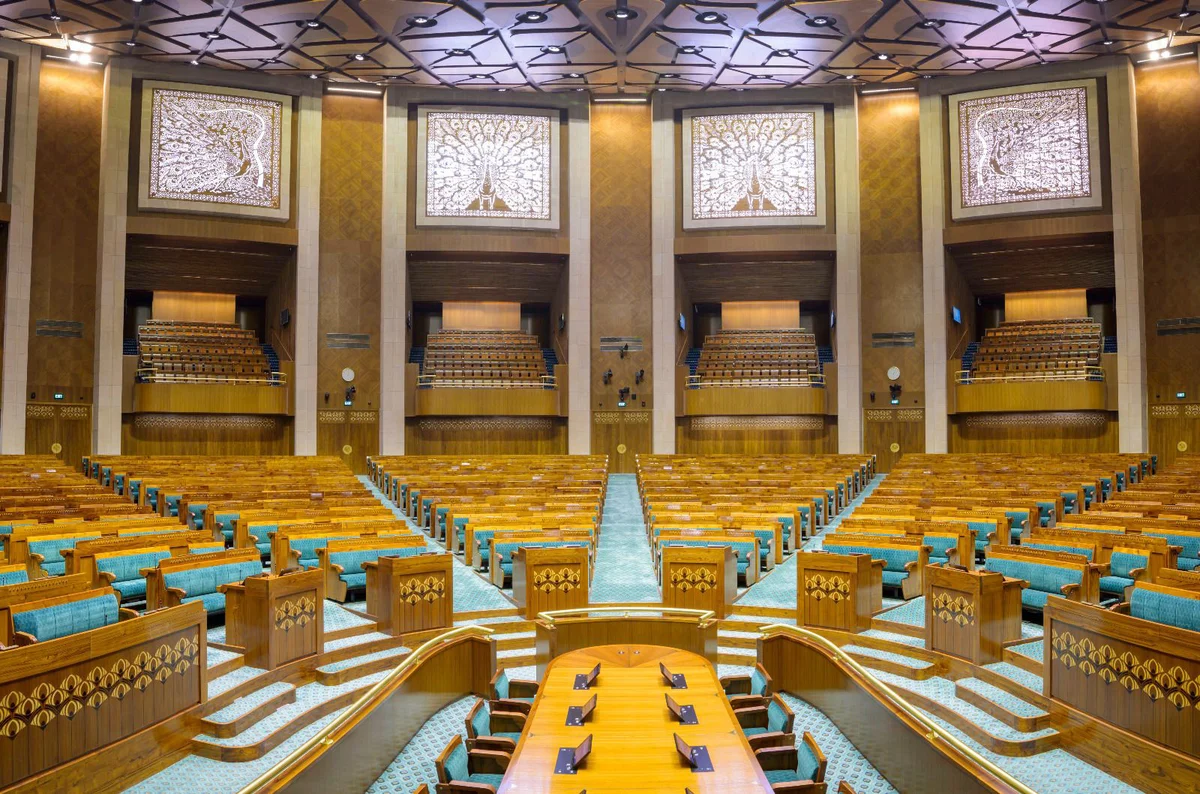
- Visual candidate — 2023 photograph of the Lok Sabha chamber in the new Parliament building
- PIB copy of the Election Commission’s 16 March 2024 schedule
