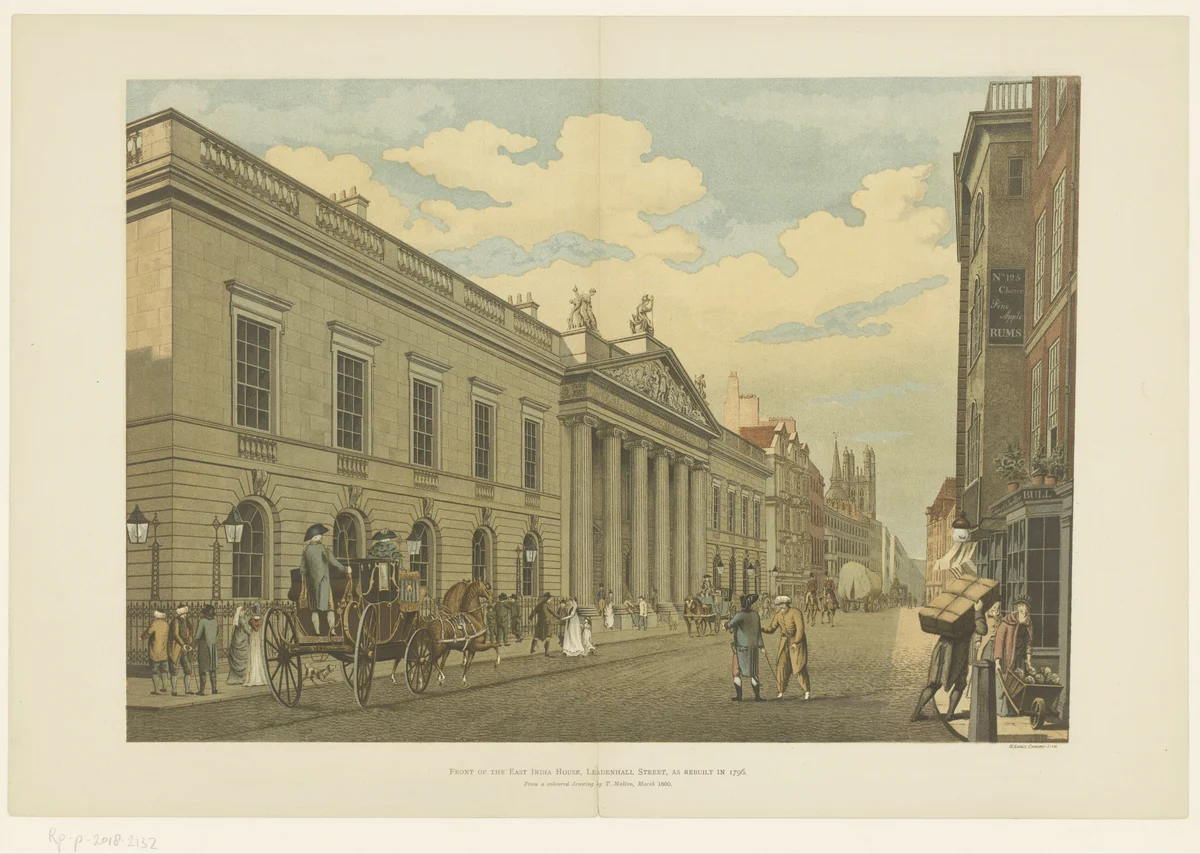
What the East India Company was founded to do
One original goal of the East India Company was to secure a monopoly over English trade with the East Indies. Elizabeth I’s founding charter of 1600 created a corporation of London merchants for that trade, and the evidence supports this commercial purpose without establishing an official list of three goals.
The word English defines the scope of the monopoly. The charter concerned who could conduct that trade on the English side. It did not give the merchants control over all commerce in the East Indies. The destination also matters. The charter described a trading region wider than India, even though the Company’s later authority in India is the focus of this timeline.
The British Library’s item record dates its copy of the founding letters patent to 31 December 1600. It names the Earl of Cumberland and 215 others as the people authorised to form the corporation and identifies Thomas Smith as its first governor. In this document, governor is a corporate office. The title belongs to the organisation of the merchant body and carries a different meaning from the later offices of governor-general and viceroy in India.
A worksheet may group trade, territorial expansion and government as three features of the Company’s history. The order matters if the question asks what the Company originally intended. The letters patent establish the merchant corporation, while Miles Ogborn’s study follows the development of commercial and administrative authority through the Company’s records. The founding charter is the place to start when the wording asks what the Company was created to do.
French East India Company in India: Pondicherry, Bengal and the transfers
Timeline of trade, territorial power and Crown rule
Read the timeline by asking what kind of power each date marks. The 1600 charter organised English merchants for overseas trade. The milestones of 1757 and 1764 belong to the Company’s rise as a territorial and political power. The diwani grant in 1765 identifies specific governing powers, and the 1858 statute identifies the authority that took over the Company’s government. These events answer different questions even when they appear together on a single timeline.
| Date | What changed or what the record establishes |
|---|---|
| 31 December 1600 | The founding letters patent authorised a corporation of London merchants for trade with the East Indies. |
| 1757 and 1764 | UK Parliament identifies both years as milestones in the Company’s rise to territorial and political power. |
| August 1765 | Shah Alam II granted the diwani to Robert Clive, conveying authority for revenue collection and civil justice in the provinces concerned. |
| 1773 | Parliamentary inquiries and legislation brought Company governance and finances under British state oversight. |
| 1813 | The East India Company Act marks a further stage of parliamentary regulation of the Company and its chartered trade. |
| 1833 | Parliament removed the remaining monopoly over the China tea trade and the Company continued to administer territory. |
| 1856 | Charles Canning became governor-general. |
| 1858 | The Government of India Act transferred the Company’s governing powers to the Crown. Canning became the first viceroy. |
| 1 November 1858 | A proclamation publicly announced Queen Victoria’s assumption of government. |
| 1873 to 1 June 1874 | The stock redemption statute set the corporate dissolution date. India Office stock records document the final administrative work. |
| 18 July 1946 | A House of Lords debate records public use of the Crown-jewel metaphor for India. |
Company records can narrow the story from an institutional timeline to a particular place. The British Library catalogues its factory records in geographic series. A factory in this context was often a trading station or establishment. If a record mentions a factory, check the location and series before picturing a manufacturing site or assuming that it did the same work as another station. The geographic series give readers a way to investigate a station’s actual functions.
Dates also need to be matched to the events a record describes. The British Library’s group catalogue gives a different day for the founding charter from the specific item record. For a day-level entry, use 31 December as given in the item record and identify the document as a copy. The year 1600 is enough when the question simply asks when the Company began. That level of precision also suits a timeline focused on the later changes in governing authority.
- British Library: Copy of Elizabeth I's Founding Letters Patent, December 31, 1600
- British Library: Benjamin West's Painting of the Diwani Grant
- UK Legislation: Government of India Act 1858 as Enacted
- British Library: Governor-General's Proclamation on the Government of India, November 1, 1858
- National Portrait Gallery: Charles John Canning
- UK Parliament: 1946 House of Lords Debate, The Mission to India
- UK Parliament: Parliament and the East India Company
- UK Legislation: East India Company Act 1813
- British Library: East India Company Factory Records
- British Library: East India Company Charters and Core Documents
- UK Parliament, East India Company and the Raj, 1785 to 1858
- Government of India Act 1858, enacted text
- East India Stock Dividend Redemption Act 1873, section 36
How the Company gained governing powers
The Company’s imperial role in India involved the acquisition and exercise of territorial and political authority. UK Parliament’s history identifies 1757 and 1764 as milestones in that rise. The grant of August 1765 gives a more precise way to describe what this meant in practice. According to the British Library, Mughal emperor Shah Alam II conveyed the diwani to Robert Clive. The grant concerned revenue collection and civil justice in the provinces to which it applied.
Revenue collection meant exercising authority over public income in the provinces concerned. A merchant’s receipts from sales came from transactions, while revenue under the diwani came from the exercise of an assigned public power. Civil justice added authority in civil matters. These functions explain how a company with a commercial origin also came to govern. The geographic qualification matters because the powers described in the grant applied to the relevant provinces, and the record alone cannot establish the extent of Company authority elsewhere.
A search for Allahabad and August 1765 can lead to an original treaty that answers a different question. The British Library describes the treaty of 16 August as an agreement in Persian and English between the Company and the Nawab Wazir of Oudh. It bears the Mughal emperor’s seal and concerns Oudh and an indemnity. To identify the instrument, read the named parties and the terms together. The date, place and presence of the imperial seal are insufficient to identify that treaty as the emperor’s separate grant of the diwani.
The image associated with the grant answers a question about portrayal. The British Library identifies its subject as Shah Alam II conveying the diwani to Clive, but the surviving artwork is a later copy of a commissioned painting by Benjamin West. Use the catalogue’s description to identify the portrayed event and the kind of authority conveyed. The image can show how the encounter was represented. It cannot independently establish who stood where, what people wore that day or the appearance of the setting.
How Parliament regulated the Company before 1858
British state oversight began while the Company still exercised governing authority. UK Parliament’s history records inquiries and new laws in 1773 that treated Company governance and finances as matters for parliamentary attention. That date belongs in the story of imperialism in India because it marks a change in who scrutinised the Company’s conduct. It also explains why a reference to British government involvement can be accurate for a period when the East India Company still governed.
The East India Company Act of 1813 supplies another dated point in that relationship. It belongs to the history of Parliament regulating the Company and trade within its charter limits. For a question about what merchants could do in a particular market after 1813, consult the statute’s provisions on the trade at issue. The date and title identify the relevant enactment, while the text is needed to support any claim about which trade rules changed and how far the change reached.
Suppose a reading passage refers to the British government taking responsibility for the Company’s conduct. If the passage is about Parliament examining the Company’s finances or regulating its governance, 1773 is the relevant date in this timeline. If it says that the Crown took over the government of the Company’s territories, look to the 1858 Act. The verb in the passage helps distinguish parliamentary oversight of Company government from a legal transfer of the powers the Company had exercised.
Parliament’s institutional history describes the 1813 charter renewal as preserving administration and asserting Crown sovereignty over Company territories. It dates the end of the remaining China tea monopoly to 1833. The Company’s history therefore has several turning points. Trading privilege ended in one phase, governmental power was transferred in 1858 and the legal entity still had financial affairs to wind up after that transfer.
Why Britain appointed viceroys in India
Britain appointed viceroys to represent the Crown in governing India under the arrangement that began in 1858. Charles Canning became the first viceroy that year, having become governor-general in 1856. If a question begins with the broad phrase ‘beginning in the 1800s,’ 1858 is the useful date to supply. Canning’s two appointments show how someone already in office could serve through a change in the authority under which India was governed.
The Government of India Act 1858 transferred the government of the Company’s territories and associated powers to the Crown. It established a secretary of state assisted by a Council of India. Those offices help explain the structure behind the viceroy’s role. Canning represented Crown government in India, while the secretary of state and council formed part of the governmental arrangement created by Parliament. For a question about which body the Act established, the statute is more direct evidence than Canning’s biography.
The public announcement has a separate date and record. The British Library catalogues the governor-general’s proclamation concerning Queen Victoria’s assumption of government on 1 November 1858. Use that day when the question is about the proclamation. Use the Act when it asks what transferred the powers. If a question asks when the Company ceased to exist as a corporation, that requires evidence for its later dissolution. The end of Company government answers a narrower question about who exercised governing authority.
- British Library: East India Company Charters and Core Documents
- UK Legislation: Government of India Act 1858 as Enacted
- British Library: Governor-General's Proclamation on the Government of India, November 1, 1858
- National Portrait Gallery: Charles John Canning
- Government of India Act 1858, enacted text
When was the East India Company dissolved?
The Government of India Act of 1858 transferred government to the Crown. The Company still appeared in later legal and financial records because stock and dividend business remained. In March 1873, the sponsor of the redemption bill in the House of Commons described the separate milestones of commercial activity, government and legal dissolution.
Section 36 of the East India Stock Dividend Redemption Act 1873 set 1 June 1874 for the remaining powers to cease and the Company to be dissolved, subject to the Act’s provision for unclaimed dividends. The British Library catalogue contains a volume of commutation records with a January 1874 advertisement to shareholders and stock applications. They show why a Company-related document can carry a date after the start of direct Crown rule.
Why India was called the jewel in the crown
British imperial accounts called India the ‘jewel in the crown’ because of its economic importance to Britain and the prestige Britain attached to ruling it. The image of a prized jewel describes how imperial speakers valued India within the empire. When explaining the phrase, specify whose viewpoint it expresses. The valuation belonged to the people invoking the imperial metaphor, and it tells the reader what they considered valuable about holding power in India.
The House of Lords debate on the Mission to India on 18 July 1946 supplies a dated instance of public parliamentary use of the metaphor. It shows that the expression circulated by then. Establishing its first use would require earlier dated sources and evidence of who used it, including whether a speaker was quoting someone else. For the meaning of the phrase, the institutional history from Historic Royal Palaces explains the economic importance and prestige behind it. For a documented instance of usage, the parliamentary transcript is the direct record.
Keep that parliamentary example in its own period when answering a question about Company motives. It comes from a debate on India decades after the 1858 transfer. The UK National Archives’ collection on Indian independence provides original material for this later period of British rule. It gives readers a place to investigate the political context of a late imperial phrase. The founding letters patent belong to an earlier question about the commercial purpose of a corporation created in 1600.
How to verify an archive caption or flag identification
An archive catalogue can describe several dates associated with one object. Before using a record for a visual timeline, check the date of the event, the date or approximate date of the object, and its status as an original, copy or reconstruction. The British Library’s collection description distinguishes the period of Company operation from documents compiled or retained later. The item description is where a reader can check which date belongs in the timeline and which belongs in the image caption.
The striped ensign at Royal Museums Greenwich illustrates the distinction. The museum classifies the object as a copy made from a design supplied around 1911 by William Foster, an India Office Records official. If an image search labels it a seventeenth-century Company flag, check the museum’s object description before repeating the label. A caption can identify the design as a Company ensign and identify the pictured object as a later reconstruction. Both details matter when readers are using the image to date an artefact.
A flag resource serves a distinct purpose when the reader wants to identify the ensign or understand the provenance of a pictured example. The dated charter, grant and legislation carry the narrative about governing authority. The museum’s object record is the appropriate place to check the ensign’s attribution and collection credit. If the image is to be published, confirm the terms for that specific reproduction and intended use. The catalogue credit identifies the collection, while permission depends on the asset selected.
Sources
- British Library: East India Company Charters and Core Documents
- UK National Archives: Indian Independence, Part Two
- British Library: Copy of Elizabeth I's Founding Letters Patent, December 31, 1600
- University of Chicago Press: Miles Ogborn's Research on the English East India Company
- British Library: Benjamin West's Painting of the Diwani Grant
- UK Legislation: Government of India Act 1858 as Enacted
- British Library: Governor-General's Proclamation on the Government of India, November 1, 1858
- National Portrait Gallery: Charles John Canning
- Historic Royal Palaces: India and the Jewel in the Crown Phrase
- UK Parliament: 1946 House of Lords Debate, The Mission to India
- UK Parliament: Parliament and the East India Company
- British Library: August 1765 Treaty of Allahabad with the Nawab Wazir of Oudh
- UK Legislation: East India Company Act 1813
- Royal Museums Greenwich: East India Company Ensign, Collection Object
- British Library: East India Company Factory Records
- UK Parliament, East India Company and the Raj, 1785 to 1858
- Government of India Act 1858, enacted text
- House of Commons Hansard, stock dividend redemption debate, 26 March 1873
- East India Stock Dividend Redemption Act 1873, section 36
- British Library, Commutation of East India Stock, volume one