The company's early foothold in Pondicherry
France chartered the Compagnie française des Indes orientales in August 1664. In Pondicherry, the local gazetteer records Bellanger’s arrival in 1673 and François Martin’s arrival in 1674. Martin then developed the trading post. The French commercial company changed through several corporate forms, while French-administered territories in India followed a separate history that extended into the twentieth century.
The district administration's history gives Pondicherry a specific place in the company's story. It names Martin, identifies a year and describes an activity. That makes 1674 useful when explaining the development of the commercial centre. The wording also matters. A date for the development of a trading station leaves open when individual premises opened, when particular trade arrangements began and how the company acquired access to the land it used. Each of those questions calls for more specific evidence.
For a reader in present-day Puducherry, the account provides a way to connect the city with the seventeenth-century company at the scale of the settlement. A claim about a particular site needs a finer grain of evidence. The district history can explain why Pondicherry belongs in a discussion of the French East India Company. Locating Martin's activities within the modern city would require a record that specifies a place and enough information to match that place to today's streets or properties.
The Bibliothèque nationale de France identifies a founding edict dated 4 August 1664. The Lorient museum separately dates the royal declaration of privileges to 27 August. That gives two document dates for the founding month. Use August 1664 for a short timeline and name the document if you give the day. France’s overseas archives also identify a trading post in Surat by 1668. The move into Pondicherry was a later foothold on the Coromandel coast.
- District Administration of Puducherry: History
- Bibliothèque nationale de France — the charter and trading companies
- Musée de la Compagnie des Indes, Lorient — three distinct corporate phases
- Bibliothèque nationale de France authority record — Compagnie des Indes after 1719
- Archives nationales d’outre-mer — company organisation memorandum around 1719
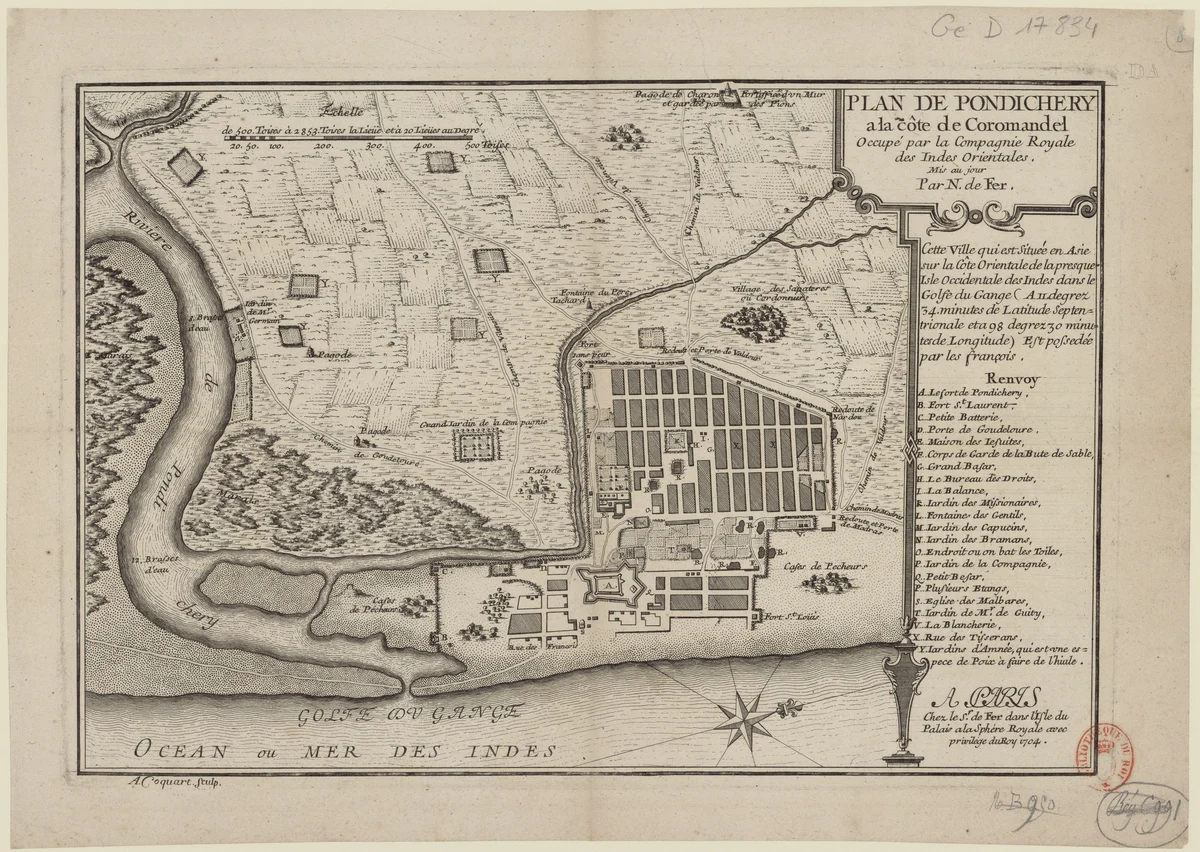
- Public-domain engraving — Nicolas de Fer's plan of Pondicherry, BnF 1704 impression
What the date 1674 tells you
The district history uses the 1670s to place the company's early permanent presence and 1674 to date Martin's development of Pondicherry as a commercial centre. The two references work at different scales. One locates an early phase of the company's activity within a decade. The other attaches a specific year to an episode in the history of one place. A short chronology can use both if each date keeps the description that goes with it.
A commercial centre raises questions about who traded there, which goods passed through and how transactions were arranged. Those details would give the description economic substance, and each would need evidence beyond the district account used here. Cargo records could describe shipments, correspondence could explain a trading decision, and local agreements could illuminate the terms under which the company operated. A record of a particular shipment would support a claim about that shipment, with a wider account of trade depending on evidence across a longer period.
Suppose a walking-tour label gives 1674 as the date a specific warehouse was built. Start by checking where the label got the year. If it points to the district history's account of Martin, that supports the year as part of the town's commercial history. A dated building record, a contemporary plan that identifies the structure, or a heritage assessment explaining the basis for its date could support the more specific warehouse claim.
The Puducherry gazetteer dates permission to use the former Danish lodge to November 1672 and Bellanger de l’Espinay’s landing to 4 February 1673. François Martin arrived on 14 January 1674 and became chief in May 1675. The local history uses 1674 for the development of the French settlement. These dates identify the permission, occupation and development of the post, so they can all appear on the same timeline.
Dutch occupation interrupted French rule at Pondicherry from 1693. The Treaty of Ryswick in 1697 and the actual return in September 1699 mark separate events. The 1704 plan on this page belongs to the years after that return. The heading names the French East India Company and the Coromandel coast. The date describes this impression of the map, so use the gazetteer to establish the earlier events.
Follow Pondicherry and Chandernagor in the archives
The French overseas archives' finding aid for the French establishments in India indexes several localities, including Pondichéry and Chandernagor. Pondichéry is the spelling to try when looking for Pondicherry in that French catalogue. Begin with the indexed names when exploring the scope of the records. The place index gives you separate starting points, so you can ask how the history of one post relates to another and see where the underlying documents might support a comparison.
The evidence available for the two places has different levels of detail. For Pondicherry, the district history provides a dated account of commercial development under Martin. For Chandernagor, the finding aid gives a place entry and a route into the records. Establishing when company activity began there, what role the post played, or how its relationship with Pondicherry changed requires reading dated material for Chandernagor itself. Any comparison should identify the period and the particular activity being compared.
Suppose you want to compare how the two posts handled a particular category of trade. Build the comparison around documents for both places from the same period and check whether they record the same kind of activity. A letter proposing a shipment and an account recording one answer different questions. If all you have for one locality is a reference in the index, keep that entry as a lead and leave the comparison open.
In Bengal the district and BnF tell a complementary story. The BnF records a land transaction in 1673–74, Bourreau-Deslandes’s installation in 1689 and work on a lodge starting in April 1690. Hooghly District uses 1688 for the permanent French settlement. Read each date with its associated event. The same town appears as Chandernagor or Chandernagore in historical documents and as Chandannagar in local records.
BnF’s eighteenth-century overview connects Pondicherry with Coromandel cotton cloth, Chandernagor with Bengal textiles, and Mahé with Malabar pepper. Use the place and commodity together to read the commercial geography. The 1763 Treaty of Paris refers to restoration of French trading factories and includes separate limits affecting Bengal and other coasts. It supplies a state agreement about trading posts, while the archives supply the commercial records of the companies using them.
- District Administration of Puducherry: History
- Archives nationales d’outre-mer: French Establishments in India
- Bibliothèque nationale de France — France in India in the eighteenth century
- Bibliothèque nationale de France — Chandernagore and French Bengal
- Hooghly District Administration — Chandannagar settlement chronology
- Treaty of Paris, 10 February 1763 — Article XI, University of Ottawa transcript
Company trade and the later territorial transfer
The district history distinguishes the early trading station from the transfer of French-administered territory after Indian independence. Read those episodes with attention to the institution involved. The early passage is about a company and the development of its commercial centre. The later passage concerns administered territory and its transfer. The continuing place name connects the episodes geographically, while the events call for different kinds of records and different language.
For an account of the transfer, establish what the date in each source refers to. A date attached to an agreement can refer to its signing or to the point at which it took effect. A date attached to a local account can refer to a change in administration or to the public observance of that change. Assign any precise date to the event the source actually identifies. The district history supports the broad sequence here, with Indian independence preceding the transfer.
Suppose a museum panel gives one transfer year and a commemorative publication gives another. Copy the verbs around each date before trying to reconcile them. A panel that describes who took over administration and a publication that describes the effect of an agreement may be discussing different stages. To decide, look for the official record each account relies on and check which places it covers. Leave both dates attached to their stated events until the records establish the relationship.
Chandernagore followed its own path to India. The United Nations treaty record notes the 19 June 1949 consultation and an Indian administrator from 2 May 1950. The cession treaty was signed in Paris on 2 February 1951 and entered into force on 9 June 1952. India’s Chandernagore (Merger) Act puts the internal merger into West Bengal on 2 October 1954. Keep the provisional administration, sovereign cession and state merger distinct.
For Pondicherry, Karikal, Mahé and Yanam, the 21 October 1954 agreement transferred administration from 1 November. The separate Treaty of Cession was signed in New Delhi on 28 May 1956. The Pondicherry (Administration) Act identifies 16 August 1962 as its entry into force. The French authorisation of ratification is another dated record, on 28 July 1962. When a place account gives only 1954 or 1962, check which stage it means.
- District Administration of Puducherry: History
- Treaty of Paris, 10 February 1763 — Article XI, University of Ottawa transcript
- Archives nationales d’outre-mer — company and French establishments research guide
- United Nations Treaty Series no. 2744 — Chandernagore cession treaty
- India Code — Chandernagore (Merger) Act, 1954
- United Nations Legislative Series — the four establishments' 1954 and 1956 agreements
- India Code — Pondicherry (Administration) Act, 1962
- Légifrance — French authorisation of ratification, Law 62-862
Keep the French and British companies identifiable
The phrase East India Company on its own can obscure which company a passage is about. For Pondicherry in 1674, the district history's reference is to the French company and François Martin. If a book, caption or search result uses the shorter phrase, read the surrounding text for the company name, the place and the action. A caption may have room for only a few words, while the catalogue entry or the main text may identify who acted.
A claim that brings the French and British East India companies into the same episode needs a source that identifies the participants and their roles. Look for who issued the instruction, who received it and who carried it out. A letter preserved in a French collection might describe another institution's actions. The French archive's place index can lead to material about Pondicherry, but identifying the parties to an event requires reading the document or a reliable account of its contents.
Suppose an exhibit groups several reproductions under a heading about European companies and dates one using a reference to Pondicherry. Read the individual caption for the creator, then check whether the date belongs to the original document or to the event described in it. You can use the district account to orient yourself in the town's early French commercial history. Any claim about British participation in the particular event needs its own documentary support.
The corporate history also has several dates. John Law’s 1719 consolidation brought the older East Indies company together with other trading companies. The resulting Compagnie des Indes lost its monopoly in 1769. Lorient’s museum identifies a later company formed under Calonne in 1785 and abolished in 1793. A nineteenth-century record for Pondicherry can document continued French administration without referring to an operating seventeenth-century company.
East India Company in India: trade, rule and dissolutionModern India after independence: a timeline from 1947
- District Administration of Puducherry: History
- Archives nationales d’outre-mer: French Establishments in India
- Bibliothèque nationale de France — the charter and trading companies
- Musée de la Compagnie des Indes, Lorient — three distinct corporate phases
- Bibliothèque nationale de France authority record — Compagnie des Indes after 1719
Check a building, map or museum label
In Puducherry, separate the history of the plot from the history of the building you can see. A site may have had several uses, and a building may have been altered or replaced. If a label connects an address with the French East India Company, look for the part of the claim that can be checked. It might concern who occupied the site, when construction took place or which features survive. Those details each describe a different aspect of the property's history.
Suppose a heritage description says a present building stands on land formerly used by the company. Ask whether it identifies the historical property on a map or by a boundary description, then look for a source that matches the historical parcel to the current address. For a question about surviving fabric, consult the description of the building itself. The district chronology can supply context for interpreting the attribution, and the archival place entry can help you find more detailed records.
When a claim appears on a map, read the legend and the catalogue description together. A date in the catalogue could be the date of the map, a later copy or the period the map reconstructs. The map's scale affects what you can identify. A town plan might locate a street or compound, while identifying a building may require a more detailed plan or a matching property record. For a visit, check the current access information with the venue or custodian responsible for the site.
| Date | Scope | Record or event |
|---|---|---|
| August 1664 | French company | Founding edict and separate privileges declaration |
| 1673–75 | Pondicherry | Bellanger at the lodge, Martin’s arrival and later appointment |
| 1688–90 | Chandernagor | Permanent settlement, installation and construction dates in district and BnF records |
| 1719 | French company | John Law’s consolidation of trading companies |
| 1769 | French company | Loss of the eighteenth-century company monopoly |
| 1785–93 | French company | Calonne’s successor company and abolition |
| 9 June 1952 | Chandernagore | Sovereign cession took effect |
| 2 October 1954 | Chandernagore | Merger with West Bengal |
| 1 November 1954 | Remaining four establishments | India assumed administration |
| 16 August 1962 | Remaining four establishments | Treaty of Cession entered into force |
For a surviving collection, Hooghly District identifies the Chandannagar Museum and Indo-French Institute and its French East India Company gallery. Read the collection entry for what it records about the past and confirm opening and access directly if planning a visit. For the Pondicherry map, Gallica’s impression is dated 1704. Portugal’s National Library dates its separate impression to 1705. Cite the date and holding institution of the version you are looking at.
- District Administration of Puducherry: History
- Archives nationales d’outre-mer: French Establishments in India
- Hooghly District — Chandannagar Museum and Indo-French Institute
- Public-domain engraving — Nicolas de Fer's plan of Pondicherry, BnF 1704 impression
- National Library of Portugal — catalogue of the De Fer engraving
Turn a catalogue entry into a verifiable reference
The French overseas archives' finding aid also points to complementary diplomatic archives for India. Follow that reference when the question concerns official relations or when the local entry points beyond the material described in the finding aid. Record the repository, collection title and any reference number the catalogue provides. Those details let you relocate the description and give an archivist a concrete starting point if access requires a request.
When you find a promising entry, check the level at which it describes the records. An entry for a group of documents can cover several places and years. Its date range describes the group, so look at the individual item before assigning a precise date to an episode. In the item itself, check who created it and why. A contemporary account, an enclosure and a later copy can appear together, and the origin of the passage you rely on matters for interpreting it.
Suppose a search returns a catalogue description that mentions both Pondichéry and Chandernagor. Save the reference and identify which document discusses each place. Even within a single file, the relevant passages may concern separate matters. If the catalogue entry is visible but the document image is missing, check the repository's current consultation or reproduction instructions. Until you can inspect the item, cite the description for what it actually establishes and keep the historical claim as a question for the record.
Sources
- District Administration of Puducherry: History
- Archives nationales d’outre-mer: French Establishments in India
- Bibliothèque nationale de France — the charter and trading companies
- Musée de la Compagnie des Indes, Lorient — three distinct corporate phases
- Bibliothèque nationale de France authority record — Compagnie des Indes after 1719
- Archives nationales d’outre-mer — company organisation memorandum around 1719
- Puducherry Gazetteer, Modern Period — local grant, early personnel and Dutch interlude
- Bibliothèque nationale de France — France in India in the eighteenth century
- Bibliothèque nationale de France — Chandernagore and French Bengal
- Hooghly District Administration — Chandannagar settlement chronology
- Treaty of Paris, 10 February 1763 — Article XI, University of Ottawa transcript
- Archives nationales d’outre-mer — company and French establishments research guide
- United Nations Treaty Series no. 2744 — Chandernagore cession treaty
- India Code — Chandernagore (Merger) Act, 1954
- United Nations Legislative Series — the four establishments' 1954 and 1956 agreements
- India Code — Pondicherry (Administration) Act, 1962
- Légifrance — French authorisation of ratification, Law 62-862
- Hooghly District — Chandannagar Museum and Indo-French Institute
- Public-domain engraving — Nicolas de Fer's plan of Pondicherry, BnF 1704 impression
- National Library of Portugal — catalogue of the De Fer engraving
