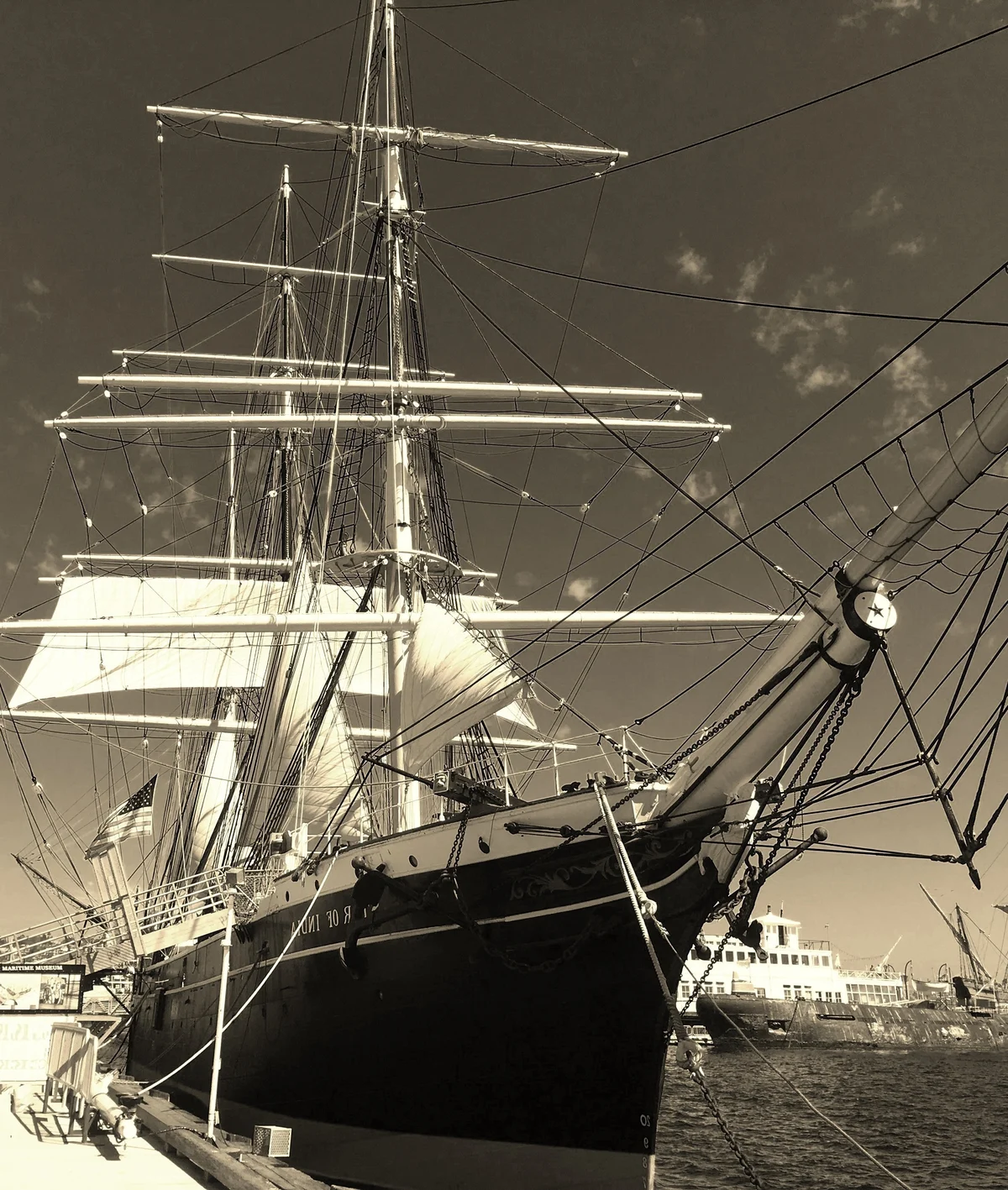
Why the ship is associated with India
The Star of India’s connection to India comes from six early cargo voyages made under its original name, Euterpe, including a documented round trip from Liverpool to Calcutta. Launched at Ramsey on the Isle of Man on 14 November 1863, the ship took its present name in 1906 during its Alaska Packers Association career and is now berthed at the Maritime Museum of San Diego.
Three places establish the ship’s provenance. Ramsey was where Gibson, McDonald & Arnold built the iron hull. Liverpool was the homeport the museum archive lists for 1864–1867 and the English port named in the account of the first India round trip. Calcutta, now Kolkata, was a destination in the ship’s early trading career. San Diego belongs to the later preservation story.
The vessel had already spent decades under the name Euterpe before the Alaska Packers Association renamed it to match its fleet. The museum’s finding aid and the detailed National Historic Landmark registration papers both give 1906 for the change. The shorter summary in those registration papers compresses the acquisition and renaming into a sentence dated 1901. The detailed chronology assigns 1901 to the acquisition and rig conversion.
For a caption or family-history note, use Euterpe when describing the India voyages and give Star of India as the name under which readers can find the ship today. That wording lets a reader search period records under the name the ship carried at the time. The city’s 1883 photograph record also uses Euterpe, by then in the New Zealand phase of its career.
- Maritime Museum of San Diego, Star of India ship history and exhibits
- Maritime Museum of San Diego, Star of India sail training manual, historical summary and rig vocabulary
- Maritime Museum of San Diego, Euterpe and Star of India original documents collection
- City of San Diego digital archives, Euterpe in New Zealand and launch date
- US National Park Service, Star of India National Historic Landmark designation and interpretation
- US National Park Service, historical registration papers for Star of India
The Liverpool to Calcutta round trip
Captain William Storry first departed England on 9 January 1864. A collision forced him back to Liverpool. The museum’s ship history also records a mutiny during the first voyage, and its training manual says a new crew sailed after repairs. Those events explain why an account of the first departure can start with an interrupted passage even though the ship went on to complete its first India round trip.
The museum training manual identifies the completed voyage as Liverpool to Calcutta and back and gives 18 months for the round trip. It describes the historical England–India cargo trade via the Cape of Good Hope. The destination and direction are clear for this round trip. The duration covers the voyage as a whole, and the manual’s description of the trade route supplies context for the passage without enumerating every call.
Write the outward and return directions separately when describing the voyage. Liverpool to Calcutta is the outward leg. Calcutta to Liverpool is the return. A reference to an 18-month journey from Liverpool to Calcutta alone would assign the entire round-trip duration to one leg. The available account gives no basis for allocating that time between the two passages, repairs and time in port.
The archive associates the India voyages with jute. The training history describes the later India voyages as carrying general cargo. Those statements work at different levels. One identifies a commodity associated with the India trade, while the other describes the broader cargo service. A claim about the quantity of jute or which leg carried it requires documentation for a specific shipment.
The cyclone voyage and four later India voyages
The second voyage has a different record. A cyclone in the Bay of Bengal forced Euterpe away from Madras, now Chennai. The museum manual records subsequent repair work at Trincomalee and Calcutta. Trincomalee is in present-day Sri Lanka and appears here in the repair history. Madras belongs to the account of the cyclone, and Calcutta appears again as a place where the ship underwent repairs.
Storry died during the return passage and was buried at sea. His death belongs to the homeward part of the second voyage, after the damage and repairs. The known sequence can anchor an account of what happened even when a complete sailing itinerary is unavailable. A map should distinguish the first voyage’s documented endpoints from the places named in the second voyage’s storm and repair account.
The manual identifies East India merchant David Brown as the subsequent purchaser. It credits his captains with another four India voyages carrying general cargo. Together with the two voyages under Storry, that makes six in the museum’s account. The count supports a history of repeated commercial service, and the published evidence gives much more detail about the first two voyages than it does about the four that followed.
To describe an individual voyage under Brown, start with a vessel name, a port and an approximate year, then look for a dated arrival or departure record. Add a cargo description only where a manifest or comparable record gives one. The published histories already establish the four voyages as a group. Individual port sequences, dates and cargoes remain separate research questions.
Kolkata travel guide: museums, Howrah and KumartuliIndian Ocean map: seas, coasts and islands around India
How to check a route, cargo or name claim
Start with the museum training manual for a narrative of the first two voyages and the original documents collection finding aid for the scope of surviving material. The collection spans 1879 to 1986 and is open for research. Its listed date range begins well after Euterpe’s first India departure, so a relevant-sounding document category in the finding aid is only a starting point for research into an early voyage.
The finding aid lists bills of lading, crew lists, navigational notes, vessel surveys and Alaska Packers fleet records. Choose the record by the claim you need to establish. A bill of lading can identify a consignment, while a dated port record can place a vessel at an arrival or departure. Even a genuine bill of lading covers the goods described in that document. Use its date and ports to place it in the correct voyage before drawing a wider conclusion about the trade.
If a family note places a sailor aboard Star of India at Madras, search for Euterpe and use the storm account to narrow the period. A match between the modern ship name and the place in the family note provides a lead. A dated crew record or employment agreement naming the sailor and vessel would give the identification firmer support. The museum’s later collection may still help trace ownership or names while you seek earlier records elsewhere.
| Claim | Starting record | Detail to verify |
|---|---|---|
| First India round trip | Museum sail training manual | Liverpool to Calcutta and back, with 18 months given for the round trip |
| Cargo on a particular passage | Dated bill of lading or manifest | Vessel name, goods, loading port and destination |
| Euterpe name in the New Zealand years | City of San Diego photograph record | Catalogue date of 1883 and identification as Euterpe |
| Date of the Star of India name | Museum finding aid and detailed landmark continuation sheet, reference 66000223 | 1906 renaming and 1901 acquisition as separate events |
Star of India sapphire: origin, weight and the 1964 theft
- Maritime Museum of San Diego, Star of India sail training manual, historical summary and rig vocabulary
- Maritime Museum of San Diego, Euterpe and Star of India original documents collection
- City of San Diego digital archives, Euterpe in New Zealand and launch date
- US National Park Service, historical registration papers for Star of India
Where the New Zealand and Alaska voyages fit
Shaw Savill bought Euterpe in 1871. The museum treats 1871–1897 as a separate operating period, during which the ship carried emigrants to New Zealand for about a quarter-century. It records 21 circumnavigations in this service, with occasional calls in Australia, California and Chile. Those calls show the geographic reach of that phase. A passenger’s actual route still depends on the sailing they boarded.
| Date or period | Name in use | Documented milestone |
|---|---|---|
| 14 November 1863 | Euterpe | Launched at Ramsey on the Isle of Man |
| From 1864 | Euterpe | India cargo service, including the Liverpool–Calcutta round trip |
| From 1871 | Euterpe | Shaw Savill’s New Zealand emigrant service |
| 1901 | Euterpe | Alaska Packers acquisition and change to a barque rig |
| 1906 | Star of India | Renamed during the Alaska Packers era |
| 1923 | Star of India | Finished the Alaska fisheries phase |
| 1976 | Star of India | Sailed again for the US Bicentennial |
The steerage area aboard the museum ship is a useful place to consider the New Zealand emigrant service. For a person or family inquiry, the 1883 image catalogue can help establish the ship’s name during that period. A passenger list or other record tied to a dated sailing would be the evidence to look for when tracing someone’s embarkation or arrival.
The Alaska Packers Association acquired the vessel in 1901. Seasonal California–Alaska voyages began in 1902, carrying supplies and workers north to the fisheries and cases of canned salmon south. The museum archive also reports lumber, sugar and coal in the later Pacific trade. Keep those commodities attached to the period and route supported by the record, especially when using them alongside references to jute in the India years.
The National Park Service dates the end of the ship’s fishing-industry voyages to 1923. Preservation in San Diego began with its purchase in 1926, and the museum archive credits the Star of India Auxiliary, formed in 1959, with advancing restoration. The ship returned to sea in 1976 as part of the United States Bicentennial. The waterfront exhibit is the product of that preservation effort.
- Maritime Museum of San Diego, Star of India ship history and exhibits
- Maritime Museum of San Diego, Star of India sail training manual, historical summary and rig vocabulary
- Maritime Museum of San Diego, Euterpe and Star of India original documents collection
- City of San Diego digital archives, Euterpe in New Zealand and launch date
- US National Park Service, Star of India National Historic Landmark designation and interpretation
- Maritime Museum of San Diego | Euterpe and Star of India history
What to look for aboard the ship
From the waterfront, find the three masts and look for the yards that carry square sails on the foremast and mainmast. The rear mast, called the mizzenmast, has a fore-and-aft rig. That arrangement makes the vessel a barque in its present configuration. A full-rigged ship has square sails on all three masts. The Alaska Packers Association’s 1901 conversion changed the sail arrangement on the existing hull.
The museum exhibits cargo and steerage areas. In the cargo area, use the contrast between the India trade and the later salmon runs to ask what the vessel carried on a given passage. In steerage, use the New Zealand emigrant years to frame questions about how passengers occupied a working ship. Exhibit labels can show which period an object, reconstruction or display depicts.
The landmark registration records a length of 205 feet and a size of 1,200 gross tons for the iron-hulled vessel. If a display or another reference gives a different length, check what the two figures measure. A stated hull length and an overall length that includes projecting spars use different endpoints.
- Maritime Museum of San Diego, Star of India ship history and exhibits
- Maritime Museum of San Diego, Star of India sail training manual, historical summary and rig vocabulary
- Maritime Museum of San Diego, Euterpe and Star of India original documents collection
- US National Park Service, Star of India National Historic Landmark designation and interpretation
- US National Park Service, historical registration papers for Star of India
Plan a dockside visit in San Diego
The Star of India is a United States National Historic Landmark at the Maritime Museum of San Diego, 1492 North Harbor Drive. The museum posts daily hours of 10:00 to 17:00, with last entry at 16:00. Admission includes the museum’s ships and exhibits, subject to temporary closures of individual vessels for maintenance or events. Children need an accompanying adult.
The posted adult price is US$28 at the waterfront and US$30.36 online with fees. The museum’s concession category is US$20 at the waterfront and US$21.69 online. Ages 6–17 cost US$15 at the waterfront and US$16.34 online, and ages five and under enter free. Check the admission page for current prices and concession eligibility before paying.
| Visitor | Walk-up price | Online price including fees |
|---|---|---|
| Adult | US$28 | US$30.36 |
| Museum concession | US$20 | US$21.69 |
| Ages 6–17 | US$15 | US$16.34 |
| Ages five and under | Free | Free |
For a same-day visit decided after breakfast, the posted online cutoff of 08:00 can matter more than the price difference. Walk-up sales continue until 16:00 under the posted terms. If Star of India is the reason for going, confirm the ship’s boarding status with the museum before travelling, particularly if you would arrive close to last entry.
The museum lists shorter docent-led options and a separately reserved fleet tour. Its private offer lists two hours on most weekdays at US$35 per person, with a US$350 minimum and two weeks’ notice. Check availability and whether the itinerary includes time aboard Star of India. The archive describes the ship as maintained in sail-ready condition. For a trip on the water, check the museum’s separate event listing for the vessel, boarding arrangements and ticket terms.
Sources
- Maritime Museum of San Diego, Star of India ship history and exhibits
- Maritime Museum of San Diego, Star of India sail training manual, historical summary and rig vocabulary
- Maritime Museum of San Diego, Euterpe and Star of India original documents collection
- City of San Diego digital archives, Euterpe in New Zealand and launch date
- US National Park Service, Star of India National Historic Landmark designation and interpretation
- US National Park Service, historical registration papers for Star of India
- Maritime Museum of San Diego, general admission and boarding
- Maritime Museum of San Diego, current guided tours
- Wikimedia Commons, Star of India in San Diego by MichaelEBM
- Maritime Museum of San Diego | Euterpe and Star of India history
