What the surviving records establish
The records reviewed provide no authenticated ancient evidence that Jesus travelled to India. Nicolas Notovitch’s 1894 account of a journey before Jesus’s ministry and Mirza Ghulam Ahmad’s account of a journey after the crucifixion document two distinct claims, with different chronologies and different evidence to assess.
The first claim places Jesus in India during a gap in the story of his early life. Its best-known source in these records is a book in which Notovitch says he learned of an account about Issa at Hemis monastery in Ladakh. The second claim places Jesus in Kashmir after the crucifixion and identifies a burial site in Srinagar. Evidence about one alleged journey would leave the other to be assessed on its own.
The dates on the records tell us when someone made a claim or challenged it. A Paris edition fixes Notovitch’s account in print by 1894. A signed statement from Hemis records what the abbot said in 1895 about the alleged encounter. The publication history of Mirza Ghulam Ahmad’s book traces when readers could encounter his account in Urdu and English. None of those dates establishes when the journeys described in the books took place.
- Institut national d'histoire de l'art catalogue for Nicolas Notovitch's 1894 Paris book
- Original published expedition testimony, Douglas and the Hemis abbot, transcribed alongside Müller's article
- Ahmadiyya Muslim Community original publisher and edition history for Jesus in India
- USCCB Bible text, Luke chapters 2 and 3
What Luke says about the years before the ministry
Luke 2:41–52 recounts an episode in Jerusalem when Jesus was twelve. Luke 3:23 gives his age as about thirty at the beginning of his ministry. Those passages supply the two markers behind the popular expression “lost years.” The word “about” matters if a retelling assigns exact ages to a proposed itinerary. Luke gives an approximate age at the second marker and provides no continuous itinerary between the two.
A gap in a narrative can explain why a later story has room to develop. It cannot single out a destination. A proposed stay in India may fit within the span between the two episodes, but fitting the interval gives the proposal no geographical support. Establishing a journey would require evidence that connects the person and the place, with a date or transmission history that puts the claim in historical context.
Suppose a timeline shows Jerusalem at twelve, India in the middle and the start of the ministry around thirty. To assess the middle entry, look at its citation independently of the two entries around it. Luke supports the ages on either side. If the middle entry leads to Notovitch, its documentary basis is the nineteenth-century account and the material he said lay behind it. The timeline’s tidy sequence can conceal that change in sources.
This textual gap is relevant specifically to a journey before the ministry. Once an account places the proposed journey after the crucifixion, the two ages in Luke cease to supply the interval the story is trying to explain. Check where the author places the journey before judging whether the cited passage even addresses it.
What Nicolas Notovitch reported at Hemis
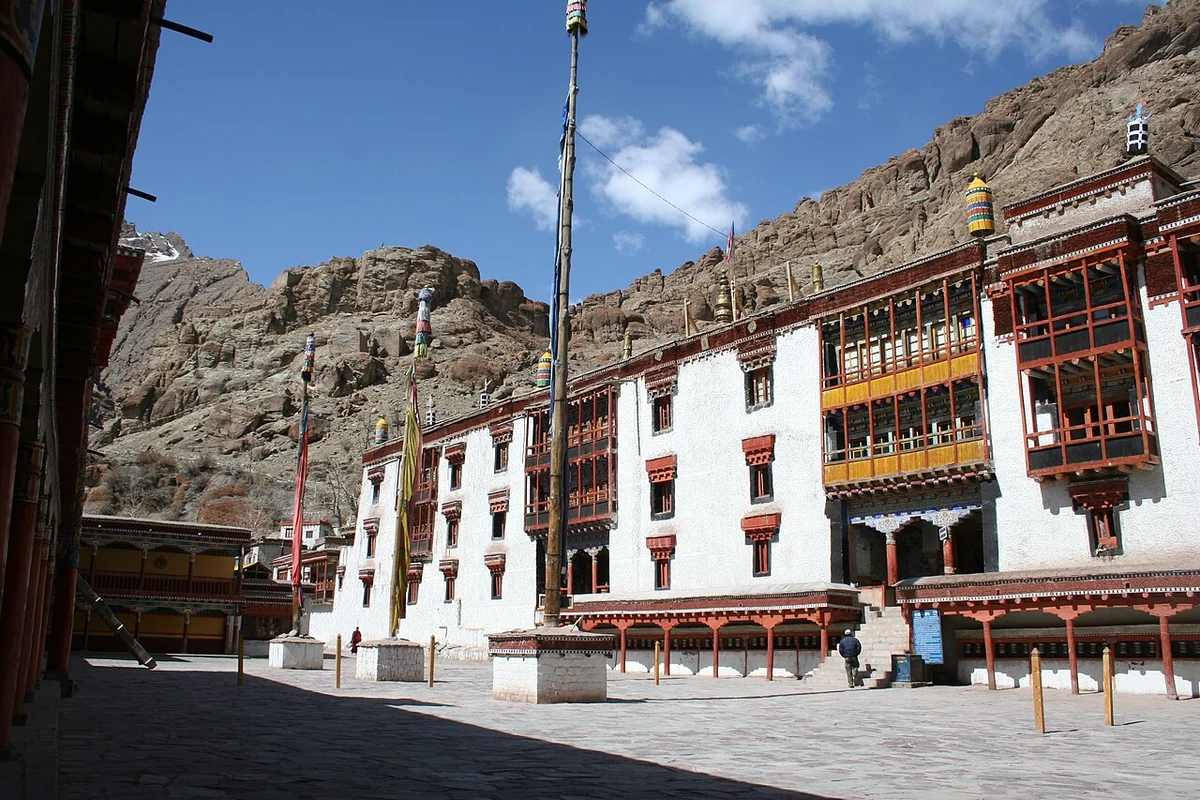
The Institut national d’histoire de l’art catalogues Nicolas Notovitch’s La Vie inconnue de Jésus-Christ as a Paris publication issued by P. Ollendorff in 1894. Notovitch identifies Issa with Jesus and presents a purported journey before the ministry. In his telling, he was recovering from a broken leg at Hemis when the chief lama read from Tibetan volumes and an interpreter conveyed their contents. That encounter is the route by which the account says the text reached him.
The route matters because each step raises a different question. The printed book can be inspected and dated. The oral interpretation is reported by the author. The purported Tibetan copy would need to be identified, and any earlier source behind it would need a documented relationship to that copy. Even a dated Tibetan witness would establish that the story existed by the date of that witness. A connection to the first century would still need its own evidence.
| Date or period | Record | Claim or subject | What kind of evidence it provides |
|---|---|---|---|
| Biblical narrative | Luke 2 and 3 | Jerusalem at age twelve and the beginning of ministry around thirty. | Text describing two points in Jesus’s life. |
| 1894 | Nicolas Notovitch, Paris edition | Pre-ministry travel manuscript claim. | A printed assertion with no independently identified ancient manuscript in the reviewed records. |
| October 1894 | Max Müller, The Nineteenth Century | Published criticism and questions about the claimed provenance. | A contemporary assessment of the story. |
| 3 June 1895, published April 1896 | Hemis abbot’s testimony in J. Archibald Douglas’s article | Douglas reported receiving the abbot’s signed and sealed account. | A dated counter-account of the alleged discovery. |
| 1908 Urdu, 1944 English | Mirza Ghulam Ahmad, Jesus in India | Separate account placing Jesus in Kashmir after the crucifixion. | Publisher’s edition history and statement of the belief. |
| 1922 trip, 1987 English edition | Swami Abhedananda, Journey into Kashmir and Tibet | Later travel account associated with Hemis traditions. | Publication and journey record, with separate dates. |
| 1929 work | Nicholas Roerich, Altai-Himalaya | Records Issa stories in a travel diary. | A later record of traditions |
A scan of the period French edition or the contemporary English edition lets a reader check what Notovitch put into print. Look at the passages where he describes the encounter as well as those where he presents the story of Issa. The first gives his explanation of how he obtained the material. The second gives the text as it reached his readers. The records reviewed supply no authenticated ancient original, catalogue reference or documented chain of transmission linking that passage to the first century.
Search results can divide the material between the spellings Hemis and Himis. Leh district’s current heritage entry uses Hemis for the Buddhist monastery in Ladakh, while the older spelling appears in the contemporary controversy. Searching both helps when tracing references. The district entry establishes the location and its heritage context. Confirmation of a particular manuscript would require a collection record or an equivalent way to identify and inspect it.
What Müller and Douglas could check
Max Müller challenged the account in “The Alleged Sojourn of Christ in India,” published in the October 1894 issue of The Nineteenth Century, volume 36, pages 515–522. He questioned the provenance and considered whether Notovitch himself might have been misled. That possibility matters when interpreting the challenge. A defect in the chain of evidence leaves open more than one explanation for how the story reached print.
J. Archibald Douglas pursued a question that could be put to people at the monastery. He reported visiting Hemis in 1895 and interviewing the abbot through Shahmwell Joldan, a retired Ladakhi postmaster. His article reproduces testimony signed and sealed at Hemis on 3 June 1895 and Joldan’s declaration dated 5 June 1895 in Leh. The article itself appeared in April 1896, in volume 39 of The Nineteenth Century, starting on page 667.
The abbot said he had served for fifteen years and denied that an injured European had stayed there in that period. He also denied that he or his monks had shown a life of Issa to a European visitor. Douglas expressly left open the possibility that Notovitch had simply visited Hemis. A visit, a stay while injured and access to a particular text are three different claims. The testimony addresses the circumstances that would explain how Notovitch obtained the material.
Douglas’s report gives direct counter-evidence about the nineteenth-century encounter and its alleged witnesses. Its reach ends there. The abbot’s statement supplies no ancient record about Jesus’s whereabouts. When checking a date from the online transcription, use the explicit dates on the signed statements and the institutional bibliography for the journal issue. The transcription has inconsistent years elsewhere, and the interview date and publication date refer to separate events.
How to read the later accounts of Issa
Nicholas Roerich’s Altai-Himalaya: A Travel Diary records and discusses legends about Issa, including stories associated with the Indus, Benares and the Himalayas. The Nicholas Roerich Museum gives 1929 as the original publication year and 2017 as the date of its hosted second edition. The diary documents the circulation of these stories in the twentieth century. A place name in a legend can show where the narrator situates the story. It does not independently establish a stop on an ancient route.
Swami Abhedananda’s Journey into Kashmir and Tibet presents a different problem for readers comparing citations. The trip took place in 1922. The American Alpine Club Library identifies the cited English translation as a 1987 Ramakrishna Vedanta Math publication. The English edition also includes a separately credited extract from Notovitch on pages vii–xxvii. The date of the trip, the date of that edition and the authorship of an individual passage each answer a different bibliographic question.
If an article cites Abhedananda for a passage on page xv, check the edition and the credit above the passage. In the cited English edition, that page falls within the separately credited Notovitch extract. Counting the passage as an additional witness would count the same printed account twice. A passage from Abhedananda’s own narrative would instead need to be evaluated according to what he says he saw, heard or read.
Accounts can add independent evidence of how widely a tradition circulated even when they cannot establish independent access to the original event. With a travel diary, check who supplied the story, what the writer says about its status and whether any physical text is identified. A dated account of a legend has value for tracing the legend. Establishing its age before that account requires a further source.
For the Kashmir claim, the Urdu and English publication years describe the edition history provided by Mirza Ghulam Ahmad’s publisher. The printed text records a distinct religious interpretation about Jesus after the crucifixion. A claim identifying a particular historic burial would need independently verifiable evidence linking the named person, the site and the period. A later guide can cite the text for the belief and the publication dates.
What the Srinagar burial tradition claims
Mirza Ghulam Ahmad’s Masih Hindustan Mein, published in English as Jesus in India, concerns a proposed journey after the crucifixion. The Ahmadiyya Muslim Community’s edition history dates the first Urdu publication to 1908 in Qadian and the first English edition to 1944, also in Qadian. The publisher describes a journey ending in Kashmir and a burial identification in Srinagar. The author’s text specifies the Khanyar quarter.
The community’s edition provides a direct source for explaining the belief in the terms used by the author and publisher. A historical identification of a burial has a different evidentiary basis. It would require a documented connection between the site and the particular person named. An address makes an identification more specific and easier to investigate. It cannot establish who was buried there. The publisher’s record supplies no archaeological identification of the grave.
Keep the journey and the burial identification distinct even when presenting them as parts of one account. Evidence that could date a structure would address the structure’s history. Evidence identifying an occupant or showing when that identification first circulated would address a different question. When reading a new account of the site, check which of these questions its underlying source actually answers and whether it gives enough information to find that source.
Hemis and Khanyar play different roles in the two narratives. Hemis is where Notovitch said he heard a text about an earlier journey. Khanyar is where Mirza Ghulam Ahmad locates a burial after a later journey. The abbot’s denial bears on the reported encounter at Hemis. Evaluating the burial identification calls for evidence specific to the Srinagar site and the history of its attribution.
How to verify a newly reported discovery
If a new report says the Hemis manuscript has been found, start with the named holding institution and ask what object the report identifies. Look for a shelfmark or inventory entry, a description of the language and physical manuscript, and the basis for any proposed date. An institutional description of the monastery can confirm the place. An inventory entry can confirm that a particular object is recorded there. A dated scholarly description would let readers evaluate what that object contributes to the claim.
Keep the date of the physical copy separate from the date attributed to the story. A proposed copy date concerns the surviving object. An earlier date for its contents requires evidence about transmission, such as an identifiable earlier witness or a documented relationship to another text. Where a translation identifies Issa as Jesus, check whether the identification appears in the underlying passage, as the translator’s interpretation or in later editorial material.
For a newly digitized source, verify the title page, edition and page numbers before relying on a search snippet. Digitization can make a historical item easier to inspect without changing when its testimony was first recorded. A page image can resolve whether a discrepancy comes from the printed source or a modern transcription. Bibliographic records for the journal can independently fix the issue date, while signed dates within the article identify when the testimony was given.
For a report about the Srinagar burial, look for the full institutional or scholarly record behind the announcement. Check what was examined, how it was dated and what supports the proposed identification. A record that dates the first known attribution can change the history of the tradition even if it leaves the occupant unidentified. The wording of any update should reflect that specific finding.
- Institut national d'histoire de l'art catalogue for Nicolas Notovitch's 1894 Paris book
- INHA Notovitch bibliography with the Müller and Douglas contemporary records
- Original published expedition testimony, Douglas and the Hemis abbot, transcribed alongside Müller's article
- Vedanta Society publisher record for Swami Abhedananda's Journey into Kashmir and Tibet
- Ahmadiyya Muslim Community original publisher and edition history for Jesus in India
- Leh district government heritage entry for Hemis
Sources
- Project Gutenberg: Nicolas Notovitch's The Unknown Life of Jesus Christ
- Institut national d’histoire de l’art: Max Müller's 1894 Response
- Institut national d’histoire de l’art: J. Archibald Douglas's 1896 Himis Account
- Institut national d'histoire de l'art catalogue for Nicolas Notovitch's 1894 Paris book
- INHA Notovitch bibliography with the Müller and Douglas contemporary records
- Original published expedition testimony, Douglas and the Hemis abbot, transcribed alongside Müller's article
- Nicholas Roerich Museum digital edition of Altai-Himalaya: A Travel Diary
- Vedanta Society publisher record for Swami Abhedananda's Journey into Kashmir and Tibet
- Ahmadiyya Muslim Community original publisher and edition history for Jesus in India
- USCCB Bible text, Luke chapters 2 and 3
- Leh district government heritage entry for Hemis
- Michael Day photograph of Hemis Monastery, CC BY 2.0
