Why the Beatles Ashram matters
The Beatles went to Rishikesh in 1968 to study Transcendental Meditation with Maharishi Mahesh Yogi. They began writing songs there that later appeared on the White Album. The former grounds are open as Chaurasi Kutiya under Rajaji Tiger Reserve. India’s tourism ministry lists usual hours of 10:00 to 16:00, and the reserve says restoration can restrict daytime access.
The Beatles’ official recording history places the visit between February and April 1968. That range describes the visit as a whole. The two sources here give no member-by-member calendar, so the date range works as an introduction to the episode. A claim about who was present on a particular day would need a more detailed account.
Incredible India identifies the Beatles Ashram with the former meditation grounds and connects them to the 1968 visit. The name helps you find the place today. When reading about the period, look for references to the Maharishi’s meditation academy. That wording explains the setting the band visited, while the familiar visitor name points to the association that brings many people there today.
This is a place to connect a specific period of the band’s work with its setting. You can arrive with a clear idea of what happened during the visit and let the grounds supply the sense of place. The connection is already substantial at the level of the academy, so the historical value of a visit stands even if a particular room cannot be identified or entered.
Two archival photographs give precise markers for the trip. An agency caption identifies John Lennon and George Harrison leaving Heathrow on 15 February. A second caption dates George Harrison’s birthday gathering in Rishikesh to 25 February and names all four Beatles in the picture. Those support a departure date for two members and a day when the quartet was together. The timing of each member’s arrival and departure is a separate question.
- The Beatles: The White Album Recording History
- Incredible India: Rishikesh Beatles Ashram
- Getty Images original photograph – Lennon and Harrison at Heathrow, 15 February 1968
- Getty Images original photograph – Harrison’s birthday at Rishikesh, 25 February 1968
- Rajaji Tiger Reserve – official Chaurasi Kutiya visitor FAQ
- Rajaji Tiger Reserve – official booking portal and tariff table
From Rishikesh songwriting to the White Album
The Beatles’ recording history gives the story three stages. Much of the initial songwriting took place during the visit to Rishikesh. Later that May, the group recorded acoustic demos for 27 songs at George Harrison’s home in Esher. Studio recording followed. Keeping those stages in order explains how Rishikesh fits into the making of the record and where the documented demo sessions belong.
The figure of 27 counts songs demoed at Esher. It cannot be used to count songs written at the academy, since the tally describes a later recording session in a different place. The official account’s wording also matters when it describes the work in India as initial songwriting. It establishes a significant early phase and leaves room for songs to have changed as the group worked on them.
A friend planning the visit describes the grounds as the place where the band made the White Album. A more precise description for a trip note is that the Beatles did much of the album’s early songwriting during their Rishikesh visit. If the note also mentions the acoustic demos, give Esher its own sentence. This preserves the story in a form short enough to use in a photo caption or itinerary.
| Date | Place | What the records establish |
|---|---|---|
| 15 February 1968 | Heathrow, London | John Lennon and George Harrison leave for India |
| 25 February 1968 | Rishikesh | Archival birthday photograph shows all four Beatles |
| February–April 1968 | Rishikesh | Meditation visit and songwriting |
| Last week of May 1968 | Esher, Surrey | 27 songs demoed at George Harrison’s home |
| 30 May–16 October 1968 | London recording studios | Album sessions, with 19 songs from the demos appearing on the album |
| 22 November 1968 | United Kingdom | The White Album released |
The band’s archive places the songwriting period between February and April. In the last week of May, the Beatles made demos at George Harrison’s home in Esher. The archive counts 27 songs demoed, 21 later recorded in the studio and 19 of those included on the White Album. The album sessions began on 30 May and ran until 16 October at London studios. The release date was 22 November 1968 in the UK.
- The Beatles: The White Album Recording History
- The Beatles – The Beatles album release and artist accounts
- The Beatles – Yer Blues song history
- Getty Images original photograph – Lennon and Harrison at Heathrow, 15 February 1968
- Getty Images original photograph – Harrison’s birthday at Rishikesh, 25 February 1968
What the sources establish about John Lennon
If John Lennon is your reason for looking up the ashram, the documented starting point is the Beatles’ visit to the academy and the group’s songwriting there. The recording history supports that account at band level. A more specific Lennon claim, whether about a particular lyric, his departure, or a room assigned to him, needs a source that addresses the detail directly.
For an individual song, separate composition from the first known recording. A demo can document that a version existed by the time of the session. To locate the start of the writing, look for a dated draft, a recording history that discusses the track, or an attributable recollection. If a source places only part of a song in India, keep that distinction when describing the song’s connection with Rishikesh.
The same care applies to claims about Lennon’s movements. A date attached to a photograph can establish when the photograph was taken if the caption has reliable provenance. Establishing an arrival or departure takes evidence of that event. A later interview can add a participant’s perspective, and its value for exact dates depends on how specific it is and whether other records corroborate it.
You see a caption identifying a building as Lennon’s quarters. Record the wording and who supplied it if that detail matters to you. A photograph of the building captures its appearance during your visit. The historical identification rests on the evidence behind the caption, such as a documented site plan or a period photograph with a traceable caption.
The Beatles’ official song page identifies Lennon as the writer of Yer Blues in Rishikesh, under the Lennon–McCartney credit. It gives 13 August 1968 at EMI Studios in London for recording. The band’s anniversary material also reproduces a postcard from Lennon to Ringo Starr after Starr had left, documenting songwriting during the period. Taken together, the song and postcard provide two different kinds of evidence for a process spread across several months.
- The Beatles: The White Album Recording History
- Incredible India: Rishikesh Beatles Ashram
- The Beatles – The Beatles album release and artist accounts
- The Beatles – Yer Blues song history
- Getty Images original photograph – Lennon and Harrison at Heathrow, 15 February 1968
- Getty Images original photograph – Harrison’s birthday at Rishikesh, 25 February 1968
Confirm the entrance and admission
Use the national tourism listing to identify the Beatles Ashram in Rishikesh. Before setting out, check the current entrance with the site operator or a local visitor information office. A name on a map may direct you to the grounds in general. For planning transport, the useful location is the gate admitting visitors on your day, together with the point where your chosen transport can leave you.
Check opening hours and last admission separately. Opening hours tell you when the site operates, while the admission cutoff determines whether you can still enter near closing. Ask about the day of your visit, especially if your itinerary depends on the ashram being open. Confirm any current ticket charge and accepted payment methods with the same source so you can plan for both admission and payment.
If listings disagree, compare who issued them, the date or period they cover, and whether each one refers to the same gate or facility. An older itinerary can be accurate about the site’s history and out of date about entry. When a source gives only a general schedule, ask about your particular date before arranging travel around it. Keep the location information somewhere you can consult at the point of departure.
Your arrival in Rishikesh and your proposed ashram visit fall on the same afternoon. Confirm last admission before putting the ashram in that slot. Allow for the transfer to the gate and the time you want inside. If the remaining margin depends on every connection going smoothly, use the next verified opening that fits your plans.
The reserve’s booking portal lists Chaurashi Kutia separately from the safari zones. Checked on 26 November 2026, the named row displayed an entry tariff of ₹150 for India and SAARC visitors and ₹600 for foreign visitors. The separate columns headed online displayed ₹50 and ₹100 for those categories. These are the amounts and labels on the published tariff. The actual total, last admission and payment methods for a particular date remained unverified.
Build a visit around your interests
A focused visit can start with one question about the relationship between the academy and the band’s work. Read the short songwriting chronology beforehand, then use any available interpretation to orient yourself once inside. Choose your turnaround based on the areas open that day and the time you want for the return. This gives a short visit enough shape without requiring a particular building to be accessible.
A longer visit makes sense if you want time to read signs, examine how accessible parts of the grounds relate to one another, or take photographs where permitted. Build in time to pause. The same stop may take different amounts of time for someone reading every panel and someone interested mainly in seeing the setting. Agree on a meeting point or check-in time if your group wants to move at different speeds.
Which stop comes first in a Rishikesh itinerary depends on the constraints of the day. Place a confirmed reservation or an admission cutoff on the schedule before fitting in activities with flexible start times. Check the onward leg as well as the approach, particularly if someone else has booked a departure or is meeting you elsewhere.
You are pairing the ashram with a meal and another Rishikesh stop. If the other stop has a fixed booking, compare it with the confirmed admission window and the time needed between the two. Keep the meal flexible if that gives you room to read the site material. A usable itinerary has enough time for the activities you chose to go there for.
Check walking conditions and visitor facilities
Ask about access from the drop-off point through the gate to the specific areas you hope to see. A listing that describes an entrance as accessible answers only the first part of that question. Useful details include the surface, slopes or steps, the distance involved, and whether a visitor can turn back easily. Ask about the return to the pickup point as part of the same conversation.
Confirm any facilities your group depends on. Knowing whether a toilet exists is different from knowing where it is, whether it is open and whether everyone in the group can use it. Apply the same specificity to seating and rest stops. If a guide or on-site interpretation is important to the visit, establish current availability and any booking requirement before making it the basis of your itinerary.
Look again at conditions close to your visit if weather or temporary work might affect which areas you can reach. Ask about the specific path or part of the grounds you intend to use. A site can admit visitors while limiting access within the grounds. An answer that names an open section is more useful than a general assurance if you have a particular destination in mind.
One person in your group can manage a short level walk and needs a place to rest. Ask whether there is a currently open area they can reach from the drop-off point without steps, and where they could sit before returning. That information lets the group decide together how much of the outing is practical.
The operator publishes Chaurasi Kutiya as a daytime, year-round visit option and describes restoration-related restrictions. Ask the reserve whether any rooms are closed and how far you can reach on the route currently open. Its official site provides a booking support contact. The usual tourism hours do not by themselves establish last admission, current access to a particular hut, or a continuous step-free path through the grounds.
Read the grounds and captions in context
The term former meditation grounds describes the place’s historical use. A visit offers a view of the site as it exists today. If you see a sign linking a feature to 1968, read it closely for the difference between a broad historical association and a dated identification. For your own notes, record the text of a sign separately from what you observed around it. That makes it easier to verify either later.
If you want to take photographs or record video, check the current rules for the area and the intended use. Ask specifically about publication or equipment if that is part of the plan. For a historical comparison, check the archival photo’s date, place and credit, then verify reproduction rights before relying on it for publication. A reliable archival caption is especially helpful when the present view includes features added after the period you are writing about.
You want to pair a present-day photograph with a short note about the album. Identify the image as a view of the former meditation grounds if that is what it shows, and attach the historical claim to the visit as a whole. If you later find a reliable dated source for the pictured feature, add that detail to the caption. Until then, the site-level wording keeps both the image and the history accurate.
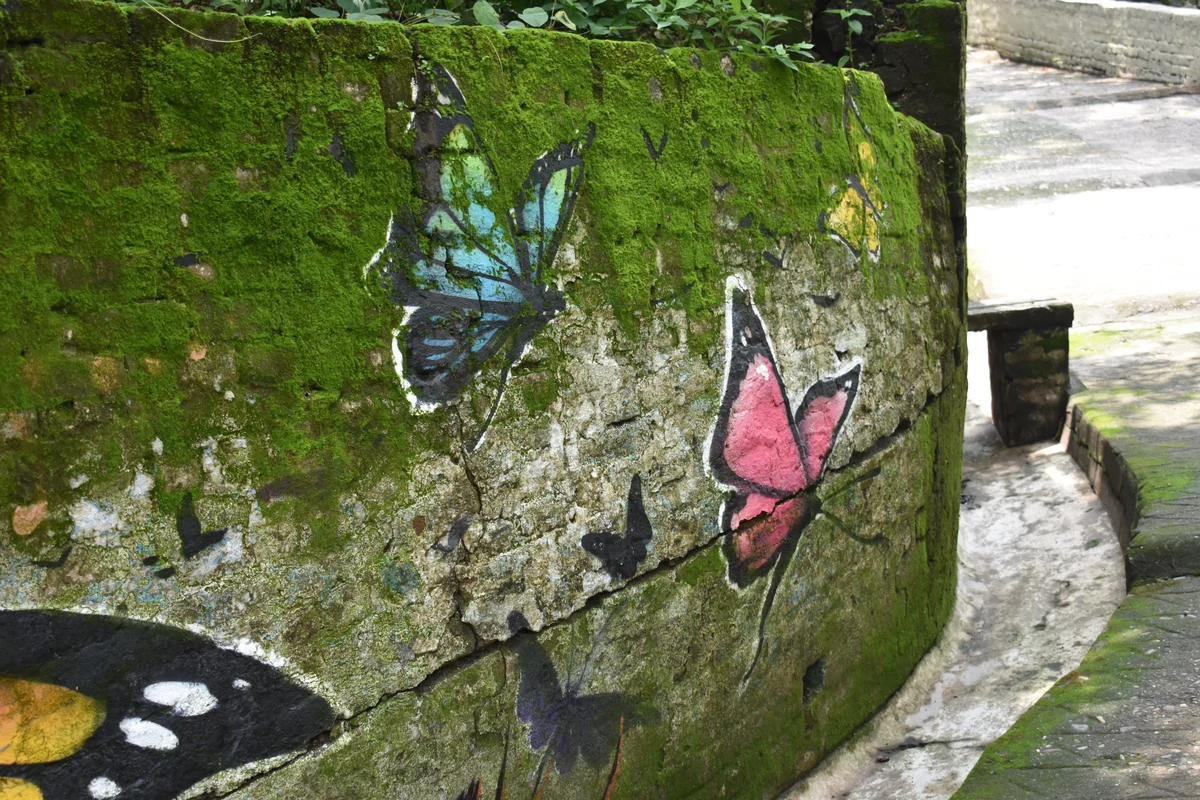
Today’s painted walls and meditation structures are best read with the dated photos and artist archive alongside them. The image here shows paint and stone steps photographed in 2018. Use the 1968 photograph to establish who was present on Harrison’s birthday and a contemporary record to date a feature to 1968. The current site is evidence of what a visitor can see today, subject to restoration and access.
Sources
- The Beatles: The White Album Recording History
- Incredible India: Rishikesh Beatles Ashram
- The Beatles – The Beatles album release and artist accounts
- The Beatles – Yer Blues song history
- Getty Images original photograph – Lennon and Harrison at Heathrow, 15 February 1968
- Getty Images original photograph – Harrison’s birthday at Rishikesh, 25 February 1968
- Rajaji Tiger Reserve – official Chaurasi Kutiya visitor FAQ
- Rajaji Tiger Reserve – official booking portal and tariff table
- Rajaji Tiger Reserve – official homepage and ticket support