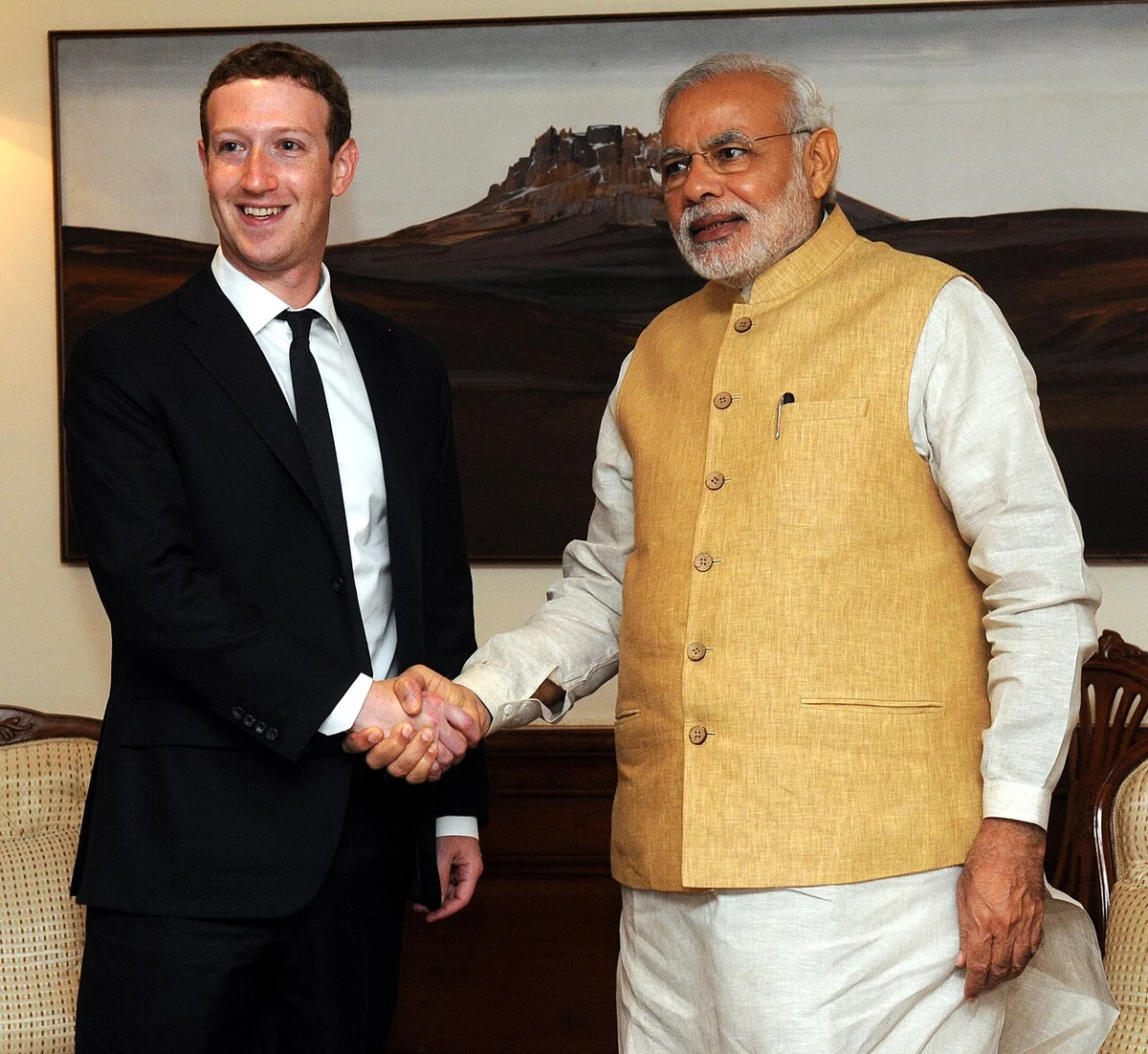
When Zuckerberg was in India
Mark Zuckerberg’s documented India appearances include the Internet.org Summit and a meeting with Narendra Modi in New Delhi in October 2014, a Taj Mahal visit and an IIT Delhi town hall in October 2015, and private pre-wedding festivities in Jamnagar in March 2024. He also recalled an earlier personal trip during Facebook’s early years, and he told that story at a September 2015 town hall with Modi in California.
The dated appearances establish places where Zuckerberg was physically present and what he did there. The two public technology events took place in New Delhi. A government meeting, a sightseeing stop and a private celebration supply three other kinds of evidence about his time in the country. The early trip has a different basis. Zuckerberg described it himself, but the public transcript leaves its dates and stops open.
Read the dates below as local calendar dates in India. The two entries in October 2014 describe consecutive engagements in New Delhi. The two in October 2015 record activity in different cities on consecutive days. Those sequences give enough detail to date a photograph or event caption when the venue or occasion is identifiable. They leave the arrival and departure dates for the broader trips unconfirmed.
| Date | Record type | Place or scope | What the source documents |
|---|---|---|---|
| During Facebook’s early years | First-person recollection | India | He recalled travelling for nearly a month. The recorded account did not name a temple or give a trip date. |
| 9 October 2014 | Confirmed India appearance | New Delhi | Opened the first Internet.org Summit. |
| 10 October 2014 | Confirmed India appearance | New Delhi | Met Prime Minister Narendra Modi. |
| 10 February 2015 | Business or policy milestone | Six-state rollout | Facebook and Reliance Communications announced their Internet.org pilot. |
| 27 September 2015 | First-person recollection | California, United States | Recalled the early India trip during the Facebook town hall. |
| 27 October 2015 | Confirmed India appearance | Agra | Posted from the Taj Mahal. |
| 28 October 2015 | Confirmed India appearance | New Delhi | Answered questions in person at IIT Delhi. |
| 8 February 2016 | Business or policy milestone | India national regulation | TRAI issued the discriminatory data-tariff regulation. |
| 22 April 2020 | Business or policy milestone | India business disclosure | Reliance and Facebook announced ₹43,574 crore for a 9.99% Jio Platforms stake on a fully diluted basis. |
| 1 March 2024 | Confirmed India appearance | Jamnagar | Attended a private pre-wedding celebration and shared his own event post. |
- Meta: October 2015 IIT Delhi Town Hall
- First-person account recorded at Facebook headquarters by India’s Press Information Bureau
- Facebook newsroom archive of the first Internet.org Summit in New Delhi
- Prime Minister’s Office record of the Zuckerberg–Modi meeting in New Delhi
- Zuckerberg’s dated Taj Mahal visit post preserved by NDTV
- Reliance Industries’ signed April 2020 Facebook–Jio Platforms press release
- Zuckerberg’s Jamnagar post and first-person host context
The 2014 summit and meeting with Modi
Zuckerberg opened the first Internet.org Summit in New Delhi on 9 October 2014. Facebook’s account of the conference puts relevant content alongside connectivity. The discussion addressed what people could find and use once they were online, including content in local languages. That gives the keynote a place in the history of Internet.org before Facebook announced the app’s India pilot.
On 10 October, Zuckerberg met Modi in New Delhi. The Prime Minister’s Office describes a discussion of Digital India, a proposed Clean India app and possible collaboration in education and healthcare. The wording matters for anyone tracing a specific project. A meeting readout establishes which subjects the participants discussed. A claim that any resulting service opened to users would need a separate release or other record documenting delivery.
A government photograph shows Zuckerberg and Modi together at the 10 October meeting. The caption, place and date agree with the Prime Minister’s Office account, and Wikimedia Commons preserves the file and its government provenance. Anyone checking a reused version can compare it with the archived image and caption. For the summit, Facebook’s archive gives the event date in its account of the conference. The page also displays a 2019 update date, which belongs to the archive entry.
Use the summit account to verify what Zuckerberg presented publicly and the government readout to verify what came up in the meeting. If a photograph of the two men is used to illustrate the summit, its caption should still identify the photographed occasion as the meeting the following day. That keeps the image useful as evidence of the visit while giving each engagement its own date and purpose.
Where the early India trip story comes from
On 27 September 2015, Zuckerberg and Modi took part in a town hall at Facebook headquarters in California. In the official transcript, Zuckerberg recalls a difficult period during Facebook’s early years when Steve Jobs suggested that he visit a temple in India. Zuckerberg said he travelled in India for nearly a month. The transcript is primary evidence for what he said publicly, years after the travel he described.
The account gives a rough duration and a place in Facebook’s early history. It leaves the year, the temple’s name and the route unspecified. A reader checking a named temple can use the transcript to verify the general story and look for an independently dated record that identifies the site. A precise year or town repeated across several retellings still needs a source that supplies the detail.
The California location matters because the two men also met in New Delhi and Zuckerberg held another town hall there. Where a clip has been cut to the temple anecdote, the longer government transcript restores who was present and where the discussion took place. A caption can give the September 2015 date for the telling and leave the date of the journey open. That preserves the difference between a recorded public appearance and the earlier travel it describes.
The Taj Mahal and IIT Delhi in October 2015
Zuckerberg visited the Taj Mahal in Agra, Uttar Pradesh, on 27 October 2015. His dated photograph and post describe the visit, and NDTV’s contemporary coverage preserves the post and cross-checks the timing with a dated ANI dispatch. If the original social post fails to load, the contemporary report still gives readers a way to check the location and date. The photograph documents the stop itself and leaves the rest of that day’s movements open.
The following day, 28 October, Zuckerberg answered questions in person at the Indian Institute of Technology Delhi in New Delhi. Facebook’s archive provides video and a selection of questions about net neutrality and Internet.org, artificial intelligence, decisions he made early in Facebook’s history and his Taj Mahal visit. The connection between the two stops therefore appears in the event record as well as in the dates of the photograph and town hall.
The IIT Delhi archive works as an event reference because it records the setting and gives readers a way to retrace what was discussed. For the policy debate, start with the net neutrality question and then check the later regulator’s record for the rule that was issued. For a quote about Facebook’s early decisions, use the video where available. The selected questions identify topics, while the recording supplies the wording and context of the answers.
Internet.org, Free Basics and India’s data tariff rule
On 10 February 2015, Facebook and Reliance Communications announced the Internet.org app for customers of that telecom operator in Tamil Nadu, Maharashtra, Andhra Pradesh, Gujarat, Kerala and Telangana. The announcement described access to an initial list of basic services. It establishes the operator, the original geographic footprint and the limited catalogue. A claim about access elsewhere in India, or about a service outside that list, needs its own contemporary evidence.
On 24 September 2015, Facebook announced the name Free Basics for the app and its accompanying mobile site. Internet.org also referred to the wider initiative. Both terms are useful when looking up earlier records. The February launch announcement uses Internet.org, and material about the consumer service after the September naming announcement may use Free Basics. The date and the subject of the document help determine which meaning applies.
The limited list of included services helps explain the net neutrality question at IIT Delhi. If someone used an included service and then followed a link to a site outside the catalogue, the pilot announcement would support the offer for the included service. It would give them no basis to assume the same treatment for the destination. The policy issue was whether users could face different data prices depending on the content they accessed.
On 8 February 2016, the Telecom Regulatory Authority of India issued its Prohibition of Discriminatory Tariffs for Data Services Regulations. TRAI’s dated release describes the measure as preventing telecom service providers from offering or charging discriminatory data tariffs based on content. A description of what happened to the Free Basics model should identify that tariff practice and the providers subject to the rule. The regulation’s title and issue date are the strongest starting points for verifying its scope.
What Facebook announced with Jio Platforms in 2020
On 22 April 2020, Reliance Industries announced signed agreements for Facebook to invest ₹43,574 crore in Jio Platforms for a 9.99% stake on a fully diluted basis. Facebook’s own US release carries a date of 21 April. Use 22 April for an Indian chronology and retain 21 April if identifying the US release as a document. Both dates appear in contemporary company records for the agreement announcement.
The entity names help distinguish the two projects that carry the Reliance name. Reliance Communications was the telecom operator named in the February 2015 pilot announcement. Jio Platforms, within Reliance Industries, was the company named in the 2020 investment announcement. The earlier source describes a consumer offer available through an operator. The later release describes a proposed ownership stake under signed agreements and gives the terms on which the percentage was reported.
The release establishes a company transaction announcement. It supplies no venue or evidence of Zuckerberg’s physical presence in India. For a chronology about him personally, the investment provides business context between documented visits. For a question about a later closing, a changed shareholding or a service developed after the investment, look for a dated disclosure or product announcement that records that later milestone.
Jamnagar and checking future appearances
Zuckerberg and Priscilla Chan attended Anant Ambani and Radhika Merchant’s private pre-wedding festivities in Jamnagar, Gujarat. Arrival reporting places them there on 29 February 2024, and Zuckerberg’s dated post documents their attendance on 1 March. Reporting with access through the couple independently confirms the weekend attendance. The lead-up to the wedding was the occasion, and the documented role of Zuckerberg and Chan was that of social guests.
The Jamnagar records establish who attended and when. They supply no public registration or programme details. For an event reference, use the arrival report for the arrival date and the first-person post for documented attendance. The IIT Delhi record serves a different reader need. It identifies a public company Q&A and gives readers an archive they can consult after the event.
For a future appearance, check an announcement from the organiser, venue or Meta for Zuckerberg’s named role, the scheduled location and whether people can attend. Use the announced local date and label any published time for an India venue as Indian Standard Time, UTC+05:30. Check whether attendance is open, registration is required or access is by invitation. A recording can also be public after an event with restricted attendance, so verify those two details separately.
Recheck any future listing when publishing or updating the page and again on the scheduled local date. After the event, expire attendance details and look for a recording, organiser recap or contemporary reporting before adding it to the visit history. Keep a scheduled appearance described as scheduled until there is evidence it happened. The sources here support a dated history through the March 2024 festivities and leave any later appearance or upcoming itinerary unverified.
Rihanna in India, the Jamnagar performance and Mumbai visitSteve Jobs in India, the 1974 trip and Kainchi Dham
Sources
- Meta: October 2015 IIT Delhi Town Hall
- Prime Minister of India: September 2015 Facebook Headquarters Transcript
- First-person account recorded at Facebook headquarters by India’s Press Information Bureau
- Facebook newsroom archive of the first Internet.org Summit in New Delhi
- Prime Minister’s Office record of the Zuckerberg–Modi meeting in New Delhi
- Zuckerberg’s dated Taj Mahal visit post preserved by NDTV
- Facebook’s February India pilot announcement and September Free Basics name change
- TRAI’s February 2016 general data-tariff regulation
- Reliance Industries’ signed April 2020 Facebook–Jio Platforms press release
- Zuckerberg’s Jamnagar post and first-person host context
- PIB photograph of Zuckerberg and Modi on 10 October 2014 in New Delhi
