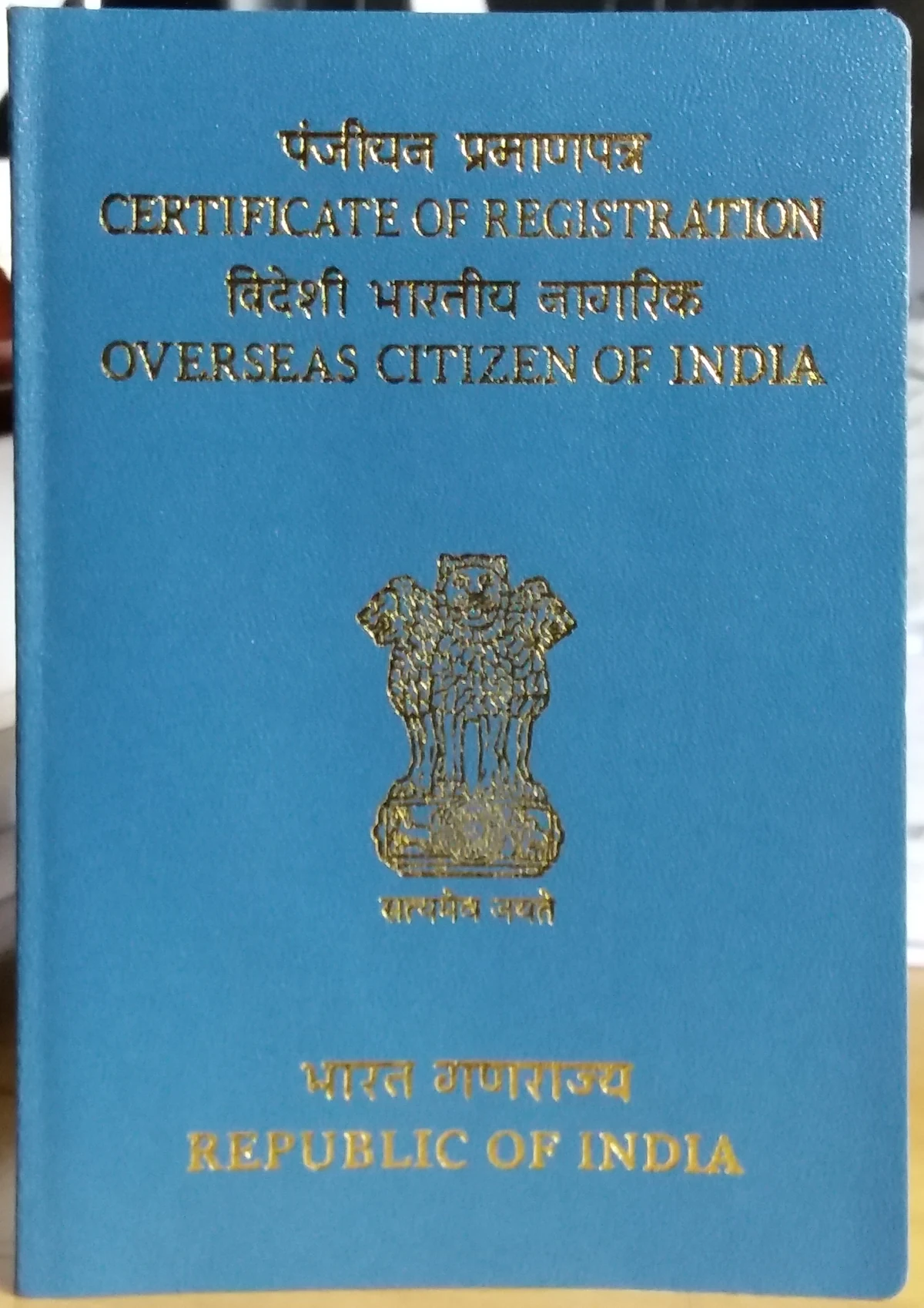
Indian citizenship and OCI are separate statuses
India does not allow an Indian citizen who voluntarily acquires foreign citizenship to retain Indian citizenship as a general rule. Overseas Citizenship of India, or OCI, is a registration for eligible foreign nationals that provides specified benefits in India, including long-term multiple-entry travel, and carries no Indian citizenship or entitlement to an ordinary Indian passport.
Section 9 of the Citizenship Act, 1955 governs cessation of Indian citizenship following voluntary acquisition of another country's citizenship. Section 7A governs registration as an OCI cardholder. The word citizenship appears in the name of both statuses, but the provisions answer different questions. Section 9 addresses whether a person remains an Indian citizen. Section 7A addresses whether a foreign national qualifies to register for OCI.
Residence abroad is a separate fact. An Indian citizen living overseas may still hold Indian citizenship, while a foreign national living in India may hold OCI. For someone weighing naturalisation abroad, the relevant event under section 9 is voluntary acquisition of the foreign citizenship. A move overseas and the acquisition of foreign citizenship are different events, even when both occur during the same period of residence.
If a form or application asks about nationality and OCI, establish the current citizenship position first. A past Indian passport may be evidence of someone's history, while an OCI record establishes a registration held as a foreign national. Keep the documents and their dates distinct when describing that history. The next step depends on whether the issue is citizenship status, eligibility for first-time OCI registration or service on an existing OCI record.
When acquisition dates and a child's status matter
Section 9 centres on whether foreign citizenship was voluntarily acquired. When a question arises about whether, when or how someone acquired it, the Act assigns that determination to a prescribed authority. A reader can use the statutory rule to identify the issue, but the answer in a disputed case depends on the acquisition facts and the prescribed determination.
Suppose an Indian citizen applies for naturalisation abroad and later receives a first passport from that country. The application date, the date the person's new citizenship took effect and the passport issue date can fall on different days. The effective acquisition date is the one to establish for the section 9 question. Start with the record that sets out the grant and its effective date, and keep the passport issue date as a separate entry in the chronology.
A child who acquires a foreign nationality at birth presents a different question from an adult who applies to naturalise. The general section 9 rule alone does not settle citizenship acquired at birth or the position of a minor. Establish the child's place and date of birth, the parents' citizenship at that point and the stated basis for acquisition of each nationality. If a parent's citizenship changed later, record that event separately. The chronology gives the relevant authority the facts it needs to address the child's own position.
What OCI changes for travel, work and property
Section 7B provides for OCI rights through government notifications and sets out statutory exclusions. The Ministry of Home Affairs describes benefits that include long-term multiple-entry travel and specified economic and education benefits. Check the official rule for the activity you have in mind, since the value of OCI for entering India can be quite different from its value for a particular course, job or transaction after arrival.
Take a cardholder planning to attend a family wedding and buy a farmhouse during the same visit. OCI's travel benefit is relevant to the wedding trip. The intended purchase raises a separate question because central guidance restricts acquisition of farmhouses, agricultural land and plantation property. Verify the property's recorded classification and consult the official rules for that category before drawing conclusions from a listing description or from the fact that the buyer holds OCI.
The Act excludes OCI cardholders from voting and from specified public or constitutional positions. Government permission is also required for specified activities. For a proposed job, placement or project in India, look for the exact role or activity in the official OCI guidance and any applicable notification. For an education decision, verify the stated benefit and the institution's eligibility criteria for the particular programme. The relevant wording can be narrower than a general reference to economic or education benefits in the FAQ.
| Decision | Indian citizen living abroad | Foreign national with OCI |
|---|---|---|
| Identify current nationality | Indian citizenship, subject to any later change in status | Foreign citizenship with OCI registration |
| Identify the travel document | Indian passport, subject to passport rules | Foreign passport with OCI travel documentation |
| Check voting rights in India | Subject to applicable electoral rules | Voting is excluded under section 7B |
| Check eligibility for a public role | Check the rules for the position | Section 7B excludes specified positions |
| Check a proposed property purchase | Check the rules for the property | OCI guidance restricts acquisition of agricultural land, farmhouses and plantation property |
Find the OCI eligibility route that fits
The Ministry of Home Affairs lists routes for specified former Indian citizens and people who qualify under the historical criteria, specified descendants through great-grandchild, certain minor children, and eligible foreign-origin spouses. Each route has its own qualifying facts. Identify the provision that fits the applicant before assembling documents, especially if several members of the same family are applying on different grounds.
For a descendant researching eligibility through a great-grandparent, the useful question is whether the ancestor meets the relevant citizenship or historical criterion and whether the family relationship can be documented through every intervening generation. Start with the official eligibility wording, then read the document instructions for the mission handling the application. This shows which record has to establish the ancestor's qualifying status and which records have to connect the applicant to that person.
The foreign-origin spouse route applies to an eligible spouse of an Indian citizen or an OCI cardholder. The marriage must have been registered and must have subsisted continuously for at least two years immediately before the application. Use the intended filing date when checking that period. Check the spouse-specific validity and documentation rules before relying on general descriptions of how long OCI lasts.
The statute also excludes applicants with specified nationality or ancestry histories. Read the exact wording of the exclusion alongside the route that appears to fit. An applicant researching eligibility through a relative may need evidence about that relative's nationality history as well as proof of the family relationship. For a minor, use the provision for children that matches the family's circumstances and the authority's document requirements.
Passport surrender and citizenship renunciation
The Citizenship Act distinguishes renunciation of Indian citizenship under section 8 from cessation after voluntary acquisition of foreign citizenship under section 9. Surrendering an Indian passport is a related administrative matter that can follow acquisition of a foreign nationality. OCI registration has two further categories of its own. Section 7C deals with renunciation of OCI registration, and section 7D deals with cancellation of OCI registration.
The Consulate General of India in Chicago provides a concrete example for its U.S. jurisdiction. It directs people surrendering an Indian passport after voluntarily acquiring foreign nationality to the government overseas Passport Seva application and the designated VFS channel. Its guidance separately describes a procedure for renunciation by people who still hold Indian citizenship. A former Indian citizen applying for OCI in that jurisdiction should also check Chicago's request for a surrender or renunciation certificate.
The wording on the OCI supporting-document list has to be read alongside the instructions for obtaining the relevant document. When a mission asks for a surrender or renunciation certificate, first establish which event actually occurred, then match the evidence to the checklist. Someone applying outside Chicago should use the relevant mission's instructions to check the forms, provider, fees and submission method. Keep the certificate or other proof the mission issues available for later steps where it is requested.
Apply through the office that serves your location
The Government of India's Online OCI Services portal separates registration, reissue and miscellaneous services. Use registration to research an initial application and consult the service instructions for an existing OCI record. Identify the Indian mission with jurisdiction if applying abroad, or the jurisdictional Foreigners Regional Registration Office, known as the FRRO, if applying in India. The office matters because original-document presentation, payment and provider arrangements can vary.
Consider a Canadian passport holder who normally lives in Canada and wants to file while visiting India on a tourist visa. The in-India tourist visa exclusion in the official OCI guidance is the immediate filing issue. The next place to check is the Indian mission serving the applicant's residence in Canada. For someone considering applying from another foreign country, check that mission's rules for applicants living outside their country of nationality. Any residence condition should be read in the context of the filing location and the applicant's status there.
Before paying or booking an appointment, reconcile the portal's instructions for the chosen service with the office's current submission page. Confirm who takes payment, where originals are presented and which documents are required for that eligibility route. An online application and an original-document appointment may be separate steps. The local instructions determine what the applicant needs to do after completing the portal portion.
Indian passport reissue, fees and appointments in IndiaIndian passport photo sizes and the DS-160 book numberMoving from the United States to India
Travel with e-OCI and update a renewed passport
The Ministry of Home Affairs announced the launch of e-OCI on 30 June 2026. Existing physical OCI cards remain valid and accepted. Existing holders can also download the digital version free using a login linked to the email address on the OCI record. Before travelling, check the current e-OCI advisory and make sure the registration document you plan to present is available and accessible.
A renewed foreign passport triggers a separate update. Suppose a 24-year-old cardholder receives a new passport before a trip to India. The Ministry's passport-change FAQ calls for updating passport details at any age by uploading the new passport's photo page and a recent photograph. It describes biometrics after age 20 at a mission or FRRO during the update, or on first entry or departure following the update. Foreign-spouse registrations require additional evidence of the continuing marriage.
The updated OCI record is issued digitally through miscellaneous services. Use those instructions when older guidance refers to obtaining a fresh physical booklet after turning 20. Keep the date you received your new passport to hand. The FAQ lists a US$25 late fee for a passport update lodged more than three months after receipt, and the portal announces a waiver through 31 December 2026. Check the current portal notice when filing, especially if your timing falls close to or after the waiver's stated end date.
| Situation | Published procedure or date | Official source to check |
|---|---|---|
| Existing physical OCI card | Current government guidance continues to accept physical cards after the 30 June 2026 e-OCI launch | Government e-OCI announcement and portal |
| Existing cardholder wants a digital version | The e-OCI portal describes a free download using the record’s linked email | OCI Services portal |
| New foreign passport at any age | The current FAQ calls for a passport detail update with new passport page and recent photo | OCI miscellaneous services FAQ |
| Update after more than three months | The FAQ lists US$25 and the portal announces a waiver through 31 December 2026 | Check the current OCI Services notice at filing |
Sources
- India Code Citizenship Act, 1955, sections 7A–7D, 8 and 9
- Ministry of Home Affairs current OCI eligibility, rights and process FAQs
- Government of India June 30, 2026 launch of e-OCI
- Ministry of Home Affairs OCI passport-change workflow
- Consulate General of India in Chicago surrender and citizenship renunciation
- India Ministry of Home Affairs | Parliamentary OCI answer
- Government of India | Online OCI services
- Government of India OCI Services announcements