Where relations stand in 2026
India and Bangladesh’s relationship in November 2026 includes separate histories of independence, land-boundary agreements, a maritime award and cooperation over shared rivers. In recent documentation, Bangladesh’s foreign ministry records the swearing-in of Prime Minister Tarique Rahman on 17 February and the presence of India’s Lok Sabha Speaker Om Birla. The original Ganges treaty reaches its 30-year anniversary in December, and November’s committee meeting concerned the current agreement’s implementation report.
Bangladesh’s foreign ministry records Birla’s attendance at the ceremony. The Indian mission also records an invitation for a later bilateral visit. Attendance is an event with a date and a named representative. The invitation establishes that a visit was proposed, while a dated account of the meeting would establish that it took place and identify who attended. Any policy commitments would need to be traced to the visit’s official readouts or documents.
The November meeting in Dhaka offers a second, more specific measure of contact. Bangladesh Sangbad Sangstha quoted Joint Rivers Commission member Anwar Kadir saying the committee had finalised its implementation report. India’s public broadcaster also covered the meeting and the approaching treaty expiry. Each development has a defined scope. The ceremony documents high-level representation during a change of government, and the meeting documents continued technical work on a specific river agreement.
- Bangladesh Ministry of Water Resources — original 1996 Ganges waters treaty
- Bangladesh Sangbad Sangstha — Joint Rivers Commission participant’s statement, 22 November 2026
- Bangladesh Ministry of Foreign Affairs — new government sworn in, 17 February 2026
- Bangladesh Ministry of Law — Constitution of the People's Republic of Bangladesh
- India Ministry of External Affairs — 1974 Land Boundary Agreement and 2011 Protocol
From Partition to Indian recognition
The 1947 Indian Independence Act created the dominions of India and Pakistan and divided British Bengal into East Bengal and West Bengal. East Bengal became part of Pakistan. Bangladesh’s Constitution identifies the territory immediately before its March 1971 proclamation as East Pakistan, with specified territorial changes accounted for in its definition. Using the names in their historical sequence gives each political entity its proper place. Bengali language and culture span the present border, and Bangladesh’s Constitution establishes Bangla as the state language.
Bangladesh dates its proclamation of independence to 26 March 1971 in the constitutional preamble. In a letter dated 30 December 1971, acting President Syed Nazrul Islam also identified 26 March as the date of the sovereign republic’s proclamation. The archived constitutional text separately refers to the Mujibnagar Proclamation of 10 April 1971. These records let a reader place the two dates within Bangladesh’s own account of its founding.
India’s recognition has its own date. Prime Minister Indira Gandhi told the Lok Sabha on 6 December 1971 that India had decided to recognise the People’s Republic of Bangladesh. The liberation war ended on 16 December 1971. Bangladesh’s Constitution came into effect on 16 December 1972, one year later. The shared day and month can obscure the year when a caption or timeline uses only ‘16 December’. The constitutional record and the parliamentary debate identify the events precisely.
| Date | Event |
|---|---|
| 1947 | Partition creates the dominions of India and Pakistan. East Bengal is included in Pakistan. |
| 26 March 1971 | Bangladesh proclaims independence, as dated in its constitutional preamble. |
| 10 April 1971 | Date of the Mujibnagar Proclamation referenced in the archived constitutional text. |
| 6 December 1971 | Indira Gandhi announces India’s recognition of Bangladesh in the Lok Sabha. |
| 16 December 1971 | The liberation war ends. |
| 16 December 1972 | Bangladesh’s Constitution takes effect. |
The Indian Independence Act divided British Bengal into East and West Bengal for the new dominions in 1947. Bangladesh’s constitutional preamble dates its proclamation to 26 March 1971. On 6 December 1971 Indira Gandhi told the Lok Sabha that India had decided to recognise Bangladesh. The end of the liberation war on 16 December 1971 and the constitution’s commencement in December 1972 are two further dates with separate meanings.
- UK Parliament — Indian Independence Act 1947, sections 1–3 as enacted
- Bangladesh Ministry of Law — Constitution of the People's Republic of Bangladesh
- Lok Sabha Debates — India’s recognition of Bangladesh, 6 December 1971
- Lok Sabha Debates — 19 March 1972 Treaty of Friendship, Cooperation and Peace and Joint Declaration
The agreements that shaped early cooperation
Indira Gandhi and Sheikh Mujibur Rahman signed the Treaty of Friendship, Cooperation and Peace in Dacca on 19 March 1972. The Lok Sabha record of 20 March reproduces the agreement. Article XI provided for a 25-year term and allowed renewal by mutual agreement. That term matters when the treaty appears in a present-day account. The parliamentary text establishes what the two governments agreed in 1972. Establishing its later status would require a record of what they did at or after the end of that term.
A separate joint declaration on 19 March set out the decision to establish a permanent bilateral Joint Rivers Commission. Its remit included studying shared rivers and cooperating on flood control and forecasting. Those tasks explain why shared-river diplomacy can involve practical work beyond dividing water at a particular point. Forecasting concerns how information about river conditions is used, while an allocation agreement sets out how the countries share available flows under specified conditions.
The Cultural Cooperation Agreement illustrates another strand of the early relationship. Signed in December 1972, it took effect on 7 May 1974 and covered exchanges in culture, art, education and science. For a history of government commitments, the agreement supplies both the relevant fields and the date it took effect. For an account of an exchange that actually happened, the useful next record would be a dated programme or institutional report identifying who participated and what took place.
The 19 March 1972 Treaty of Friendship, Cooperation and Peace and joint declaration establish early cooperation in the original documents. The friendship treaty had a 25-year term renewable by agreement. The joint declaration describes a permanent bilateral Joint Rivers Commission for river studies and cooperation. Use the term in the treaty text if you are writing about 1972 and consult a current legal record before assigning a historical instrument a current status.
How the land and maritime boundaries were settled
India and Bangladesh signed the Land Boundary Agreement in New Delhi on 16 May 1974 and a follow-up protocol in Dhaka on 6 September 2011. The protocol addressed undemarcated boundary segments, enclaves and parcels historically held by the other side. An enclave was a piece of one country surrounded by the territory of the other. Article 3 of the original agreement gave residents in transferred areas the right to stay and become nationals of the country receiving the territory.
The two governments exchanged instruments of ratification on 6 June 2015. On 31 July, 111 former Indian enclaves passed to Bangladesh and 51 former Bangladeshi enclaves passed to India. A later answer in India’s Lok Sabha reported that 920 former enclave residents moved from Bangladesh to India. A reader comparing the figures should keep the units and direction in view. The first two figures count territories transferred, and the last counts residents reported to have moved in one direction. The figures leave room for separate questions about how residents who stayed accessed schools and public services.
The Bay of Bengal boundary followed a separate legal process. On 7 July 2014, a tribunal constituted under Annex VII of the United Nations Convention on the Law of the Sea issued its award. The decision delimited the boundary in the territorial sea, the exclusive economic zone and the continental shelf, including parts of the shelf beyond 200 nautical miles. For a question about jurisdiction at sea, the award is the relevant document. For an account of transferred villages and the options open to their residents, the land agreement, protocol and implementation records supply the relevant evidence.
The land sequence starts with the agreement of 16 May 1974, proceeds through the 6 September 2011 protocol and the 6 June 2015 exchange of ratification instruments, and reaches the 31 July 2015 enclave exchange. The documented exchange transferred 111 former Indian enclaves to Bangladesh and 51 former Bangladeshi enclaves to India. The original text provided a right for residents to remain as nationals of the receiving state in the relevant areas.
| Date | Instrument or implementation | What it concerns |
|---|---|---|
| 16 May 1974 | Land Boundary Agreement | Land boundary and arrangements for areas transferred. |
| 6 September 2011 | Protocol to land agreement | Outstanding segments, enclaves and separately held parcels. |
| 7 July 2014 | Bay of Bengal maritime award | Maritime delimitation under UNCLOS Annex VII. |
| 6 June 2015 | Ratifications exchanged | Land agreement and protocol process. |
| 31 July 2015 | Enclave exchange | 111 former Indian and 51 former Bangladeshi enclaves transferred. |
India’s neighbouring countries: borders, disputed areas and official maps
What the Farakka treaty allocates
The two governments signed the Ganges water treaty in New Delhi on 12 December 1996. It establishes a mechanism for sharing flows at Farakka during the lean season, using successive 10-day periods from 1 January through 31 May. Article II and Annex I set out the allocation mechanism, including special provisions for low flows and guaranteed allocations in alternate periods. A claim about either country’s allocation needs the relevant period and conditions because a single figure can lose its meaning when detached from those provisions.
Suppose a report says Bangladesh received less water at Farakka during a particular period in April. First identify the comparison it is making. It could mean less than in the preceding period, less than in the equivalent period of an earlier year, or less than the amount due under the agreement. To check the last claim, identify the exact treaty period and use the corresponding flow and delivery records alongside Article II and Annex I. A year-on-year comparison answers a different question about how observed conditions changed.
The treaty’s scope is specific to a location, a season and an allocation mechanism. A question about a different shared river requires records for that river. Even within the Ganges, a figure reported for a location downstream needs its own station and observation dates before it can be compared with Farakka. The original text is the starting point for the allocation rule. Measured flows and actual deliveries require dated implementation records.
The 1996 Ganges treaty sets a Farakka allocation schedule in ten-day periods from 1 January through 31 May. Its own text describes special conditions and review provisions. Read the signed treaty and its annex for the method, reach and applicable dates. It concerns a particular seasonal allocation point rather than providing a single rule for every shared river.
- Government of India Water Resources: Ganges Water Treaty
- Bangladesh Ministry of Water Resources — original 1996 Ganges waters treaty
- Bangladesh Sangbad Sangstha — Joint Rivers Commission participant’s statement, 22 November 2026
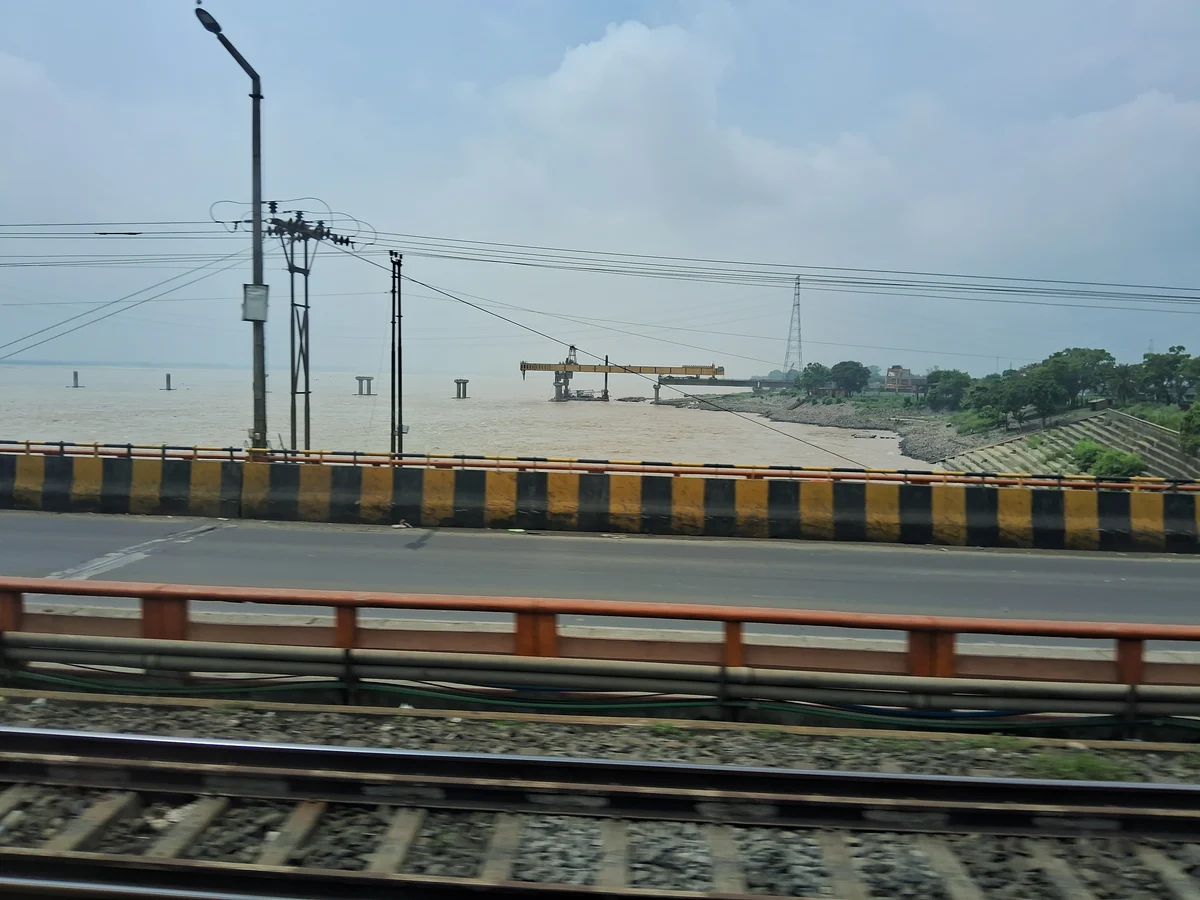
- শরদিন্দু ভট্টাচার্য্য — the Ganges as seen from Farakka, West Bengal
- India MEA parliamentary answer on renewal discussions, 13 February 2026
How to verify the treaty’s status after December 2026
The Ganges treaty entered into force on signature and provided for a 30-year term, with renewal by mutual consent. Its review provisions envisage reviews at five-year intervals or sooner if required. In a parliamentary reply on 13 February 2026, India’s Ministry of External Affairs identified December 2026 as the expiry month and said renewal discussions had yet to start as of that reply. Reporting around the November meeting identified 12 December as the approaching expiry date.
Anwar Kadir’s statement after the 91st routine joint committee meeting on 22 November establishes that the committee finalised the 2026 implementation report. The news agency’s account did not include the report itself, so it supplies no basis for reading out its measurements or conclusions. To verify a later claim of renewal, check both foreign ministries’ releases and treaty records for a signed instrument or official confirmation of mutual agreement. Record the signature and effective dates separately and check whether the governments describe an extension, a replacement or another arrangement.
- For a review, look for a dated meeting record that identifies the provisions or implementation period under discussion.
- For negotiations, look for statements that identify who met and what the two sides agreed to discuss.
- For renewal or replacement, look for a joint announcement or legal text that specifies the arrangement and when it takes effect.
A Bangladesh Joint Rivers Commission member told the state news agency after the 22 November 2026 meeting in Dhaka that the committee had finalized its 2026 implementation report for the existing treaty. The covered meeting is evidence of technical implementation work. The original treaty is a 30-year agreement signed on 12 December 1996, with renewal by mutual consent. No signed extension or replacement was verified in the official material reviewed through 26 November. Check the signed instrument if the status changes after the anniversary.
- Government of India Water Resources: Ganges Water Treaty
- Bangladesh Ministry of Water Resources — original 1996 Ganges waters treaty
- Bangladesh Sangbad Sangstha — Joint Rivers Commission participant’s statement, 22 November 2026
- India MEA parliamentary answer on renewal discussions, 13 February 2026
- India’s public broadcaster on the November Joint Rivers Commission meeting
Sources
- Government of India Water Resources: Ganges Water Treaty
- Ministry of External Affairs: 2024 India–Bangladesh Digital Partnership
- UK Parliament — Indian Independence Act 1947, sections 1–3 as enacted
- Bangladesh Ministry of Law — Constitution of the People's Republic of Bangladesh
- Lok Sabha Debates — India’s recognition of Bangladesh, 6 December 1971
- Lok Sabha Debates — 19 March 1972 Treaty of Friendship, Cooperation and Peace and Joint Declaration
- India Ministry of External Affairs — 1974 Land Boundary Agreement and 2011 Protocol
- Permanent Court of Arbitration — Bay of Bengal maritime boundary award, 7 July 2014
- Bangladesh Ministry of Water Resources — original 1996 Ganges waters treaty
- Bangladesh Sangbad Sangstha — Joint Rivers Commission participant’s statement, 22 November 2026
- Bangladesh Ministry of Foreign Affairs — new government sworn in, 17 February 2026
- শরদিন্দু ভট্টাচার্য্য — the Ganges as seen from Farakka, West Bengal
- Prime Minister’s Office, India — Singh and Hasina witness the Land Boundary Agreement Protocol signing in Dhaka
- India MEA parliamentary answer on renewal discussions, 13 February 2026
- India’s public broadcaster on the November Joint Rivers Commission meeting
- UN archive text of the 2014 Bay of Bengal award
- Bangladesh Ministry of Water Resources, 1972 joint declaration

