From institutional formation to programme approval
India’s public record gives two starting points for this history. The Defence Research and Development Organisation, or DRDO, dates its establishment to 1958. The Ministry of Defence later told the Lok Sabha that the Integrated Guided Missile Development Programme received sanction on 26 July 1983. The first date belongs to the creation of an organisation. The second belongs to the administrative approval of a defined programme within it, a quarter-century later.
The distinction helps readers reconcile year-only timelines and biographies. A history of DRDO can start in 1958 and cover work across many research fields. A chronology of the integrated programme can begin in July 1983, then follow what the ministry and its officials reported about its management. Parliamentary records, an official scientist’s biography and statements about international commitments each answer a different historical question.
Public accounts also use several kinds of milestones. A sanction is approval to begin or fund work. A report to Parliament records a ministry’s dated account of progress. A public announcement of a trial records what the issuing authority said had occurred. Participation in an international arrangement belongs to diplomacy and export-control governance. Reading the documents in order exposes these roles in a way that a list of dates alone can miss.
The dated record at a glance
The table supplies referral points for readers following a person, an institution or a diplomatic relationship. It includes civilian space and presidential dates where they explain a career often compressed into a single title. It gives both a day of activity and a publication date when that distinction affects how a claim should be phrased. The notices concern public history, its formal approvals and the organisations responsible for issuing records.
One way to read the timeline is to follow the changes in institutional responsibility. The civilian space organisation’s chronology describes its own mission history. The President’s Secretariat records Kalam’s earlier appointments and later constitutional office. Parliamentary material supplies programme administration and scrutiny dates. The diplomatic documents trace commitments made by governments to international partners.
| Date | Public record | What the record supports |
|---|---|---|
| 1958 | DRDO formation | Creation of a defence research organisation from earlier government units. |
| 18 July 1980 | ISRO and the Rohini mission | Civilian space mission in Kalam’s career. |
| 26 July 1983 | Integrated programme sanction | Ministry identifies approval date in Lok Sabha written reply. |
| 21 February 1999 | Lahore Declaration and associated memorandum | Start of the documented bilateral confidence-building sequence. |
| 25 July 2002 | Kalam becomes President of India | Beginning of his five-year presidential term. |
| 4 January 2003 | Cabinet Committee on Security statement | Public description of civilian political oversight. |
| 3 October 2005 | Bilateral follow-up agreement | Dated Indian and Pakistani confidence-building agreement. |
| 3 May 2010 | Lok Sabha written answer | Dated review of sanction and administrative schedule. |
| 27 June 2016 | MTCR accession | Regime’s chairs confirm India joined as the 35th partner. |
| 1 January 2021 | DRDO Foundation Day release | Ministry’s public retrospective on developments reported for 2020. |
| 17 November 2024 | Defence Ministry trial announcement | Ministry documents its claim about a trial on the preceding day. |
- President of India — A. P. J. Abdul Kalam’s official profile
- Indian Space Research Organisation — civilian space programme chronology
- Lok Sabha written answers — programme sanction and dated administrative review, 3 May 2010
- United Nations Digital Library — Lahore framework and diplomatic confidence building
- Ministry of External Affairs — public statement by the Cabinet Committee on Security, 4 January 2003
- Missile Technology Control Regime chairs — accession of India, 27 June 2016
- Ministry of Defence — DRDO Foundation Day public account, 1 January 2021
- DRDO press release archive — dated announcement of a flight trial, 17 November 2024
What DRDO’s founding date describes
DRDO’s institutional history traces the organisation to the consolidation of earlier defence technical development and science units in 1958. Among the predecessor bodies it identifies are the Defence Science Organisation and the Directorate of Technical Development and Production. A Defence Ministry Foundation Day release says the organisation had ten laboratories at formation. That figure describes institutional scale at the outset as reported by the ministry decades later.
DRDO is under the Department of Defence Research and Development in the Ministry of Defence. An institution can span multiple research lines, reporting duties and kinds of public work. The department, its laboratories and individual programmes each receive different names in government sources. This is why a date attached to one must stay with the body named in the record.
The 2021 Foundation Day release shows the breadth of the ministry’s institutional account. It reviewed accomplishments as reported for 2020 and also described work by DRDO laboratories during the COVID-19 pandemic. Those announcements belong to the reporting history of one organisation. Their subject matter ranges from dedicated defence work to a response to a civilian emergency, an important distinction when deciding which archive entry supports a particular claim.
Kalam, the integrated programme and the presidency
A. P. J. Abdul Kalam’s official biography places civilian space research before his responsibility for the integrated programme. ISRO dates its formation to 15 August 1969 and the establishment of the Space Commission and Department of Space to 1 June 1972. It dates the Rohini satellite mission to 18 July 1980. The President’s biography associates Kalam with that mission as project director. This episode belongs to India’s civilian space programme and helps explain the career that preceded his defence administration role.
In a 15 April 2005 address, Kalam gave his recollection of programme approval in 1983 and discussed responsibility, funding, collaboration and review. The speech describes participation across laboratories and universities. It is a first-person account delivered while he was president, useful for how one leader understood the programme’s organisation. For the precise sanction date, use the dated parliamentary answer, which gives 26 July.
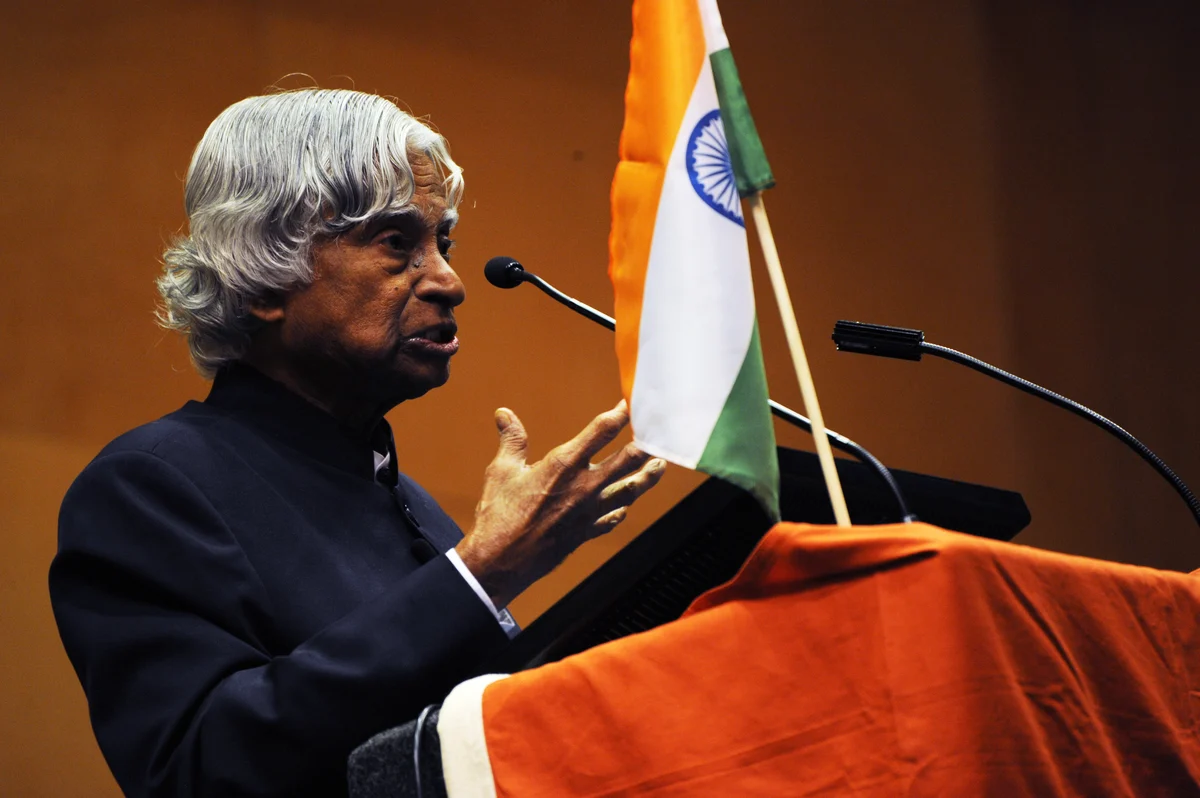
The President’s Secretariat dates Kalam’s service as scientific adviser to the defence minister and departmental secretary to July 1992 through December 1999. It lists November 1999 to November 2001 for his tenure as principal scientific adviser. He then held the presidency from 25 July 2002 to 25 July 2007. The photograph above dates from 2009 and records a university event after those positions.
- President of India — A. P. J. Abdul Kalam’s official profile
- Indian Space Research Organisation — civilian space programme chronology
- President of India — Kalam’s 15 April 2005 address to the Project Management Institute
- Lok Sabha written answers — programme sanction and dated administrative review, 3 May 2010
How to read the parliamentary and ministry records
In its written answer of 3 May 2010, the ministry used a table to distinguish the original sanction, an original planned completion date of 30 July 1995 and a revised administrative deadline of 31 December 2010. A reader looking for an approval date can cite the sanction column. A reader looking for completion should treat a planned or revised date as an approved schedule at the time the ministry answered. A dated completion claim requires its own record.
The Lok Sabha Standing Committee on Defence describes its public mandate as including the Department of Defence Research and Development. It examines matters including demands for grants and annual reports in the ministry’s remit and reports back to Parliament. Use the committee’s own material when explaining public scrutiny. A programme’s spending decision, a ministry’s progress statement and a parliamentary committee’s review can all be documented without treating them as interchangeable.
In January 2021 the ministry’s DRDO anniversary release described a demonstration as one item in its review of the previous year. The DRDO press archive also lists a 17 November 2024 statement, in which the ministry said a flight trial the previous day had succeeded. The most precise historical treatment attributes the 2024 result to the ministry and gives both dates. The archive establishes the issuing authority and date of the public announcement.
The type of parliamentary record matters when checking who said what. A written answer supplies the minister’s formal reply to the tabled question on its stated date. A committee’s terms of reference describe what members can examine. A report from that committee would be a separate document. When a reproduced quotation drops the question date or the column label, go back to the record and restore both before deciding what the date means.
- Lok Sabha written answers — programme sanction and dated administrative review, 3 May 2010
- Ministry of Defence — DRDO Foundation Day public account, 1 January 2021
- DRDO press release archive — dated announcement of a flight trial, 17 November 2024
- Lok Sabha — Standing Committee on Defence, public oversight mandate
Civilian oversight and diplomatic agreements
The 4 January 2003 statement of the Cabinet Committee on Security describes civilian political oversight. It identifies a Political Council chaired by the prime minister within the Nuclear Command Authority. That statement belongs to the public history of government responsibilities and doctrine. Use it for the policy structure it sets out. Parliamentary institutional documents serve a different purpose and establish the ordinary scope of committee scrutiny.
The United Nations General Assembly record places the Lahore Declaration and associated memorandum on 21 February 1999. The documents set out an India–Pakistan confidence-building initiative, and the Ministry of External Affairs archive then records an agreement signed in Islamabad on 3 October 2005. A historical account can cite both events to show how an earlier public commitment led to a subsequent agreement. To describe legal status or subsequent bilateral relations at another date, check the relevant treaty record and latest public statements.
The chairs of the Missile Technology Control Regime announced India’s accession on 27 June 2016 as the 35th partner. The MTCR is a voluntary arrangement among governments on transfer controls and non-proliferation. The chairs’ announcement confirms participation and its date. A separate same-day United States government statement and an Indian parliamentary reply corroborate that date. Treat accession as an international governance milestone in a timeline of India’s public institutions.
The foreign ministry’s historical index places the October 2005 agreement in a sequence of meetings. It identifies a joint statement after a second round of expert talks on 15 December 2004 in Islamabad, another statement from the 6 August 2005 dialogue in New Delhi, and a fourth-round statement in 2006. This chronology makes the agreement easier to locate and shows why the 1999 declaration and 2005 signature both belong in an account of diplomatic risk reduction.
- United Nations Digital Library — Lahore framework and diplomatic confidence building
- Ministry of External Affairs — public statement by the Cabinet Committee on Security, 4 January 2003
- Missile Technology Control Regime chairs — accession of India, 27 June 2016
- Lok Sabha — Standing Committee on Defence, public oversight mandate
- Ministry of External Affairs, index of India–Pakistan documents and talks
Use the right record for the question
For the date DRDO formed, begin with the organisation’s institutional history and corroborate it with the ministry’s anniversary statement. For sanction of the integrated programme, start with the 2010 Lok Sabha answer and preserve its distinction between approval and dates in the schedule. For Kalam’s account of how work was organised, use the 2005 speech as his account and the biography for the dates of his public roles.
For the question of who set public policy, use Cabinet and Parliament records according to the powers they describe. For a bilateral or multilateral announcement, look first for publication by the parties or the organisation issuing the agreement. In each case keep the date, issuing body, kind of record and exact claim together. A defensible summary makes it possible for a reader to check the assertion in the original archive.
If public accounts give years that look inconsistent, start by asking which event each year describes. The formation of an organisation, an earlier civilian satellite mission, sanction of a later programme, a review of deadlines and a date of accession can all appear in one biography or general timeline. Linking the evidence to the specific event resolves many apparent discrepancies and leaves disagreements in the record visible where they genuinely exist.
The same method applies to oral and archival accounts from different times. The 2005 speech is a retrospective from a participant. The 2010 answer is a subsequent formal statement of what the ministry reported to the legislature. In a citation list, include both where you need the origin story and the approval date. Keeping the two distinct allows a reader to follow the organisation’s history without turning one official’s recollection into the entire historical record.
- Defence Research and Development Organisation — institutional history
- President of India — A. P. J. Abdul Kalam’s official profile
- President of India — Kalam’s 15 April 2005 address to the Project Management Institute
- Lok Sabha written answers — programme sanction and dated administrative review, 3 May 2010
- United Nations Digital Library — Lahore framework and diplomatic confidence building
- Missile Technology Control Regime chairs — accession of India, 27 June 2016
- Lok Sabha — Standing Committee on Defence, public oversight mandate
Sources
- Defence Research and Development Organisation — institutional history
- President of India — A. P. J. Abdul Kalam’s official profile
- Indian Space Research Organisation — civilian space programme chronology
- President of India — Kalam’s 15 April 2005 address to the Project Management Institute
- Lok Sabha written answers — programme sanction and dated administrative review, 3 May 2010
- United Nations Digital Library — Lahore framework and diplomatic confidence building
- Ministry of External Affairs — public statement by the Cabinet Committee on Security, 4 January 2003
- Missile Technology Control Regime chairs — accession of India, 27 June 2016
- Ministry of Defence — DRDO Foundation Day public account, 1 January 2021
- DRDO press release archive — dated announcement of a flight trial, 17 November 2024
- Lok Sabha — Standing Committee on Defence, public oversight mandate
- Tulane Public Relations — A. P. J. Abdul Kalam at Tulane University, 26 October 2009
- Ministry of External Affairs, index of India–Pakistan documents and talks
