Identify the blue peacock
The blue peacock is the male Indian peafowl (Pavo cristatus), the species also called blue peafowl. It is India’s national bird, re-notified as the Peacock in a Ministry of Environment and Forests order dated 30 May 2011.
Use Indian peafowl when you mean the species, peacock for a male and peahen for a female. That distinction matters when you read a park species list or compare your sighting with a photograph. A species entry covers both sexes. A photo labelled “blue peacock” usually shows the male, so its colours give you a narrower picture of what you might encounter.
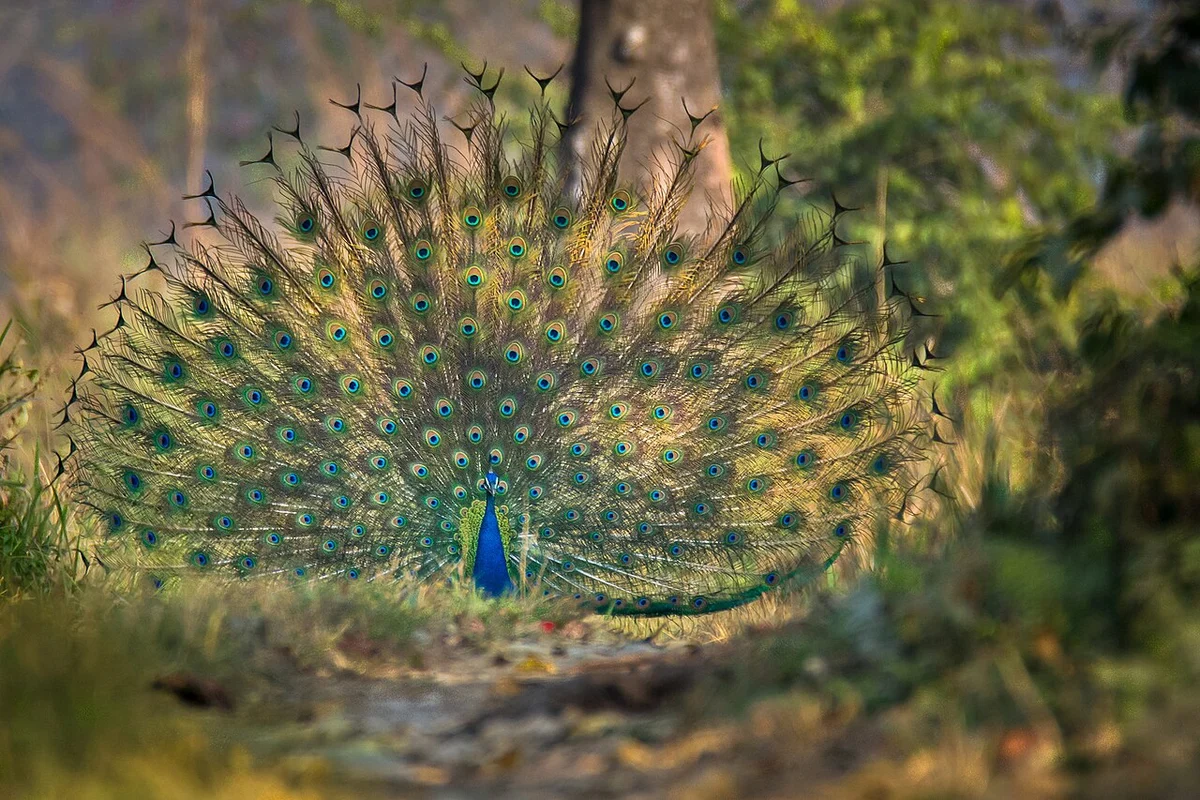
On a male, look for the iridescent blue neck and breast and the crest on the head. The long train is especially conspicuous when he raises it into a fan. If you see the bird walking with its train down, the head and neck give you a better starting point than waiting for a display. Peahens have a different appearance, so use a reference image that identifies the sex before judging a bird against the familiar blue portrait.
A documented photograph shows a male displaying in Manas National Park, Assam, on 11 February 2017. Its location and date tie the image to a particular birdwatching record in Northeast India. Use it to study the display and the proportions of the bird. For a visit to Manas, ask the park about recent observations and public viewing areas, since the photograph answers where that individual was seen on that date.
- Government of India — national animal and bird re-notification
- Wikimedia Commons — Indian peafowl Pavo cristatus.jpg
- Embassy of India | National symbols
- Animal Welfare Board of India | Indian peafowl reference
- State of India's Birds — species assessment and public data explorer
- Indian Embassy’s national symbols page
Read the range at the right scale
State of India’s Birds describes Indian peafowl as a resident species of the Indian subcontinent with a very large distribution. Resident status gives you a different planning starting point from the winter influx of migratory waterbirds at some Indian wetlands. For peafowl, start with a place you can actually visit and check its local records. A broad distribution makes it possible to look across many destinations, while the best place to spend a morning depends on what visitors can reach and what has been seen there recently.
The 2023 assessment found rapid increases over both the long and recent trend periods it analysed. These are trends modelled from observations. They express change over time at the scale of the assessment and provide no individual headcount for a park, district or lodge. The wider report assessed 942 species using more than 30 million citizen-science submissions. The partnership’s public MYNA explorer provides summaries and omits sensitive species data.
For a US reader trying to name a blue bird in a photograph, Indian peafowl is the species name to compare with a field reference. Its subcontinental range gives the species’ geographic context. If your question is whether peafowl are established in a particular US locality, check a current local bird authority or atlas for how it classifies records there. The India assessment covers the species in its own study area.
When checking an Indian reserve, make the question specific to the public visit. Ask whether peafowl have been reported along an open visitor route and how recent those reports are. A park-wide checklist helps establish that the species has occurred there. Information tied to a route and a recent observation is more useful when you are deciding where to look on the day.
Choose a site by the birds and habitat
If seeing a peacock is the main reason for the outing, start with a site that records Indian peafowl, such as Bondla Wildlife Sanctuary in Goa, and check what part of it you can visit. If you want to see several kinds of birds, choose the habitat first. A freshwater wetland offers a different set of viewing opportunities from an eastern Himalayan forest or an estuarine mangrove. The fact that peafowl occur in a state tells you little about which of its habitats will make the best use of your time.
| Site | State | Habitat | Useful first check |
|---|---|---|---|
| Keoladeo National Park | Rajasthan | Managed wetland | State forestry lists sunrise-to-sunset access. Check current fees and visitor transport. |
| Deepor Beel | Assam | Freshwater wetland | The Ramsar record explains the site. Confirm a public viewpoint and current access. |
| Eaglenest Wildlife Sanctuary | Arunachal Pradesh | Eastern Himalayan forest | Tourism lists March–April for birding and a June–September monsoon closure. Verify the actual dates and permits. |
| Dr Salim Ali Bird Sanctuary | Goa | Estuarine mangrove | Confirm sanctuary hours separately from the Ribandar–Chorão ferry timetable. |
The sites below also differ in the kind of planning they require. At Bharatpur, you can start with the park entrance and decide how to move through the reserve. At Chorão, a public ferry and sanctuary entry are separate parts of the trip. For Eaglenest, resolve state entry formalities and local access before setting aside travel days. Treat the published information as a starting point and verify the detail that determines whether your visit can go ahead.
For a Goa itinerary with one free morning, use the objective to break the tie between Bondla and Chorão. The Goa Forest Department’s peafowl record gives you a reason to check Bondla if you mainly want that species. Choose Chorão if the mangrove setting and the chance to watch birds in an estuary are the draw. Each choice leads to a different access check, even though both outings are in the same state.
Where wild tigers live in India, population and reserve visits
Plan a managed wetland visit at Keoladeo
Keoladeo National Park at Bharatpur is a managed wetland with resident and migratory birds. The Rajasthan Forest Department describes October through February as the period when migrants arrive and notes seasonal nesting by residents at other times. UNESCO’s account also links bird populations to seasonal conditions in the managed habitat. The migrant window helps you choose a month. If a particular group of birds is the reason for travelling, ask what has been observed recently and which areas visitors can reach.
The Forest Department identifies Bharatpur as the closest railway station and publishes sunrise-to-sunset operation and ticket counter access. For a visit tied to a train booking, check entry arrangements for your date before deciding how much time you have in the park. The published hours are expressed in daylight terms, so avoid building your itinerary around a fixed opening time copied from a visit in another season.
The department lists walking and managed transport options that include registered cycles and rickshaws. If two people want to watch birds together and one expects to tire on a longer walk, ask the counter about rickshaw availability before committing to a route. If both prefer to linger at a few spots, a walk on an open route lets them set their own pace. Confirm on-site conditions and tariffs for the option you intend to use. Those details matter more to a short visit than the total number of species associated with the park.
Find public wetland viewing at Deepor Beel
Deepor Beel is a freshwater wetland in Assam’s Brahmaputra valley. The Ramsar record includes Spot-billed Pelican among its wetland birds, and the annotated Indian Ramsar list notes that aquatic birds concentrate there in winter as part of migration. This gives you a season and a group of birds to look for. Read the pelican entry as a record of the species at the wetland. For a trip organised around seeing one, seek recent local observations before giving it a central place in the itinerary.
A Ramsar description explains the wetland and why it matters. To plan an outing, you still need a public observation point and a way to reach it. A pin for the wetland can place you in the right part of Assam while leaving the last part of the trip unresolved. Ask a local visitor information source to identify an open public viewing area and check for any restrictions that affect the approach or the hours you can spend there.
If a proposed outing depends on a boat, confirm with the relevant local authority that the activity is permitted and operating before treating it as part of the trip. The Ramsar records provide no boat permission or current visiting hours. A confirmed public land-based viewpoint makes a more dependable basis for the outing when boat access is uncertain. From there, watch the visible water for groups of birds and use a field reference when a distant silhouette leaves the identification uncertain.
Check Eaglenest access before fixing dates
Eaglenest is a 217 square kilometre wildlife sanctuary in West Kameng, Arunachal Pradesh. The state Forest Department describes an eastern Himalayan forest destination with several bird groups and highlights the Bugun community’s conservation work. Choose it for the forest birding experience. Even on a trip that also includes Assam, give Eaglenest its own planning time. Access to a lowland wetland and entry to this sanctuary involve different practical questions.
The department lists Tezpur as an air approach and Bhalukpong as a rail approach. Incredible India describes the public approach via Bhalukpong and Lama Camp, names March and April for birding and gives June through September as the published monsoon closure period. Use those months to narrow your options. Before committing to onward travel, confirm opening dates, road conditions and any guide arrangements with the local forest office or a local guide. The published approach identifies places to plan around, while the local confirmation determines whether the journey is practicable on your dates.
Arunachal Tourism distinguishes the tourist Inner Line Permit, or ILP, for domestic visitors from the Protected Area Permit, or PAP, for foreign visitors. If an Indian traveller and a foreign companion are arranging the same birding trip, each should check the state’s current process for their own category. A transport or guide booking addresses a different part of the visit. Confirm the applicable state entry process before making commitments that depend on both travellers reaching the sanctuary.
Coordinate the Chorão ferry and sanctuary visit
Dr Salim Ali Bird Sanctuary occupies an estuarine mangrove site on Chorão in Goa. The state describes walking access from the Ribandar–Chorão public ferry. That makes it possible to plan the approach as a ferry crossing followed by a walk. Give sanctuary admission its own place in the plan, since getting across the water only settles how you reach the island.
| Published departure time | Landings covered | What to confirm for your visit |
|---|---|---|
| 06:00 IST | Ribandar and Chorão | Check the public ferry and sanctuary opening separately. |
| 06:30 IST | Ribandar and Chorão | Allow time between reaching the island and starting a visit. |
| 07:00 IST | Ribandar and Chorão | Check the return timetable for the same travel day. |
The River Navigation Department lists 06:00, 06:30 and 07:00 among the first departures from both landings. Use those published times as a starting point and check service for the day you intend to travel. If you are considering the 06:30 departure for an early outing, check when the sanctuary admits visitors before setting your start. An early crossing can leave you waiting if admission begins later. Check the return crossing as well if the visit has to fit around an onward booking.
Ferry service and any boat outing associated with the sanctuary call for separate checks. If viewing from the water is important to you, ask the sanctuary whether such a visit is operating, how to arrange it and what the current tariff is. The ferry timetable answers the crossing question. A walking visit based on confirmed admission remains a practical choice when the details of a sanctuary boat outing are still uncertain.
Sources
- Government of India — national animal and bird re-notification
- State of India's Birds — species assessment and public data explorer
- Arunachal Pradesh Forest Department — Eaglenest Wildlife Sanctuary
- Ramsar Convention — Deepor Beel wetlands
- Rajasthan Forest Department — Keoladeo National Park, Bharatpur
- Goa Forest and River Navigation departments — coastal mangrove visit
- Wikimedia Commons — Indian peafowl Pavo cristatus.jpg
- Embassy of India | National symbols
- UNESCO | Keoladeo National Park
- Animal Welfare Board of India | Indian peafowl reference
- Indian Embassy’s national symbols page
- Ministry of Tourism’s Eaglenest visitor guidance
- Goa River Navigation Department’s Ribandar–Chorão ferry timetable
