Common trees by setting
Start with neem, gulmohar, rain tree and tamarind on planted Bengaluru streets, banyan at the Indian Botanic Garden in Howrah, and sal or teak in documented central Indian forest settings. For an individual tree, narrow the choices by habitat and confirm the identification with two visible features, ideally the structure of a complete leaf and the flower, fruit or pod.
A regional tree list works best when it tells you what kind of place its records describe. A roadside survey can point you to shade trees you might encounter on a city walk. A forest working plan tells you which trees occur in the stands it covers. A cultivated specimen may be easy to see in a garden even when the species’ original range lies far away. The examples below use documented settings and give you features you can check from the ground.
Bengaluru offers a useful starting point because IISc records several of these trees in the same urban area. In West Bengal, the Great Banyan is a named individual with an institutional identification. For central Indian forests, the Bastar case study and the Tropical Forest Research Institute’s work on teak give more specific leads than a countrywide range. Kew’s Assam and eastern Himalayan entries also help put the original ranges of familiar cultivated trees in context.
| Common name | Scientific name | Documented example setting | Visible identification clues | Native or planting context |
|---|---|---|---|---|
| Banyan | Ficus benghalensis | Parks and settlement shade | Descending prop roots, broad leathery leaves, paired figs | Native to the Indian subcontinent |
| Peepal | Ficus religiosa | Parks and settlement shade | Heart-shaped leaf base with a long narrow tip | Native in India and surrounding parts of Asia |
| Neem | Azadirachta indica | Avenues and planted grounds | Once-divided leaves with pointed toothed leaflets, small white flower clusters | Kew puts native range from Assam to Indochina, widely planted elsewhere |
| Mango or aam | Mangifera indica | Gardens and orchards | Long simple leaves, branched flower clusters, one large seed in a fleshy fruit | Kew puts native range from Assam to southern Yunnan, long cultivated across India |
| Jamun | Syzygium cumini | Gardens and orchards | Opposite glossy leaves and dark oblong fruit | Native range includes India |
| Amaltas | Cassia fistula | Gardens and orchards | Hanging yellow flower clusters and very long cylindrical pods | Kew lists western and southern India and Sri Lanka in its native range |
| Palash | Butea monosperma | Woodland and forests | Three leaflets and clusters of orange-red flowers | Native range includes parts of the Indian subcontinent |
| Teak or sagwan | Tectona grandis | Woodland and forests | Large opposite rough whole leaves and rounded fruit inside a papery calyx | Native from India into Indochina, also grown in plantations |
| Sal | Shorea robusta | Woodland and forests | Oval to oblong leaves and fruit with unequal elongated wings | Native in the subcontinent and into southeastern Tibet according to Kew |
| Gulmohar | Delonix regia | Avenues and planted grounds | Finely divided leaves, orange-red flowers and broad dark flattened pods | Native to Madagascar, introduced in India |
| Rain tree | Samanea saman | Avenues and planted grounds | Umbrella crown, twice-divided leaves and pink powder-puff flower heads | Native in tropical America, introduced in India |
| Tamarind or imli | Tamarindus indica | Gardens and orchards | Feather-like leaves with small oblong leaflets and brown pods | Introduced and long cultivated in India, regardless of the epithet indica |
- Botanical Survey of India Virtual Herbarium
- IISc Herbarium JCB regional flora lookup
- IISc Bengaluru roadsides tree descriptions
- BSI West Bengal figs illustrated reference
- Kew POWO neem: Azadirachta indica
- Kew POWO mango: Mangifera indica
- IISc gulmohar specimen from Bengaluru
- IISc Bengaluru tree report and local plant observations
- ICFRE Tropical Forest Research Institute | Teak research
- Wildlife Institute of India | Bastar vegetation case study
- Kew POWO banyan: Ficus benghalensis
- Kew POWO peepal: Ficus religiosa
- Kew POWO jamun: Syzygium cumini
- Kew POWO golden shower tree: Cassia fistula
- Kew POWO palash: Butea monosperma
- Kew species profile teak: Tectona grandis
- Kew species profile and Indian voucher for gulmohar: Delonix regia
- Kew species profile rain tree: Samanea saman
- Kew species profile tamarind: Tamarindus indica
- Kew accepted name and geographic range for sal
- Botanical Survey of India regional sal description in Mahananda
Teak and sal in central Indian forests
The Tropical Forest Research Institute documents natural populations of teak, Tectona grandis, in central India. Its seed orchard draws on teak families from Madhya Pradesh, Chhattisgarh and Maharashtra. Those origins describe the material used in the orchard and help anchor the regional record. At a particular site, check whether the source describes natural forest, a plantation or a research collection. Teak is also grown in plantations, so the setting matters when you record an observation.
For teak, look for large, rough, undivided leaves arranged in opposite pairs. Small pale flowers grow in clusters, and the rounded fruit sits inside an enlarged papery calyx. If the crown is high, use binoculars or a zoomed photograph to find a twig with several clearly visible leaf attachments. A sharp close-up of one broad leaf can show surface texture, but you need the twig to see how the leaves are arranged.
Sal, Shorea robusta, is native in the Indian subcontinent and into southeastern Tibet according to Kew’s current checklist. The Wildlife Institute of India’s Bastar study records sal in the upper forest storey. The Botanical Survey of India’s Mahananda flora describes oval to oblong leaves and a fruit with unequal elongated wings. Use several features together and check the local habitat. In the same Bastar study, the forest plan distinguishes two sal forest types, mixed deciduous forest and slightly moist teak forest.
- Botanical Survey of India Virtual Herbarium
- Kew species profile teak: Tectona grandis
- ICFRE Institute of Wood Science and Technology | Sal species reference
- ICFRE Tropical Forest Research Institute | Teak research
- Wildlife Institute of India | Bastar vegetation case study
- Forest Survey of India | India State of Forest Report 2023
- Kew accepted name and geographic range for sal
- Botanical Survey of India regional sal description in Mahananda
Banyan and peepal in eastern India and beyond
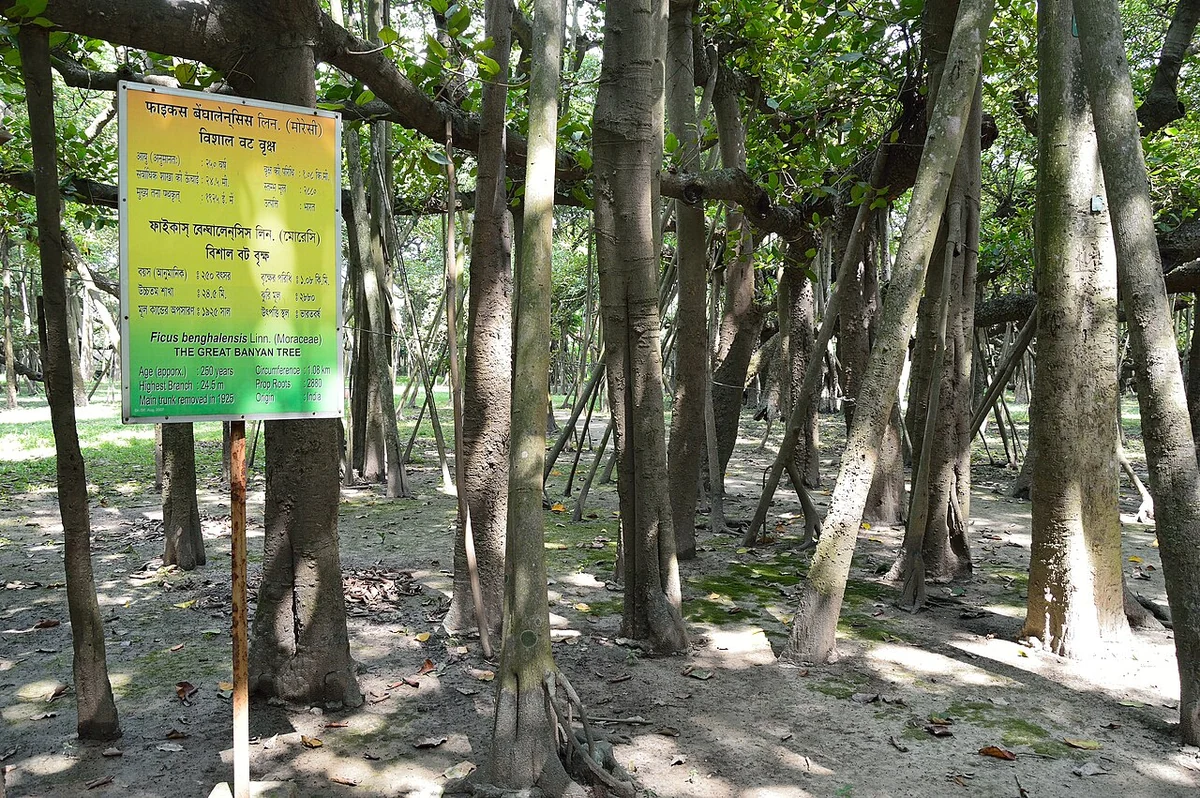
The Great Banyan in Acharya Jagadish Chandra Bose Indian Botanic Garden, Howrah, shows how a single mature banyan can fill the space of a small grove. Descending aerial roots can develop into columns supporting the crown. The Botanical Survey of India identifies this tree as Ficus benghalensis. Use its documented identity to learn what the growth form looks like, then check foliage and figs when you encounter a similar crown elsewhere.
The Botanical Survey of India’s coastal flora is useful for separating figs that may grow in the same area. Banyan has broad, leathery, oval to elliptic leaves and paired figs that attach without stalks. Kew describes the ripe figs as red. Peepal, Ficus religiosa, has a heart-shaped leaf base and a long, slender tip. Compare mature leaves and check a fig where one is visible. Other figs, including Ficus microcarpa, can also produce aerial roots.
Suppose you see several root columns under a wide crown and take a close photograph of a fallen leaf with a long tapering tip. Before recording a name, find that leaf shape on a branch attached to the tree. Under overlapping crowns, a leaf on the ground can come from a neighbour. A photograph showing the leaf base and tip, followed by one showing where figs attach, gives you a firmer basis for applying the coastal key.
Kolkata travel guide: museums, Howrah and KumartuliDeccan Plateau map, rivers, boundaries and geology
Leaf and pod clues on Bengaluru streets
Gulmohar and rain tree both have twice-pinnate leaves. Their main leaf stalk carries side branches, and those branches carry the leaflets. Gulmohar has finely divided foliage, open orange-red flowers with broad petals and long, flat woody pods that darken at maturity. Rain tree has relatively large paired leaflets, a broad umbrella-shaped crown and pink flowers gathered into powder-puff heads. Rain tree also bears dark elongated pods, so compare shape and leaflets when all you can see is a pod in silhouette.
Neem and tamarind have once-pinnate leaves, with the leaflets attached along the main stalk. Neem’s leaflets are pointed and toothed. Small white flower clusters and fruit that changes from green to yellowish can support an identification. Tamarind carries multiple pairs of small oblong leaflets, and its brown pods often have slight constrictions. Once you have traced a complete compound leaf, zoom in on the leaflet margin or on an attached pod to decide which description fits.
On a Bengaluru street where two broad crowns meet overhead, you might see pink flower heads above a layer of finely divided foliage. Trace the flower-bearing branch back to its own leaves. If the pink heads and larger paired leaflets share the same branch, rain tree is the stronger match. Another branch with finer foliage and a long flat pod may belong to a gulmohar beside it. Record the two trees separately so each photo set shows which features go together.
Flowers, fruit and leaves in gardens and orchards
Mango and jamun both have undivided leaves, and leaf arrangement is especially useful when fruit is out of view. Mango has narrow, leathery leaves and often puts out copper-red young growth. Its small flowers grow in branching clusters at shoot tips, and the mature tree can carry large fleshy fruit. Jamun has glossy, smooth-edged leaves in opposite pairs and oblong fruit that turns purple-black. If an older collection lists jamun as Eugenia jambolana, search also for Kew’s accepted name, Syzygium cumini.
Palash is easiest to recognise when its bright orange-red flowers stand out on an almost leafless crown. Later, look for three broad leaflets on each complete leaf or for broad, flat pods that typically contain one seed. The name flame of the forest can refer to other plants. If you are choosing between palash and gulmohar from a flowering photograph, look for foliage in another view of the same tree. Gulmohar’s many small leaflets give you a clear way to separate it from palash.
Amaltas carries yellow flowers in long hanging clusters, and its elongated pods are dark and cylindrical. The leaves are once-pinnate, usually with three to eight pairs of leaflets. Pods are particularly useful after flowering. Viewed from the side, a gulmohar pod is flat and a tamarind pod is brown and slightly constricted. Try to capture the profile as well as the attachment point, since a hanging pod photographed end-on may hide the feature that distinguishes it.
| What you see first | Candidates | What to check next |
|---|---|---|
| Glossy, undivided leaves | Jamun or mango | Opposite leaf pairs and purple-black oblong fruit point to jamun. Narrow leathery leaves and a copper-red flush point to mango. |
| Orange-red flowers | Palash or gulmohar | Look for three broad leaflets on palash and many small leaflets on gulmohar. |
| A long dark pod | Amaltas or gulmohar | Check the profile. Amaltas pods are cylindrical and gulmohar pods are flat. |
| Small leaflets in pairs | Tamarind or rain tree | Trace their attachments. Tamarind leaflets attach to the main stalk. Rain tree leaflets attach to its side branches. |
Native ranges and planted records
For neem and mango, country-level labels can hide the geographic detail that matters. Kew gives neem a native range from Assam to Indochina, listing Assam as native and its broader India entry as introduced. Kew places mango’s native range from Assam to southern Yunnan, with separate entries for Assam and the eastern Himalaya and an introduced designation for its broader India entry. The IISc Flora of Karnataka records mango in cultivation and documents specimens. Those records help establish where readers may encounter it today.
Some trees familiar from Indian plantings have origins overseas. Gulmohar is native to Madagascar. Rain tree is native from Central America into parts of northern and western South America. Kew’s current taxon record gives Comoros and Madagascar as tamarind’s native range, while older references describe a broader tropical African origin. These accounts all treat tamarind as introduced in India, where it has long been cultivated. Its scientific name, Tamarindus indica, is a useful search term for finding records.
Check the geographic scope before copying a range into a caption. Kew includes Indian territory in the native distribution of jamun and specifies western and southern India plus Sri Lanka for amaltas. An amaltas photographed in a planted setting elsewhere in India can be accurately labelled with its species, place and setting. Keep the native range in a separate sentence so that a reader can see exactly which statement the photograph and the taxonomic record each support.
- Botanical Survey of India Virtual Herbarium
- IISc Herbarium JCB regional flora lookup
- Kew POWO neem: Azadirachta indica
- Kew POWO mango: Mangifera indica
- Kew POWO jamun: Syzygium cumini
- Kew POWO golden shower tree: Cassia fistula
- Kew species profile and Indian voucher for gulmohar: Delonix regia
- Kew species profile rain tree: Samanea saman
- Kew species profile tamarind: Tamarindus indica
- Kew accepted name and geographic range for sal
How to check flowering season and local records
Start with the feature you want to photograph and the locality you can visit. An IISc gulmohar voucher from Bengaluru records April–June in its local flowering and fruiting information. Treat that window as a lead for Bengaluru and check the original record for the locality and the feature described. IISc’s roadside observations are local, and weather and year can affect timing. A recent observation from the same locality can help you judge what is visible this season.
Search the Botanical Survey of India’s Indian Virtual Herbarium by scientific name or region, then read the specimen label for collection locality, date and any habitat notes. The record documents a collection at a particular place and time. Before using it to plan a visit, check whether the place is identified precisely enough and whether there is a current public access source for that site. IISc’s Flora of Karnataka, Flora of the Eastern Ghats and Flora of Peninsular India offer regional starting points.
For your own field record, capture the whole crown, a twig showing leaf attachments, both sides of a mature leaf where visible, and a flower or fruit if present. Note the month and whether you were on a street, in a garden or in forest. When the canopy is bare or too distant for a useful detail, keep the identification tentative and record which feature you still need. A dated photograph of a pod or flower can then settle the comparison on a later visit.
| Species | Local source and place | Published observed seasons |
|---|---|---|
| Gulmohar | IISc JCB voucher in Bengaluru | April–June flowering and fruit |
| Sal | BSI flora in Mahananda, West Bengal | Flowers March–April, fruit May–June |
| Mango | IISc Flora of Karnataka | January–June flowering and fruit |
| Mango | IISc Eastern Ghats flora | January–July flowering and fruit |
| Sal | IISc India Trees portal record | March–June combined flowering and fruit entry |
- Botanical Survey of India Virtual Herbarium
- IISc Herbarium JCB regional flora lookup
- IISc Bengaluru roadsides tree descriptions
- Kew species profile and Indian voucher for gulmohar: Delonix regia
- IISc gulmohar specimen from Bengaluru
- Forest Survey of India | India State of Forest Report 2023
- Botanical Survey of India regional sal description in Mahananda
Sources
- Botanical Survey of India Virtual Herbarium
- IISc Herbarium JCB regional flora lookup
- IISc Bengaluru roadsides tree descriptions
- Regional Botanical Survey of India coastal plant communities flora
- BSI West Bengal figs illustrated reference
- Kew POWO banyan: Ficus benghalensis
- Kew POWO peepal: Ficus religiosa
- Kew POWO neem: Azadirachta indica
- Kew POWO mango: Mangifera indica
- Kew POWO jamun: Syzygium cumini
- Kew POWO golden shower tree: Cassia fistula
- Kew POWO palash: Butea monosperma
- Kew species profile teak: Tectona grandis
- Kew species profile and Indian voucher for gulmohar: Delonix regia
- IISc gulmohar specimen from Bengaluru
- Kew species profile rain tree: Samanea saman
- Kew species profile tamarind: Tamarindus indica
- IISc Bengaluru tree report and local plant observations
- Verified open photograph of the Great Banyan, Howrah
- ICFRE Institute of Wood Science and Technology | Sal species reference
- ICFRE Tropical Forest Research Institute | Teak research
- Wildlife Institute of India | Bastar vegetation case study
- Forest Survey of India | India State of Forest Report 2023
- Kew accepted name and geographic range for sal
- Botanical Survey of India regional sal description in Mahananda
