Compare a purifier rating with your room volume
Use indoor metres and the model’s particle CADR in cubic metres per hour. The calculation compares rated airflow with a room volume under ideal mixing.
Comparison guide + calculator
Compare five India purifier models, match replacement-filter codes and calculate nominal particle clean-air changes from your room measurements.
Read the technical guide to room air cleaner ratingsUse indoor metres and the model’s particle CADR in cubic metres per hour. The calculation compares rated airflow with a room volume under ideal mixing.
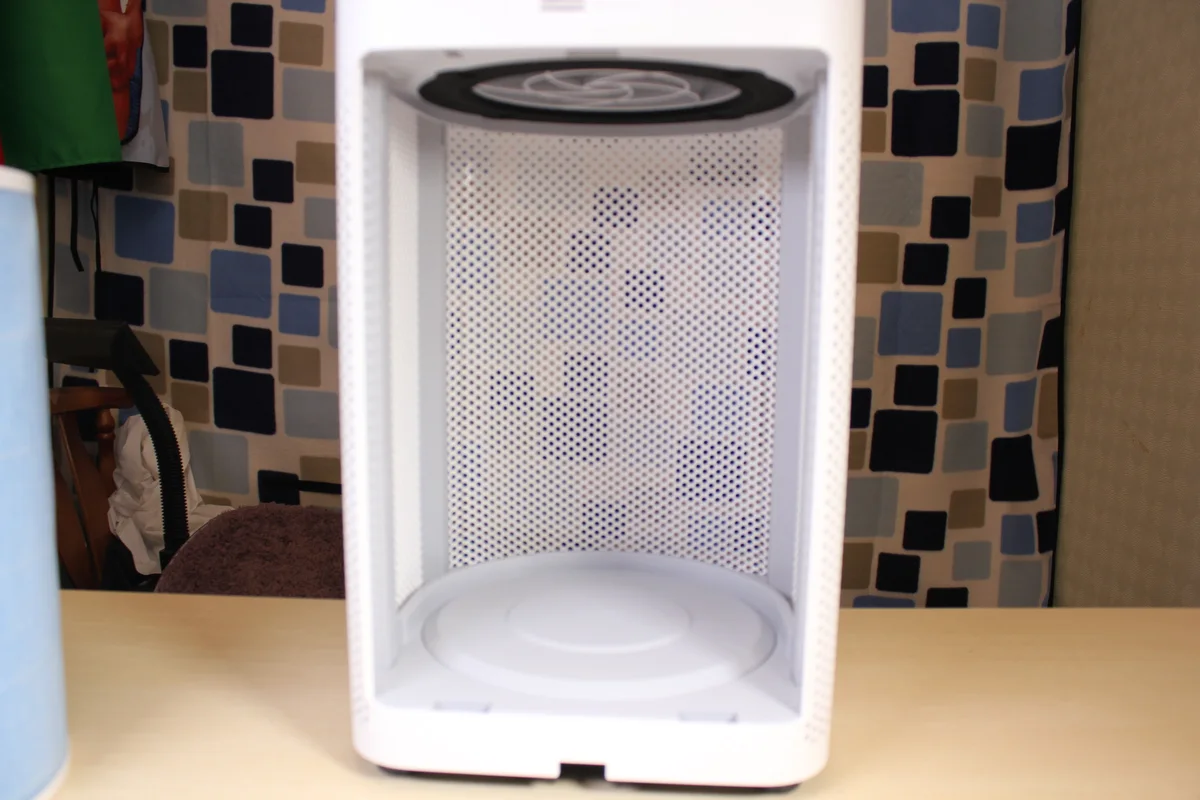
Choose an air purifier by matching its particle clean-air delivery rate, or CADR, to the volume of the room you actually use, then check the price and availability of its exact replacement filter in India. For a 4 × 4 m room with a 2.7 m ceiling, the Philips AC0920/60 at 250 m³/h gives about 5.8 nominal equivalent air changes per hour at its listed rating, enough to clear an illustrative comparison target of five.
Start with the room where you expect to run the unit most often. A bedroom with the door normally shut gives you a defined space to measure. In a living room that opens onto a dining area, include the adjoining space if you expect one purifier to serve both. The calculation gives you a first estimate for that combined volume. The shape of the rooms and the opening between them still affect where filtered air reaches.
Particle CADR measures how much particle-cleaned air the unit delivers per hour. Some test labels give different ratings for different kinds of particles, so use corresponding ratings when a seller supplies several. A particle filter and activated carbon also serve different purposes. The Philips AC1711/63 lists both HEPA filtration and activated carbon, but its 300 m³/h particle CADR describes particle cleaning. The supplied specifications give no common basis for ranking the models on odour or gas removal.
Measure length, width and ceiling height in metres. Multiply the three dimensions to get cubic metres, then multiply that room volume by the nominal equivalent air changes per hour you want to compare. The 4 × 4 m room with the 2.7 m ceiling holds 43.2 m³. At five equivalent changes per hour, the required particle CADR is 216 m³/h. To check a model against any target, divide its particle CADR in m³/h by the room volume in m³.
In that room, the listed ratings of 250, 300, 360, 443 and 600 m³/h work out to about 5.8, 6.9, 8.3, 10.3 and 13.9 equivalent changes per hour respectively. All five pass the illustrative target on their listed ratings. Raise the comparison target to eight and the same room calls for 345.6 m³/h, bringing the 360, 443 and 600 m³/h models into the shortlist. That arithmetic gives you a way to see which choices depend on your sizing assumption.
Five is a selectable comparison value. The calculation expresses how much particle-cleaned air the rated flow would supply each hour relative to the room volume. It does not predict how quickly a sensor will register a drop or how evenly particles will clear across the space. Published CADR usually reflects the highest setting. If you expect to use a quieter setting, look for a rating at that speed before assuming the model will meet the same target there.
The starter room in the calculator is 4 × 4 metres with a 2.7 metre ceiling, or 43.2 cubic metres. A listed 360 m³/h is about 8.33 nominal changes per hour in that volume. An illustrative target of five corresponds to 216 m³/h. Treat those figures as an airflow comparison at the input rating. A lower fan setting, furnishing, open doors and the room layout can affect the conditions in practice.
The five India models span 250 to 600 m³/h of listed particle CADR. The table pairs each hardware code or product name with its replacement and the observed India shop price. The Xiaomi hardware prices and the Mijia 6 filter price came from a Black Friday promotion. The Philips prices came from its shop catalog, and the 4 Lite filter price came from Xiaomi’s separate storefront listing. Use these figures to compare the recorded offers, then check the current price for each item.
| Model | Particle CADR (m³/h) | Listed power | Observed hardware price (₹) | Replacement pack | Observed pack price (₹) | Listing context |
|---|---|---|---|---|---|---|
| Philips PureProtect Mini AC0920/60 | 250 | 21 W maximum | 9499 | FY0900/30 | 2370 | Philips India shop snapshot. |
| Philips AC1711/63 | 300 | 27 W maximum | 14799 | FY1700/30 | 4495 | Philips shop snapshot marked out of stock. |
| Xiaomi Smart Air Purifier 4 Lite | 360 | 33 W at maximum filtration | 11499 | Xiaomi 4 Lite filter | 2999 | Hardware campaign capture and separately captured filter. |
| Xiaomi Mijia Smart Air Purifier 6 AC-M25-SC | 443 | 40 W rated | 18999 | Mijia 6 filter | 3499 | India Black Friday price examples. |
| Philips PureProtect Pro AC4221/61 | 600 | 54 W maximum | 26499 | FY4200/30, two in pack | 5995 | Use the entire pack price when comparing replacements. |
In this snapshot the 4 Lite cost ₹2,000 more upfront than the AC0920/60 and carried an additional 110 m³/h of listed particle CADR. Its replacement listing was ₹629 more per pack. If both models clear your target, decide whether the extra rated flow is worth that difference in purchase and replacement cost. If your room requires more than 250 m³/h at your chosen target, the lower Philips purchase price comes with a shortfall on the sizing calculation.
The AC1711/63 occupied the 300 m³/h slot, but the Philips collection marked it out of stock at the observed price. The AC0920/60 and AC4221/61 displayed add-to-cart labels. Treat those labels as catalog observations. Before buying, open the exact product listing and enter your delivery PIN for the purifier and its filter separately. Check the payable total on each listing, since a collection price, product-page price and promotion can differ.
Coverage in square metres or square feet can change with ceiling height, the selected air-change rate and the test method. Xiaomi India lists the Mijia 6 for up to 940 sq ft at two air changes per hour using a 2.4 m ceiling assumption. It also gives a 312–538 sq ft effective coverage range under GB/T. Philips gives the AC4221/61 a 72 m² GB/T rating, while its shop also shows a 156 m² maximum figure. For a consistent comparison, start from the listed particle CADR and apply one room volume and one target to every model.
Suppose you want to cover a 6 × 5 m living room with a 3 m ceiling. It holds 90 m³ and calls for 450 m³/h at a target of five. On the listed ratings, the 443 m³/h Mijia 6 reaches about 4.9 and the 600 m³/h Philips reaches about 6.7. At two equivalent changes per hour, the same room needs 180 m³/h. The target changes the shortlist even though the floor area stays fixed.
For a bedroom, look for noise and airflow figures that describe the same operating mode. Philips lists 15 dB in sleep mode and 51.5 dB in turbo for the AC4221/61. The evidence does not give a corresponding sleep-mode CADR. If published numbers cover only noise at the quiet setting and airflow at the highest setting, record those separately. A unit with a high maximum rating may be worth investigating for quieter operation, but the size of that rating alone leaves its overnight airflow uncertain.
Copy the full purifier model from the box, product listing or rating label before searching for a filter. Philips pairs AC0920/60 with FY0900/30. The similar FY0910/30 identifier can appear in Mini-series searches, so check every digit. AC1711/63 takes FY1700/30. Keep the hardware suffix when comparing specifications from /61 and /63 listings. For Xiaomi, look for explicit 4 Lite compatibility. The India storefront lists separate filters for the 4 Lite and standard 4, and the older 2 and 3 names are also distinct.
Count what comes in a pack and check the service instructions for what gets replaced together. The ₹5,995 FY4200/30 listing contains two filters. Use the pack price when budgeting an order and check the AC4221/61 manual to establish what one maintenance visit requires. Philips technical notes give a nine-month recommended change for this model. Other shop wording can give a different estimate, so use the instructions for the exact model and treat the number of packs you expect to buy as a budget assumption.
For an existing or second-hand purifier, check hardware status and consumable supply separately. Philips lists the AC2958/63 as discontinued and gives it a 380 m³/h particle CADR. Its FY2180/10 replacement still appeared in the filter shop at ₹4,571 in the observed listing. If you are considering that model second-hand, check whether the exact pack can be ordered to your address, then include its full price if the used unit needs a replacement immediately.
Pick one budgeting period and use it for every candidate. Divide the listed watts by 1,000, multiply by hours of use per day and by the number of days, then multiply the resulting kWh by a rupees-per-kWh figure from your electricity bill or tariff schedule. Add the current price of the exact replacement pack multiplied by the number of packs you expect to buy in that period. Include the purchase price and any delivery charge if you want a total for buying and running the unit.
At the 4 Lite’s listed 33 W maximum-filtration figure, eight hours a day for 30 days works out to 7.92 kWh. At an illustrative ₹8 per kWh, that is ₹63.36 for the month. On the same schedule, a 40 W rated-use estimate for the Mijia 6 gives 9.6 kWh and ₹76.80, a difference of ₹13.44 for the month. The snapshot price gap between those replacement packs was ₹500. The comparison puts the power difference and the cost of one pack in rupees, using clearly different purchase intervals.
Actual power depends on fan speed, time spent at each setting and standby consumption. Use the rated calculation to compare candidates under the same assumptions. If you already have a suitable plug-in electricity meter, a reading over representative days can replace the rated estimate in your budget. Also compare the totals under different replacement counts if you are unsure how many packs you will buy. If the estimate is sensitive to one extra pack, get a fresh filter price before weighing small differences in rated power.
Use one billed electricity rate and the same run time across models when comparing rated consumption. At 33 watts, eight hours per day for 30 days gives 7.92 kWh. At a hypothetical ₹8 per kWh that is ₹63.36. Then record whether the replacement price buys one filter or a paired pack, and how many packs your budget assumes. Your actual energy use and replacement interval depend on operation and instructions.
