How to read a traditional tattoo
Traditional tattoo practices in India vary by community, place and maker. To understand a particular tattoo, start with a record that identifies its wearer, maker or setting, and use that record to distinguish the visible design from any meaning people have documented for it.
The word godna, also written gudna in some of the accounts here, can help you find records that a search for “India tattoo” might bury among studio listings and design galleries. It appears in documentation of tattooing and in descriptions of patterns carried into painting. The spelling alone tells you little about the community, the person who made the mark or the form in which a particular design was recorded.
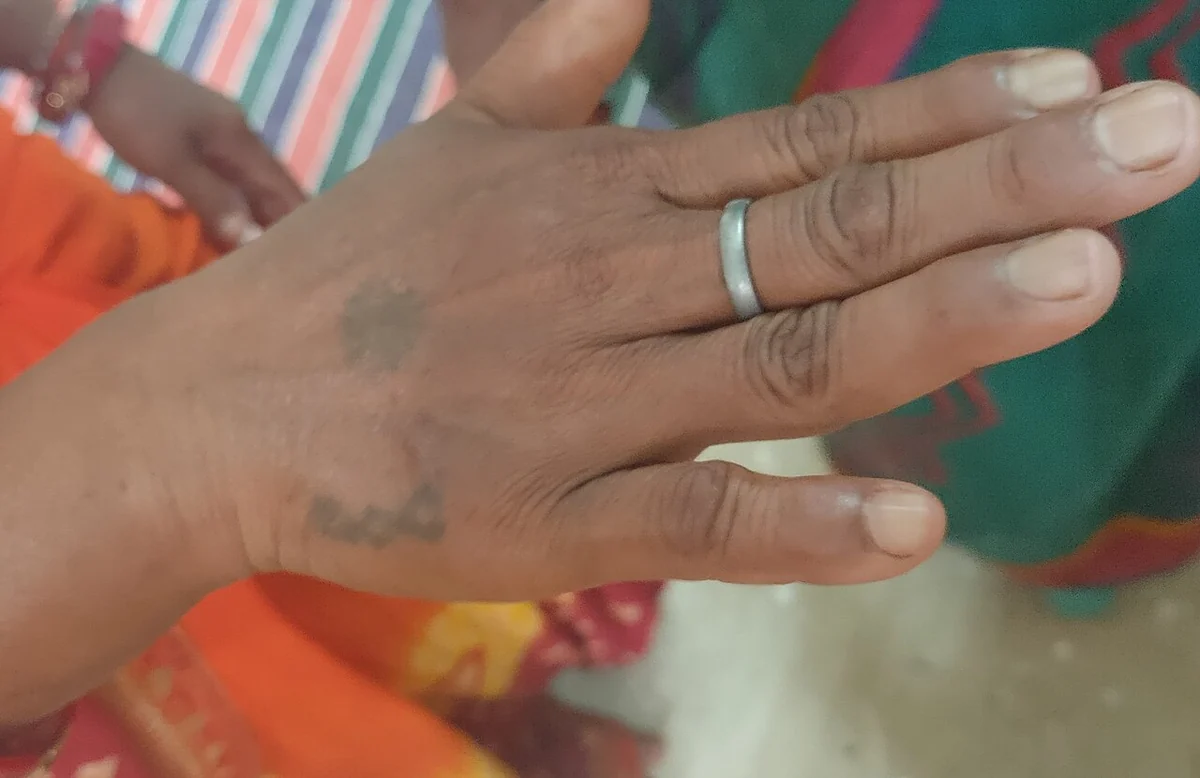
Amrit Sufi’s 2024 photograph from Bihar gives you a concrete starting point. The photographer identifies a scorpion godna on a resident’s right hand. A caption can report that identification and the state where the photograph was taken. The account supplies no interpretation of the scorpion for the wearer. If you encounter the same photograph captioned as a protective symbol or attributed to a named community, look for a separate source that actually makes and supports that connection.
Pay attention to who supplies each piece of information. A photographer can identify a subject or record the circumstances of a portrait. A wearer may explain why they chose a mark. A practitioner may describe how they learned a design or when they use it. Keeping those voices distinct helps when two records describe similar marks in very different terms.
- Indira Gandhi National Centre for the Arts: Shanti Bai and Gudna
- Census of India 1961 village survey monograph — Amwar, field-observation extract
- People’s Archive of Rural India — Joydip Mitra’s first-hand Ramnami photo report
- Wikimedia Commons — scorpion godna on a hand, Bihar, own photograph by Amrit Sufi
Shanti Bai, Baiga wearers and tattooing as work
The Indira Gandhi National Centre for the Arts documents the gudna practice of Shanti Bai of Lalpur. Its account says she began learning at ten, worked with her husband and had three daughters who took up tattooing. These details place tattooing in the working life of a named practitioner and her family. They also give a reader looking for the transmission of a practice a more precise starting point than a collection of photographs assembled around similar shapes.
The same account describes Gond Pardhan tattoo practitioners working with Baiga wearers. In that documented relationship, the community of the maker and the community of the wearer are separate details. Calling a photograph a “Baiga tattoo” can leave both details unresolved. The phrase could refer to who wears the mark, who made it or how a source groups the design. A useful description says which of those details the record actually establishes.
The Odisha Scheduled Castes and Scheduled Tribes Research and Training Institute records tattooing among women’s ornament practices in its Baiga profile. That is evidence for how the institute describes tattooing in the setting it documents. Shanti Bai’s archive supplies a different kind of detail by naming a practitioner and describing whom the practitioners in that account worked with. Read the two accounts at their own scale when writing about gender, work or community.
For a photograph with a missing credit, these accounts can suggest questions for the collection or the photographer. Ask who supplied the community attribution, whether the maker is recorded and when the photograph was taken. An archive page’s update date tells you when the site was updated. For the date of an interview or observation, look for a date attached to the field record itself.
Ramnami devotional tattoos in Chhattisgarh
Joydip Mitra’s photo report for the People’s Archive of Rural India documents members of the Ramnami Samaj in Chhattisgarh wearing the name of Ram as a devotional tattoo. The report also records the name on textiles. The connection between the two comes from reporting on people, their clothing and their gatherings. It gives a reader grounds to discuss the use of the name across media in this particular setting.
When reading an image alongside the report, identify where the writing appears and what the reporting establishes about the person shown. A wearer’s account can explain what the inscription means to them. The sight of the name by itself gives you the text of the mark, and an attribution to the Ramnami Samaj requires context about the person or the source of the photograph.
The report also explains a difficulty with estimating the size of the Ramnami population. Official population figures cannot readily isolate the group, and numbers offered by elders come from a different kind of evidence. That matters when writing about prevalence or change. A well-documented portrait can show that a person carried a tattoo and allow you to describe that person’s account of it. Measuring how widely the practice occurs, or how that has changed across generations, would require evidence collected for those questions.
What a historical survey can tell you
The 1961 Census of India village survey monograph for Amwar records variation in tattoo designs among the people surveyed. The fieldworkers said they could not confidently connect the variation they saw to a particular social meaning. If you cite the monograph, carry that uncertainty into your description. You can say that the survey recorded differences in designs in Amwar. A claim that a particular mark established a wearer’s status would need evidence that the survey did not provide.
The distinction matters when images from different places or decades appear together. Suppose a mark in a family photograph resembles the scorpion in Sufi’s Bihar photograph. The resemblance gives you a concrete feature to ask relatives about. A relative who remembers the wearer talking about the tattoo might be able to explain when or why it was acquired. Record who remembers what, and keep the attribution with the family account. The Bihar caption can identify the shape in Sufi’s own photograph.
For an archival image, look for the place, observation date or period, and the person who supplied the identification. A catalogue entry may repeat a fieldworker’s description many decades after the visit. Read the observations around the passage before lifting a description into a caption. They may show whether the author saw the tattoo, heard someone describe it or was drawing an inference. Use the narrowest attribution those details support.
Tattoo motifs on paper and canvas
The account of Shanti Bai describes the adaptation of tattoo designs to paper and canvas. The Indira Gandhi Rashtriya Manav Sangrahalaya records another instance in its 2015–16 annual report. Its Godna Srijan workshop, held in Bhopal from 5 to 14 May 2015, brought together around ten artists from Madhya Pradesh who transferred motifs to canvas. The dates, place and medium make it possible to describe a specific workshop and the work it fostered.
A painted work gives you a different object to describe. The Ministry of Tribal Affairs repository documents godna patterns in a Baiga painting of a mahua tree. Here the patterns are part of the painted tree. If you are considering the painting for an illustration, check the individual catalogue record for the artist’s credit and the description of the work. Keep the medium in the caption so a detail cropped from the painting remains identifiable as part of an artwork.
Where a painting is available as a reproduction, ask the artist or the rights contact what that reproduction can be used for. A request to show a painting in a cultural article concerns the artwork in its existing form. A request to take one element out of it for a tattoo concerns a new use. Describe that intended use when you ask, including whether the tattoo will appear in a studio portfolio or other public material.
Following artists through museum programmes
The Museum of Art & Photography’s Bengaluru programme for Marks of Belonging lists Mangala Bai Marawi with Baiga, Shomil Shah with Trajva, Moringam Khaling, also known as Mo Naga, with Neo Naga, and Amit Arjel-Sharma with multiple documented styles. It gives 21 November 2026 as the programme date. These are the museum’s listings for that event. They give you names and terms to follow into interviews or other work by the artists.
The museum’s companion programme, Keeping Them Alive, includes artist profiles and identifies Mangala Bai Marawi’s connection to Dindori. The event material also references Jyoti Bhatt’s 1992 photograph Tattoo Apparatus, made in Ahmedabad and catalogued as PHY.27778-6. Use the catalogue identifier to locate the photograph and check its credit. Keep its date and location with the photograph if you discuss it alongside the Bengaluru programme.
Event pages can remain online after the scheduled date. If you want to know whether an artist took part or a particular tattoo was made, check for a dated museum recap, an artist’s account or a photograph with a caption confirming what happened. Retain the wording “the museum listed” when the programme is your evidence. For an upcoming event, check the current listing or ask the museum directly about timing, participation and its rules for photography.

| Record | Archive or setting | What the evidence covers |
|---|---|---|
| Shanti Bai profile | Indira Gandhi National Centre for the Arts | Named practitioner and documented central Indian practice |
| Amwar village survey | 1961 Census field monograph | Historical restricted field observation |
| Godna Srijan workshop | Bhopal, May 2015 | Museum workshop and documented work in new media |
| Marks of Belonging | Bengaluru, 21 November 2026 | Dated Museum of Art & Photography programme |
| Ramnami photo report | People’s Archive of Rural India | Photographer’s on-the-ground record of distinct community practice |
| Scorpion godna image | Bihar, 6 May 2024 | Photographer’s place, date and motif description |

Indian fashion styles, regional textiles and how to buy by fitWhy it’s called India ink and what the historical record shows
Permission for a photo, a design or a tattoo
Ask before photographing someone’s tattoo, especially if taking the picture would involve moving clothing or showing a part of the body the person usually keeps covered. Say where you intend to share the image and ask how the person wants to be identified. The person may agree to a photograph of the mark and prefer to keep their face or name private. Use those preferences when framing the picture and writing its caption.
For an existing image, start with the photographer or collection record and read the terms for the particular file. Sufi’s hand photograph is available under CC BY-SA 4.0. A resized WebP version should credit Amrit Sufi and Wikimedia Commons, identify the licence and note the resize and conversion. Keep Bihar as the location in a general caption. That places the photograph without adding an unnecessary residential detail. The image licence addresses the photographer’s rights in the photograph. Other uses, including reuse of a design taken from the image, raise separate permission questions.
| Intended use | What to verify |
|---|---|
| Caption a documentary photograph | Check who identified the design, where and when the photograph was taken, and what the source says about the wearer. |
| Publish someone else’s photograph | Check the rights holder, the file’s reuse terms, the required credit and any relevant wearer permission for the intended publication. |
| Show a painting with godna patterns | Check the artist’s credit, the medium and the terms for reproducing the artwork or a detail. |
| Request a design for a tattoo | Ask the practitioner whether the design is offered for that use and whether anyone else should be consulted. |
If you want a tattoo, describe what interests you and ask the artist which work they offer for that purpose. Give them the source of any reference image so they can see whose work it shows and how it was documented. Ask separately how the studio handles hygiene. Contaminated ink or equipment can cause infection, and tattoo ink can cause allergic reactions. Seek professional care for a skin reaction or concerning change. For any claim about a local studio requirement in India, check the current information from the authority responsible where the studio operates.
- Indira Gandhi National Centre for the Arts: Shanti Bai and Gudna
- Indira Gandhi Rashtriya Manav Sangrahalaya — Godna Srijan workshop, Bhopal, 5–14 May 2015
- Museum of Art & Photography, Bengaluru — Marks of Belonging, 21 November 2026 programme
- People’s Archive of Rural India — Joydip Mitra’s first-hand Ramnami photo report
- FDA — Think Before You Ink; American Academy of Dermatology — Caring for tattooed skin
- Wikimedia Commons — scorpion godna on a hand, Bihar, own photograph by Amrit Sufi
Sources
- Indira Gandhi National Centre for the Arts: Shanti Bai and Gudna
- Odisha Scheduled Castes and Scheduled Tribes Research and Training Institute: Baiga
- Census of India 1961 village survey monograph — Amwar, field-observation extract
- Indira Gandhi Rashtriya Manav Sangrahalaya — Godna Srijan workshop, Bhopal, 5–14 May 2015
- Museum of Art & Photography, Bengaluru — Marks of Belonging, 21 November 2026 programme
- People’s Archive of Rural India — Joydip Mitra’s first-hand Ramnami photo report
- FDA — Think Before You Ink; American Academy of Dermatology — Caring for tattooed skin
- Wikimedia Commons — scorpion godna on a hand, Bihar, own photograph by Amrit Sufi