From Jagannath to juggernaut
The English word juggernaut comes from Jagannath, a name of the deity honoured at Puri’s chariot festival in Odisha. Its modern meaning of an overwhelming or unstoppable force developed later, as English writers carried their own portrayals of Jagannath and the festival into wider circulation.
Jagannātha means ‘lord of the world’ or ‘lord of the universe’. The definition helps explain why an English account might start with a divine title, even when the same account goes on to use a related spelling for a place. Merriam-Webster identifies Hindi Jagannāth as the linguistic source and glosses the name as a title of Vishnu. Oxford University Press traces the English form and its changing meanings through the reception of Jagannath in English-language writing.
Three terms make the history easier to follow. Jagannath names the deity. Ratha Jatra, also written Rath Yatra, names the chariot festival discussed here. Lowercase juggernaut is the ordinary form of the modern English common noun. Capitalised Juggernaut in an old book needs to be read in its sentence, where it may point to a deity or town. Today’s lowercase form can describe something entirely unrelated to India, such as a powerful organisation or, in chiefly British usage, a large heavy lorry.
Who rides the three chariots in Puri
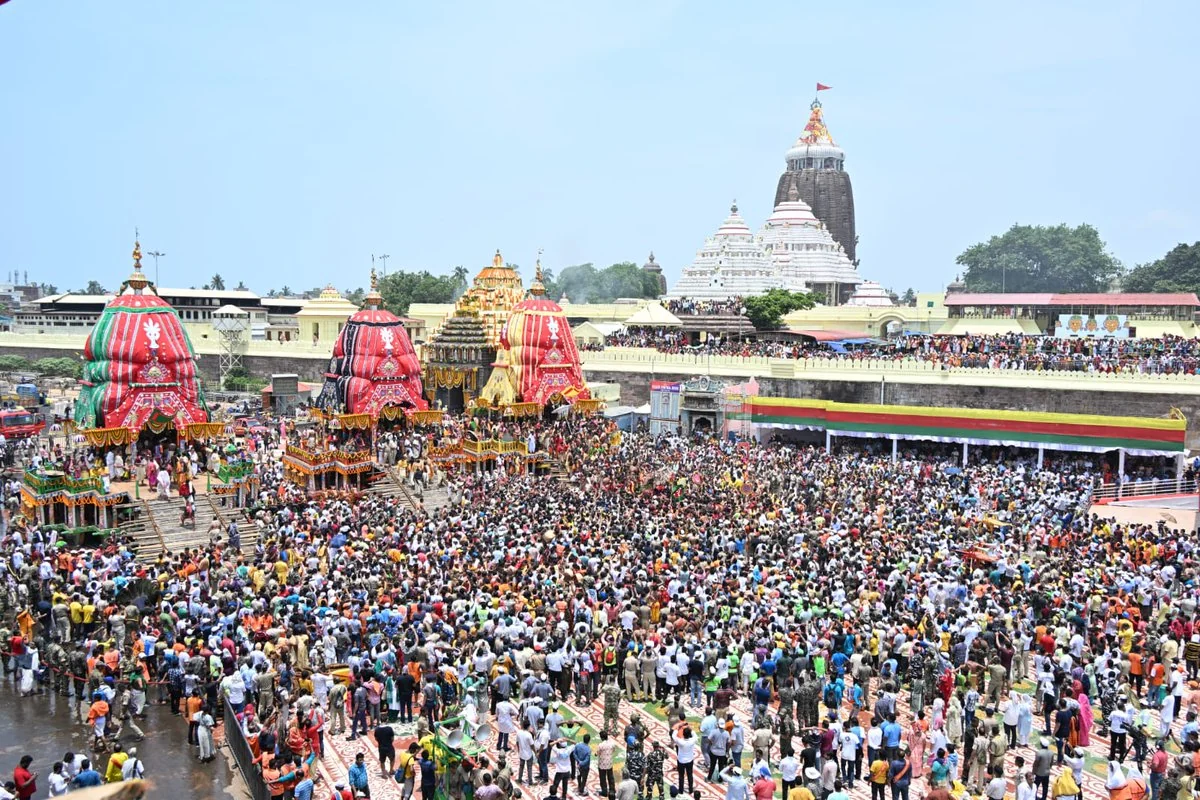
Puri’s Ratha Jatra has three named chariots. Lord Jagannath rides Nandighosha, Lord Balabhadra rides Taladhwaja and Goddess Subhadra rides Darpadalana. Those pairings matter when a description refers to a particular chariot. An English account organised around Jagannath’s name can leave a reader with the impression that a single chariot represents the entire observance. The Odisha Tourism programme gives each of the three deities and chariots its own place.
Pahandi names the ceremonial procession in which servitors carry the deities. The destination of the outward chariot journey is the Gundicha Temple, and Bahuda Jatra names the return journey. The vocabulary gives readers a way to situate an isolated caption or description within a longer observance. A report that names Pahandi is identifying the ceremonial carrying of the deities. A report that names Bahuda Jatra is identifying the return.
The destination and return also help explain what gets lost when the English metaphor is used to interpret the festival. The local programme describes who travels, how the deities are ceremonially carried and where the chariots are headed. The movement has a named destination and forms part of an observance with several stages. Those details give the chariots their place in the festival and provide a firmer basis for understanding what an image or a brief account actually shows.
| Chariot | Deity |
|---|---|
| Nandighosha | Lord Jagannath |
| Taladhwaja | Lord Balabhadra |
| Darpadalana | Goddess Subhadra |
What the 1638 travel book establishes
An English-language rendering of the name predates the nineteenth-century works associated with its wider circulation. The Huntington catalogues William Bruton’s Newes from the East-Indies as a book published in 1638. In a later reprint of the relevant chapter in the fifth volume of Hakluyt’s Collection, pages 56 and 57 contain early spellings associated with Jagannath. That passage is evidence that the name had entered English travel writing by the seventeenth century.
Anyone checking an exact quotation has two separate objects to consult. The Huntington catalogue establishes the date of the original book. The page image in the later collection shows the spelling in that printed reprint. The digitised text renders the relevant form as Iagannat, and historical dictionary transcriptions differ. The image is therefore the place to check the letters before quoting them, while the catalogue supplies the publication date for Bruton’s original work.
The distinction has consequences for a claim about when the word began. Bruton supplies a dated witness to English writing about Jagannath. To date the modern figurative use, a reader would need a passage where the term describes an overwhelming force outside that referent. A travel passage naming a deity or place answers the question of how early English writers recorded the name. The context of a figurative quotation would answer a different question about how English speakers came to use it.
How Buchanan’s account spread
Claudius Buchanan used the form Juggernaut in the Puri material in Christian Researches in Asia, published in 1811. Some passages are presented as entries dated June 1806. Both dates are useful when attached to the right event. June 1806 belongs to the dated entries as presented in the book. The 1811 date identifies the published edition, which gives readers a point from which to trace the text’s public circulation.
Buchanan wrote from a Christian missionary perspective. His account shows how he interpreted the observance and framed it for his audience. As Michael J. Altman traces in his account for Oxford University Press, Buchanan’s retelling circulated widely through British and American missionary publications. Repetition gave that portrayal a reach beyond the readers of his book. Several publications carrying versions of the account may therefore reveal the spread of one interpretation even when they look like several reports.
The historical label itself shifts with context in Buchanan’s Puri material. It can refer to the town or the deity, so the surrounding sentence matters when deciding what he means. His missionary framing also matters when assessing claims about devotees. The book can establish that a particular portrayal circulated and can show what language readers encountered. Establishing how devotees understood or carried out a practice would require evidence that speaks directly to that question. For the present-day names and ceremonies, Odisha’s festival description provides an institutional account grounded in the local programme.
What Southey’s poem adds to the record
Robert Southey’s The Curse of Kehama first appeared in 1810. Canto XIV in the transcribed second edition, dated 1812, uses the form Jaga-Naut. The two dates anchor different statements. One dates the first publication of the poem, and the other identifies the edition supplying the spelling here. Together they show that a recognisable form of the name had a place in English poetry around the time Buchanan’s book appeared.
Southey’s use belongs to a fictional poem. The canto shows what an English poet could do with the name inside an invented narrative and what a reader of the edition could encounter there. A detail from the canto has evidentiary value for the poem and its representation. Treating that detail as independent testimony about worship in Puri would require a basis outside the poem, because the narrative itself gives the author room to invent.
Putting the poem and Buchanan’s published account near each other helps explain how a related name could reach audiences in different settings. A reader might encounter a poetic figure in one work and missionary descriptions of a town or deity in another. The supplied dates establish literary and missionary circulation in the early nineteenth century. They leave open which surviving text first used a particular spelling as an ordinary figurative noun, a question that depends on finding and reading a dated passage with that sense.
How to read the modern dictionary senses and dates
In modern English, a juggernaut can be a massive, overwhelming or apparently unstoppable force. Scale and momentum make the metaphor more precise than a general description of something as successful. Suppose a local football report calls a club a juggernaut after several seasons in which it repeatedly overwhelms its league opponents. The noun compresses that sustained dominance into one word. Its force in the sentence comes from the record of dominance the report describes.
Merriam-Webster also records a chiefly British sense for a large heavy lorry. A reference to juggernauts passing through a village can therefore be literal, with road traffic as its subject. Meaning depends on what the noun refers to and what it is doing in the sentence. The everyday road sense and the figurative sense can both be looked up in the current entry, which also supplies the word’s connection to Jagannath.
A date on the same dictionary page has a narrower job. Merriam-Webster displays 1841 as a first-known-use date linked to sense 2 in its interface. Read the numbered sense alongside the date before citing it. The 1841 note can sit alongside the 1811 book’s use of Juggernaut and the earlier Bruton forms because the dated evidence concerns different uses. A dictionary date reports evidence for the sense to which the entry attaches it. A dated book establishes what appears in that book and allows the reader to judge the meaning from its context.
- Oxford University Press: Juggernaut and Jagannath Etymology
- The Huntington — William Bruton, Newes from the East-Indies, original 1638 edition catalogue
- Claudius Buchanan — Christian Researches in Asia, 1811 Library of Congress edition
- Merriam-Webster — current juggernaut dictionary entry and dated scope
How to verify the festival date for a given year
Puri’s Ratha Jatra follows the Odia Hindu calendar, so its Gregorian date varies by year. Odisha Tourism’s 2026 programme placed Ratha Jatra on 16 July and Bahuda Jatra on 24 July. The Odisha government holiday notification also recorded 16 July 2026 for Rath Yatra. Those records agree on the main festival date for 2026. The tourism programme additionally places the outward observance and the return within the longer calendar of ceremonies.
The same calendar gives 29 June for Deba Snana Purnima, 23 July for Sandhya Darshana, 25 July for Suna Besha, 26 July for Adharapana and 27 July for Niladri Bije. Read the date together with its event name. A reference to 25 July in the 2026 programme concerns Suna Besha. The entry for the chariot return is under Bahuda Jatra, which has its own date. That distinction helps when a calendar excerpt or photo caption mentions only one part of the observance.
For another year, look up the Odisha Tourism programme for Puri and check the year printed on the programme itself. The state holiday notification for that year can corroborate the main Rath Yatra date if it includes the observance. For opening arrangements or crowd plans, look for a separately dated notice from the organisers that covers the relevant day and location. A programme entry and a holiday listing establish calendar dates. The organiser’s notice is the document to consult for the arrangements that apply on the ground.
| Event | Date in 2026 |
|---|---|
| Deba Snana Purnima | 29 June |
| Ratha Jatra | 16 July |
| Sandhya Darshana | 23 July |
| Bahuda Jatra | 24 July |
| Suna Besha | 25 July |
| Adharapana | 26 July |
| Niladri Bije | 27 July |
India events calendar: announced festivals and tentative dates
Sources
- Oxford University Press: Juggernaut and Jagannath Etymology
- Odisha Tourism: Puri Ratha Jatra
- The Huntington — William Bruton, Newes from the East-Indies, original 1638 edition catalogue
- Claudius Buchanan — Christian Researches in Asia, 1811 Library of Congress edition
- Robert Southey — The Curse of Kehama, Canto XIV, Jaga-Naut
- Merriam-Webster — current juggernaut dictionary entry and dated scope
- Juggernaut Books — official publisher about page
- Wikimedia Commons — Government of Odisha I&PR photo of the three Puri chariots, 20 June 2023
