How many Jews lived in India according to the census?
India has several distinct Jewish histories, including the Cochin Jews of Kerala, the Bene Israel of the Konkan and Mumbai, Baghdadi Jews and Bnei Menashe communities in Manipur and Mizoram. The 2011 Census recorded 4,429 people across India under Jews / Judaism, a declared religious classification for that census year.
Three official national figures provide dated reference points. The 1951 Census recorded 26,781, the 2001 Census recorded 4,650 and the 2011 Census recorded 4,429. The 2001 figure appears in a Ministry of Minority Affairs release from May 2016. That release said the 2011 figure was still unpublished at the time. The later parliamentary answer of 6 December 2016 supplies the 2011 figure and the state and union territory breakdown.
The 2011 table records 2,032 in Manipur, 1,574 in Maharashtra, 332 in Mizoram, 124 in Gujarat, 118 in Nagaland, 48 in Kerala and eight in West Bengal. The Census of India places Jews / Judaism under Other religions and persuasions. A state row tells you how many people were recorded under that entry within its boundaries. It contains no breakdown by ancestry or by named Jewish community.
Geography also affects comparisons across time. A reader tracing Kerala or Maharashtra back to 1951 will encounter Travancore-Cochin and Bombay, whose boundaries differ from those of the modern states. Keep the national figures attached to their census years. For a state comparison, check the geography in each original table. A present-day estimate needs a dated source that explains whom it counted and which places it covered.
| Jurisdiction in 2011 | People reported in the category |
|---|---|
| Andaman and Nicobar Islands | 1 |
| Andhra Pradesh (undivided) | 23 |
| Arunachal Pradesh | 2 |
| Assam | 28 |
| Bihar | 5 |
| Chandigarh | 1 |
| Chhattisgarh | 0 |
| Dadra and Nagar Haveli | 0 |
| Daman and Diu | 0 |
| Delhi | 22 |
| Goa | 4 |
| Gujarat | 124 |
| Haryana | 1 |
| Himachal Pradesh | 0 |
| Jammu and Kashmir | 0 |
| Jharkhand | 23 |
| Karnataka | 9 |
| Kerala | 48 |
| Lakshadweep | 0 |
| Madhya Pradesh | 3 |
| Maharashtra | 1,574 |
| Manipur | 2,032 |
| Meghalaya | 7 |
| Mizoram | 332 |
| Nagaland | 118 |
| Odisha (Orissa in annex) | 0 |
| Puducherry (Pondicherry in annex) | 0 |
| Punjab | 4 |
| Rajasthan | 1 |
| Sikkim | 0 |
| Tamil Nadu | 2 |
| Tripura | 0 |
| Uttar Pradesh | 52 |
| Uttarakhand (Uttaranchal in annex) | 5 |
| West Bengal | 8 |
The jurisdiction table reproduces the 35 entries in the 6 December 2016 parliamentary annex. They sum to the separately printed national total of 4,429. Search by a current state name or, where noted, the historical name the annex uses. The boundaries are those in effect for Census 2011. Read these figures as census responses under a named classification during that enumeration. A particular congregation’s membership or a later population estimate needs its own dated source.
India population map: density by state and largest cities
- Lok Sabha unstarred question 3353, 6 December 2016 — Census of India religion totals
- Census 2001 count published 4 May 2016 — Ministry of Minority Affairs
- Bene Israel of Mumbai and the Konkan — ANU Museum of the Jewish People open databases
- The Sassoons exhibition primary collection records — The Jewish Museum
- Photograph of a Cochin Jewish copper-plate grant, Photo 430/81(1) — British Library
- Bnei Menashe — ANU Museum of the Jewish People exhibition
What the Joseph Rabban copper plates document
The copper-plate grant associated with Joseph Rabban gives Kerala’s Jewish history a medieval documentary reference point. The British Library catalogues a photographic facsimile by N. E. Roby of a copper charter attributed to a grant of privileges to Joseph Rabban. The record concerns the grant and its recipient. The circumstances and date of the first Jewish arrivals in Kerala remain a separate historical question.
The catalogue entry carries two kinds of dating information. The photograph dates to 1900. The catalogue also tentatively identifies a ruler whose dates it gives as 962–1020. Assigning an exact year to the grant would require firmer evidence about the ruler and the inscription. If you encounter an early date in a tourism account, check whether it refers to a proposed date for the grant, an account of settlement or a different object.
The Kerala Museum’s object history distinguishes the Jewish copper plates associated with Joseph Rabban from the Kollam plate evidence. That distinction matters when a reference mentions only 'the copper plates'. The object name and the person associated with it help you identify which record supports the claim. The British Library entry identifies the photographic item, while the museum dossier places the underlying objects in their historical context.
A timeline can therefore place the grant in the medieval record and give 1568 separately for the founding of the Paradesi Synagogue. Those entries document different events, centuries apart. The grant concerns privileges attributed to a named recipient. The synagogue date identifies an institution at a specific site in Mattancherry.
Jew Town and the Paradesi Synagogue in Mattancherry
The Paradesi Synagogue stands in Jew Town beside Mattancherry Palace in Kochi. Kerala Tourism dates its founding to 1568, its destruction to 1662 and its reconstruction to 1664. Those three dates explain why descriptions of the synagogue can give one year for its founding and another for its reconstruction. The surrounding historic buildings form part of Jew Town’s heritage, and the palace has its own entry arrangements.
A foundation stone adds another date. The stone bears 1344, came from the separate Kochangadi synagogue and was reused at the Paradesi Synagogue. It preserves evidence of another synagogue and its inscription. When recording dates from a visit, attach 1344 to the Kochangadi stone, 1568 to the Paradesi founding and 1664 to reconstruction. That small distinction keeps an object on display from being mistaken for the foundation date of the building that houses it.
The two Kerala Tourism listings give different information about Friday and visiting hours. If Friday is your only day in Mattancherry and the synagogue interior is the reason for your visit, confirm admission with the synagogue operator for that specific date before planning the rest of the day. Ask about religious observances and the final time visitors can enter. A walk in Jew Town and a palace visit are separate decisions if the synagogue is closed. Check the palace’s arrangements independently if you plan to go inside.
Paravur and Chendamangalam in the Muziris Heritage network
Paravur and Chendamangalam are separate former synagogues in Ernakulam district with museum interpretation through the Muziris Heritage network. Each has its own building history, exhibits and access arrangements. If you have time for one and want to understand how a restored synagogue presents fittings that have been moved elsewhere, Paravur offers a documented case. Chendamangalam offers a case for reading building phases alongside a surviving inscription.
At Paravur, the institutional account places the surviving synagogue building in the early seventeenth century and records a tradition of an earlier building at the site. The operator gives 1615 on one page and 1616 on another. The site record also dates state ownership to 2009 and refurbishment to 2010–13. The original ark and bimah were relocated. When reading the exhibits, check which features the museum identifies as surviving fabric and which it presents as part of the refurbishment.
At Chendamangalam, the institutional account describes rebuilding in 1614 and later renovations. It also records an earlier inscribed tombstone, with differing dates for the stone on the same page. The 1614 date describes work on the synagogue. The tombstone is a separate piece of evidence whose precise year would need confirmation from a direct record of the inscription. For a visit to either museum, check the individual listing and confirm opening and ticket arrangements for the site you intend to enter.
Bene Israel history in the Konkan, Mumbai and Thane
The Bene Israel have historical roots in the Konkan and longstanding ties to Mumbai. ANU Museum of the Jewish People documents Marathi usage, local names and occupations, and contact with Cochin and Baghdadi Jews. Those details give the history a geography beyond Bombay’s synagogue buildings. The Konkan matters to the account of village life and origins, while Bombay and Thane supply dated records of institutions established by the community.
The account of a shipwreck near Nawgaon belongs to Bene Israel community tradition. Its chronology is uncertain. The museum dates a different event precisely. Samuel Ezekiel Divekar established the first Bene Israel synagogue in Bombay in 1796. The date identifies a milestone in the community’s institutional history in the city. The shipwreck account concerns origins and has a different kind of evidence behind it.
The community-funded inauguration of Shaar HaShamaim in Thane on 30 December 1879 gives the timeline another anchor. If you were choosing between a history centred on nineteenth-century Bombay and one that includes the surrounding region, the Thane record would add a named institution and evidence of how the community supported it. For a map or timeline, label Bombay as the historical name used for the Mumbai milestone and give Thane its own entry. The inauguration record supports the date and the role of community funding. A visit would need a separate check with the current custodian.
The Sassoons and Keneseth Eliyahoo in Mumbai
The Jewish Museum dates David Sassoon’s settlement in Bombay to 1832 and uses dated objects to trace the family and its trading networks. This provides a specific example of Baghdadi Jewish history in the city. Read it alongside the Bene Israel record, which documents a synagogue in Bombay by 1796. The two dates describe different milestones, one involving a family’s arrival and the other the establishment of a place of worship.
In Kala Ghoda, Keneseth Eliyahoo Synagogue gives that family history a later building date. David’s grandson Jacob Sassoon built the synagogue in 1884. The Sir Jacob Sassoon Synagogues and Allied Trusts documents its re-inauguration, and the restoration partner dates the reopening to 7 February 2019. Keep both dates on a timeline. The first identifies the building’s origin and the second identifies the reopening after restoration.
Keneseth Eliyahoo is a place of worship as well as a restored heritage building. Its Baghdadi links explain the building’s patronage. The histories of Mumbai’s Jewish communities also include contact and shared use of historic places of worship, so a building’s patronage tells only part of the story of who used it. For a visit focused on seeing the interior, ask the trust about access on your proposed date and whether photography is permitted. The record of the 2019 reopening establishes the restoration milestone. The trust can confirm present arrangements.
- Bene Israel of Mumbai and the Konkan — ANU Museum of the Jewish People open databases
- The Sassoons exhibition primary collection records — The Jewish Museum
- Keneseth Eliyahoo Synagogue, Mumbai — trust and restoration partner documentation
- Restoration partner’s record of Keneseth Eliyahoo’s 2019 reopening
Beth El and Maghen David in Kolkata
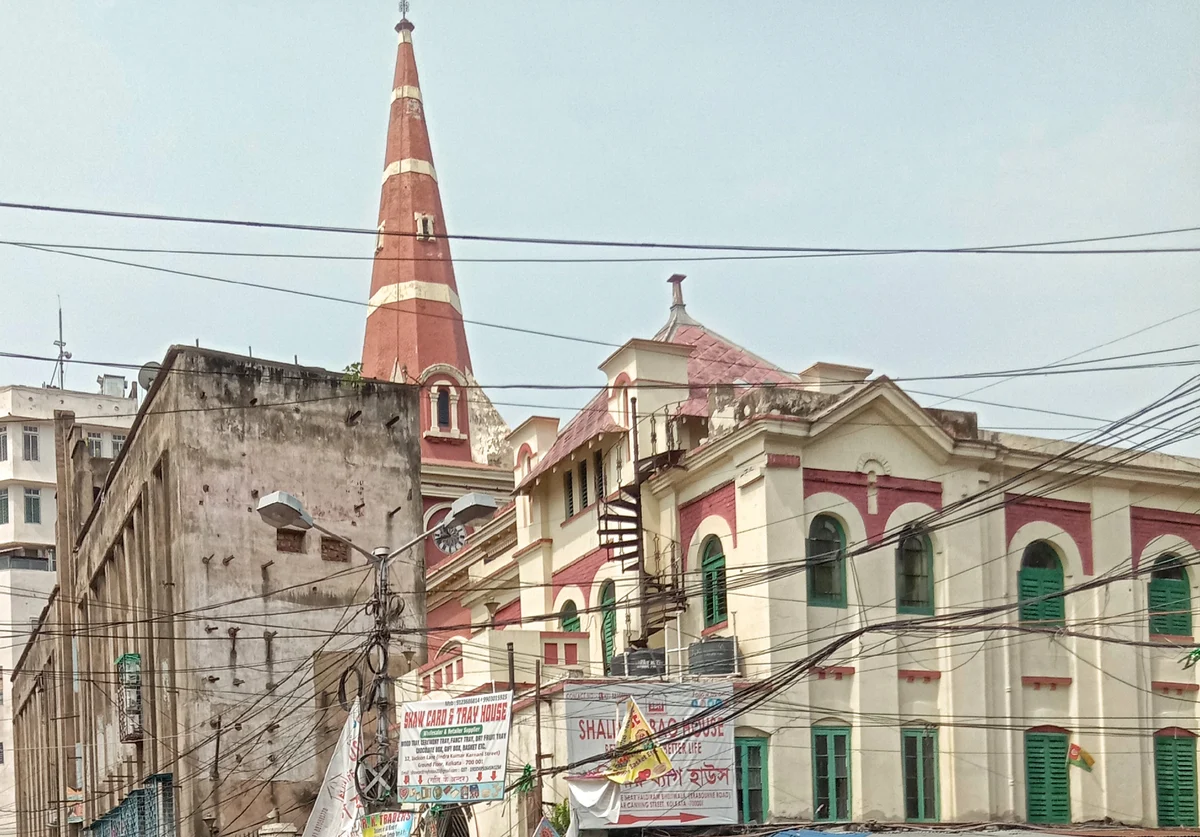
The Archaeological Survey of India’s Kolkata Circle documents two separate synagogues. Beth El is on Pollock Street, and its entrance tablet gives 1856. Maghen David opened in 1884, and the ASI lists it on B.R.B. Bose Road. The Maghen David record describes a nave, aisles and a central tebah, the platform used for reading during services. Together the records provide a building identification and an architectural point to look for if interior access is available.
Searches for Maghen David can also surface the spelling Magen David and results for Mumbai’s Magen David Synagogue. Use the city and the street to check which record you have. Even a search for an 1884 synagogue could land on Mumbai’s Keneseth Eliyahoo, which shares the year with Kolkata’s Maghen David. For notes or captions, keep the name, city and date together so the date cannot travel from one building to another.
If you plan to see Beth El and Maghen David on the same day, verify each one individually. Start with the two ASI Kolkata site records to identify the properties, then confirm admission and photography arrangements with the current custodians for the date you intend to visit. If you can see only the exterior, the site record gives you a way to identify the building and read about its interior without assuming entry.
| Site | Location | Where to start |
|---|---|---|
| Paradesi Synagogue | Jew Town, Mattancherry, Kochi | Kerala Tourism for identification, then the synagogue operator for admission |
| Paravur Synagogue | Ernakulam district | The individual Paravur listing in the Muziris Heritage network |
| Chendamangalam Synagogue | Ernakulam district | The individual Chendamangalam listing in the Muziris Heritage network |
| Keneseth Eliyahoo Synagogue | Kala Ghoda, Mumbai | Sir Jacob Sassoon Synagogues and Allied Trusts |
| Beth El Synagogue | Pollock Street, Kolkata | The Beth El record from ASI Kolkata Circle |
| Maghen David Synagogue | B.R.B. Bose Road, Kolkata | The Maghen David record from ASI Kolkata Circle |
Bnei Menashe in Manipur and Mizoram
ANU Museum of the Jewish People profiles Bnei Menashe communities in Manipur and Mizoram and records their identification with the biblical Menashe. The exhibition provides a source for how the communities describe their lineage. Attribute that account to community tradition. A claim about when an ancestral group reached a particular place would require historical evidence about chronology and movement, which the exhibition account of identification does not independently establish.
Manipur and Mizoram also appear in the 2011 Census table for Jews / Judaism. The Manipur row lists 2,032 people and the Mizoram row lists 332. Adding the rows gives 2,364 people recorded under that religion entry across the two states in 2011. The table has no Bnei Menashe field, so the arithmetic answers a question about the geography of the census returns. Community membership and present residence require evidence collected for those purposes.
That distinction matters when using a map to introduce the subject. A map based on the census can label the two states with the year and the official religion entry. An account of Bnei Menashe life can name the communities profiled in the museum exhibition and attribute their origin tradition. To describe how many members live in either state today, look for a recent community or institutional record that dates the count, defines membership and gives the area covered. The 2011 figures alone cannot establish how many people moved or when.
Sources
- Kerala Tourism: Jews in Kochi
- Kerala Tourism: Chendamangalam Synagogue
- Kerala Tourism: Muziris Heritage Museums
- Lok Sabha unstarred question 3353, 6 December 2016 — Census of India religion totals
- Census 2001 count published 4 May 2016 — Ministry of Minority Affairs
- Bene Israel of Mumbai and the Konkan — ANU Museum of the Jewish People open databases
- The Sassoons exhibition primary collection records — The Jewish Museum
- Keneseth Eliyahoo Synagogue, Mumbai — trust and restoration partner documentation
- Photograph of a Cochin Jewish copper-plate grant, Photo 430/81(1) — British Library
- Paradesi Synagogue, Mattancherry, Kochi — Kerala Tourism site records
- Maghen David and Beth El, Kolkata — Archaeological Survey of India Kolkata Circle
- Bnei Menashe — ANU Museum of the Jewish People exhibition
- Magen David Synagogue as seen from Brabourne Road — original photograph by Billjones94
- Kerala Tourism’s alternative Paradesi Synagogue listing for the schedule comparison
- Restoration partner’s record of Keneseth Eliyahoo’s 2019 reopening
- Archaeological Survey of India, Kolkata Circle, Beth El Synagogue
