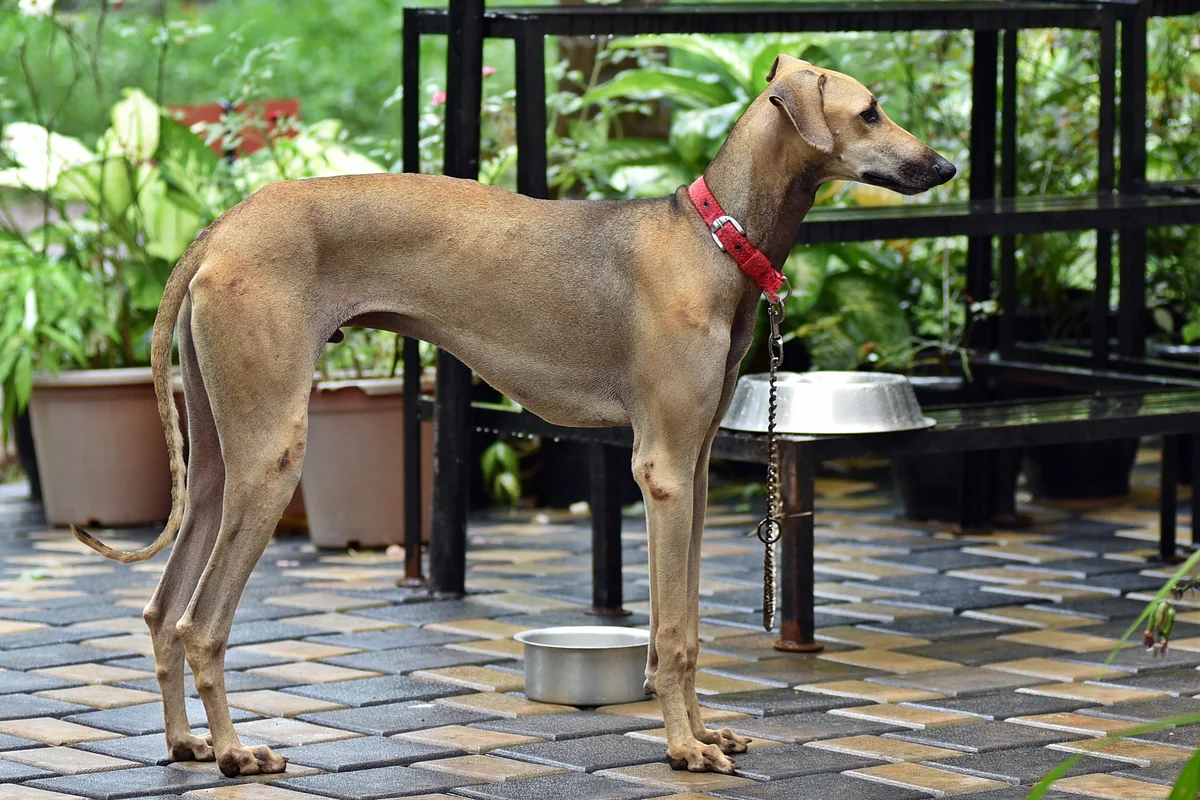
Which native dog breeds are registered in India?
India’s national register of indigenous dog breeds lists six breeds. They are Rajapalayam, Chippiparai, Mudhol Hound, Gaddi, Changkhi and Kombai. Tamil Nadu separately includes Kanni in its native dog policy.
The national list comes from the Indian Council of Agricultural Research’s National Bureau of Animal Genetic Resources, or ICAR-NBAGR. It identifies registered breed populations and assigns a home tract to each. Three of the six entries have Tamil Nadu home tracts. The other three are associated with Karnataka, Himachal Pradesh and Ladakh, with one entry for each. That distribution describes the register’s coverage.
| Breed | Home tract | Accession identifier |
|---|---|---|
| Rajapalayam | Tamil Nadu | INDIA_DOG_1800_RAJAPALAYAM_19001 |
| Chippiparai | Tamil Nadu | INDIA_DOG_1800_CHIPPIPARAI_19002 |
| Mudhol Hound | Karnataka | INDIA_DOG_0800_MUDHOLHOUND_19003 |
| Gaddi | Himachal Pradesh | INDIA_DOG_0600_GADDI_19004 |
| Changkhi | Ladakh | INDIA_DOG_3800_CHANGKHI_19005 |
| Kombai | Tamil Nadu | INDIA_DOG_1800_KOMBAI_19006 |
The accession identifier refers to the breed population in the national registration system. It is useful when you need to match a row to a dated announcement or notification, especially if the spelling or spacing varies on a website. A home tract refers to geography at the population level. To establish where an individual dog was born, or what is known about its parents, look for records that identify that dog.
The register gives no population totals. Its six rows therefore tell you how many breed populations it lists, with no basis there for estimating how common a given breed is or how many dogs live in its home tract. Community dogs and locally used names fall outside the scope of this count. If the question is which dogs you might encounter in a neighbourhood, the national table covers only a narrow part of it.
- Registered dog breeds and home tracts — ICAR-NBAGR
- Union Gazette S.O. 4086(E), 13 November 2020 — Department of Agricultural Research and Education
- January–June 2025 newsletter — ICAR-NBAGR registration and historical home tracts
- ICAR registers 16 new livestock and dog breeds — ICAR
- Tamil Nadu Extraordinary Gazette 308, 28 September 2024 — state policy text
What the registration dates establish
Rajapalayam, Chippiparai and Mudhol Hound were the first three native dog breeds registered in ICAR-NBAGR’s programme, according to the bureau’s 2020–21 record. All three appear in Union Gazette notification S.O. 4086(E), dated 13 November 2020. If you encounter a later digital signature on a copy of the Gazette, use the date printed on the notification itself when citing the notification milestone.
Gaddi and Changkhi followed. The Breed Registration Committee recommended both at its 12th meeting on 6 January 2025, a milestone recorded in the bureau’s January–June newsletter. Union Gazette notification S.O. 1720(E) includes both breeds and is dated 15 April 2025. The wording matters in a timeline. January dates the committee recommendation, and April dates the Gazette notification.
For Kombai, ICAR identifies the 14th Breed Registration Committee meeting on 7 August 2026 as the approval milestone. ICAR’s announcement supplies the accession identifier and the breed appears in the national register. Use the August date for approval. A date for a separate Union Gazette notification would require its own source.
An ICAR ceremony report covering registrations from 2023 through 2025 gave a tally of five registered dog breeds. That figure is useful when reading about the programme at the time of the ceremony. For a present-day count, check the live register and trace new entries to their dated announcements. These administrative dates establish when an institution took a particular action. Evidence for when a breed population developed or first acquired its name would come from a different record.
| Breed group | Verified date | Document or stage |
|---|---|---|
| Rajapalayam, Chippiparai and Mudhol Hound | 13 November 2020 | Union Gazette S.O. 4086(E) |
| Gaddi and Changkhi | 6 January 2025 | Breed Registration Committee recommendation |
| Gaddi and Changkhi | 15 April 2025 | Union Gazette S.O. 1720(E) |
| Kombai | 7 August 2026 | ICAR committee approval. Gazette date remains unconfirmed. |
For Kombai’s identifier, use the full row in ICAR’s dated announcement. Its accession is INDIA_DOG_1800_KOMBAI_19006. The NBAGR live table contains a different middle component for that row. The announcement names Kombai and provides the corresponding code together. Check the current register and the original announcement when recording the breed’s administrative history.
- Indian Council of Agricultural Research: Indigenous Breed Registration
- Indian Council of Agricultural Research: Registration of New Breeds
- Registered dog breeds and home tracts — ICAR-NBAGR
- Salient achievements — ICAR-NBAGR national registration record
- Union Gazette S.O. 4086(E), 13 November 2020 — Department of Agricultural Research and Education
- January–June 2025 newsletter — ICAR-NBAGR registration and historical home tracts
- Union Gazette S.O. 1720(E), 15 April 2025 — official NBAGR copy
- ICAR registers 16 new livestock and dog breeds — ICAR
Where Kanni fits in Tamil Nadu’s records
Tamil Nadu’s policy names Rajapalayam, Kombai, Chippiparai and Kanni separately. The underlying government order, G.O. Ms. No. 80, is dated 27 September 2024, and the state Gazette published it on 28 September. The Tamil Nadu Veterinary and Animal Sciences University likewise names all four in the scope of its research and conservation centre at Pavoorchatram in Tenkasi district.
Keep those institutional names intact when recording a dog or describing the scope of the conservation programme. The state policy and the university both provide a basis for a separate Kanni label in that context. An accession table for nationally registered dogs, by contrast, has entries for Rajapalayam, Chippiparai and Kombai from Tamil Nadu. The state policy also identifies other populations for further work, so the wording attached to each name in that document matters.
Suppose a display at a community event labels two photographs Kanni and Chippiparai. If you are describing Tamil Nadu’s conservation programme, its published names support retaining both captions as supplied, provided the identifications are documented for those dogs. If you are indexing the photographs to the national register, only Chippiparai has a corresponding entry. Keep the Kanni identification with the photograph’s source so readers can trace it.
The university centre’s page establishes its location and research and conservation remit. If your reason for looking it up is to arrange a visit, enquire about adoption or find out whether the centre can answer a question about an individual dog, confirm that service directly with the university. The published programme scope alone gives no details about public access or dog placement.
What the Gaddi and Changkhi records say about work
ICAR-NBAGR connects the Gaddi dog with migratory pastoralists in Himachal Pradesh. Its account records the breed across Chamba, Kangra, Kullu, Mandi, Lahaul and Spiti, and Kinnaur. That district detail gives substance to the state name in the register. The association with pastoralists also places the dog’s historical livestock-guarding role in the context of herding communities.
The same bureau account documents a historical guarding role for the Ladakh-native Changkhi and identifies sheep and goats as the livestock involved. That shared role is a useful point of comparison alongside the distinct home tracts. For a caption, use Changkhi, the spelling in the national register and the newsletter’s registration table. If you are writing about its work, the sheep and goat detail can be attributed directly to the bureau’s account.
The historical record supports describing a role at the breed-population level. It leaves open how a particular dog behaves around unfamiliar people, other animals or livestock today. An owner looking for a dog that can live around animals needs observations of that individual in relevant settings. For a historical account, the register identifies the population to look up, while the bureau’s narrative supplies the context for the work.
How to read breed descriptions and photographs
A 2017 field study of Rajapalayam dogs gives a more precise description than a photograph alone can provide. Published in the Indian Journal of Animal Sciences, it examined 88 adults and 21 pups in sampled settings that included Virudhunagar district and a government dog unit in Chennai. The researchers described a medium, compact build, a white coat, drooping ears and pink skin, nostrils and eyelids among the dogs studied.
The reported mean adult weights were 24.69 kg for males and 21.42 kg for females. Both figures are averages for the sampled dogs. They give a sense of observed size in that study and leave room for variation between individuals. When reporting them, name the study year and retain the distinction between males and females. The figures establish neither an identification threshold nor a target weight for a particular dog.
Suppose someone sends a picture of a white, droop-eared dog and asks whether it is a Rajapalayam. The study gives you language for describing visible similarities. The picture supplies no evidence about the dog’s parentage or records. If the image is for publication, use a caption that reflects what the photographer, keeper or accompanying documentation can establish. When that information is missing, describe the dog in the photograph without assigning a breed.
A well-documented image can still show an individual usefully. The photographer of one 2018 Chippiparai photograph identifies the dog as Nipper and gives its age as 14 months. Naming Nipper and stating the age tells a reader exactly what the image illustrates. Features visible in one photograph can prompt questions for a field study or breed description, where the source can say which dogs it examined.
What to check before bringing a dog home
Start with the dog’s life stage and what is known about its current routine. The American Animal Hospital Association’s canine life-stage guidance groups preventive care, behaviour, nutrition and activity around individual needs. Ask the current keeper or shelter about the dog’s ordinary day, including where it rests, what activity it currently gets and how it responds to visitors or other animals. Recent observations are especially useful when they describe conditions similar to those in your household.
Think through where exercise can happen safely, how the routine would work during the hottest part of the year and what the dog can do indoors when outdoor time is limited. Take access to veterinary care into account alongside space. A workable plan includes a place for the dog to settle, regular activity it can comfortably manage and a practical way to get preventive care. A breed’s home tract cannot predict how an individual dog will cope with its new routine.
If you are choosing between a young dog with little recorded history and an adult whose foster carer has observed it around visitors, the adult gives you more directly relevant evidence for a busy home. Ask what the carer saw when visitors entered and how long it took the dog to settle. Use what is known about each dog to work out what the first weeks would demand and where you would need more information.
Where to verify a breed name, code or recognition claim
For a national registration claim, start with ICAR-NBAGR’s dog register and note when you consulted it. If the accession identifier matters for a catalogue, caption or database, compare it with the dated ICAR announcement or Gazette notice. Kombai is a case where that second check changes the result. The live table repeats the Changkhi name token in Kombai’s row, printing INDIA_DOG_1800_CHANGKHI_19006. ICAR’s announcement gives INDIA_DOG_1800_KOMBAI_19006, the value used here.
The Mudhol Hound entry has a spacing discrepancy on the website. Gazette notification S.O. 4086(E) prints INDIA_DOG_0800_MUDHOLHOUND_19003 with the breed token joined. Use that form when transcribing the Gazette identifier, and use Mudhol Hound with the space when writing the breed name. For a state policy claim, consult the state Gazette and keep its wording, particularly for names such as Kanni.
If someone describes a breed as internationally recognised, ask which institution issued the recognition. The Fédération Cynologique Internationale publishes its own nomenclature and distinguishes definitive and provisional recognition. Its member directory also identifies the Kennel Club of India. A directory entry verifies the club’s membership. To verify the status of a particular breed, look for the breed itself in the relevant institution’s records and record the category shown there.
- Registered dog breeds and home tracts — ICAR-NBAGR
- Union Gazette S.O. 4086(E), 13 November 2020 — Department of Agricultural Research and Education
- ICAR registers 16 new livestock and dog breeds — ICAR
- Tamil Nadu Extraordinary Gazette 308, 28 September 2024 — state policy text
- Official breed nomenclature — Fédération Cynologique Internationale
Sources
- Indian Council of Agricultural Research: Indigenous Breed Registration
- Indian Council of Agricultural Research: Registration of New Breeds
- Registered dog breeds and home tracts — ICAR-NBAGR
- Salient achievements — ICAR-NBAGR national registration record
- Union Gazette S.O. 4086(E), 13 November 2020 — Department of Agricultural Research and Education
- January–June 2025 newsletter — ICAR-NBAGR registration and historical home tracts
- Union Gazette S.O. 1720(E), 15 April 2025 — official NBAGR copy
- ICAR registers 16 new livestock and dog breeds — ICAR
- Tamil Nadu Extraordinary Gazette 308, 28 September 2024 — state policy text
- Research and conservation centre for native dogs — Tamil Nadu Veterinary and Animal Sciences University
- Phenotypic characterization of Rajapalayam dogs — Indian Journal of Animal Sciences field study
- Official breed nomenclature — Fédération Cynologique Internationale
- Canine life-stage checklist — American Animal Hospital Association
- Nipper, 14 months old Chippiparai dog — original photograph by Pankajakshannair Manoj
