Did Albert Einstein visit India?
The archival sources checked for this page establish no visit by Albert Einstein to India, and the documented itinerary of his 1922–23 voyage gives no India stop. His documented India connections include scientific correspondence with Satyendra Nath Bose, conversations with Rabindranath Tagore in Germany, and a meeting with Jawaharlal Nehru in Princeton on 5 November 1949.
The scope of the travel evidence matters. The voyage records cover a particular journey, while the Bose, Tagore and Nehru sources cover particular exchanges. A claim about Einstein’s whereabouts on another journey would need evidence from that journey. The strongest positive account of his India connection comes from naming the people involved, the kind of contact they had, and the place associated with each record.
Place names can change in ways that matter to this search. The Indian National Science Academy memoir places Bose’s 1924 correspondence in the context of Dacca, then in British India. The city is now Dhaka, Bangladesh. A historical note can give both names and jurisdictions in one line. The period name explains the India connection, and the modern name lets a reader place the city on a current map.
The words visit and meeting also deserve a named subject. In July 1930, Tagore visited Einstein at his summer residence in Caputh. A calendar description such as ‘Einstein and Tagore meet’ is accurate but leaves the geography open. Add Caputh, Germany, and the date, 14 July 1930, and the entry tells a reader who travelled, where the encounter took place, and which conversation to look up.
What the 1922–23 voyage records cover
The Hebrew University’s Einstein Archives exhibit gives the voyage a precise starting point. Albert and Elsa Einstein left Marseille on 8 October 1922 aboard SS Kitano Maru. They travelled to the Far East via the Suez Canal. The published edition of Einstein’s travel diary documents the wider voyage, with stops in East and Southeast Asia as well as Palestine and Spain. The itinerary reviewed here yields no documented India stop.
The ship name and departure date give a reader a way to test a claim about this voyage. A general reference to a trip to Asia provides a region and may cover several legs. An account of a port call should supply a port and date that can be checked against the diary or other contemporary records. If the claim concerns time ashore, look for a record that places Einstein himself there.
Suppose a local history says Einstein stepped ashore in Bombay during his journey to the Far East. Start by asking which sailing the account refers to and whether it cites a dated passage or a contemporary report. The known October 1922 departure gives you a point of comparison. A description of the general route through Suez leaves the proposed Bombay stop unresolved, while a source naming Einstein at a specific port on a specific day gives you something to check.
Use the archival exhibit to identify the voyage and the published diary to follow its documented extent. If a claim supplies a date outside 1922–23, set this itinerary aside and look for a record covering that date. That keeps a finding about one journey from turning into a judgment about every year of Einstein’s life.
Bose’s 1924 letter and manuscript
The strongest dated evidence for Einstein’s scientific connection to India is Satyendra Nath Bose’s 1924 letter about his work on radiation statistics. The Indian National Science Academy’s biographical memoir reproduces the letter. The archive at the S. N. Bose National Centre for Basic Sciences catalogs the papers and correspondence and records that Bose sent Einstein his manuscript. According to the archive, Einstein recognised the work and extended its statistical calculation.
The sequence gives each scientist a distinct role. Bose initiated the exchange by sending his work, and Einstein took up and extended the calculation. For an account of who contributed what, begin with what Bose sent, then describe Einstein’s response using the archive. This preserves the direction of the exchange, a detail that can disappear when a caption or a brief biography describes the two men as collaborators.
The memoir and catalogue serve different reading tasks. Go to the memoir to see the reproduced letter and its biographical setting. Use the Bose archive to locate manuscripts and correspondence and to follow how the institution describes the scientific exchange. For a detailed account of the calculation, the manuscript and Einstein’s subsequent work would be the appropriate texts to consult. The supplied archival description supports the narrower statement about the extension.
The memoir also discusses later European contacts. Keep those in their own chronology when describing how the relationship developed. For a timeline anchored to the first correspondence, 1924 is the supported year and Dacca is the historical setting for Bose’s side of the exchange. A sentence built around the verb ‘sent’ conveys the significant action and leaves the location of any later encounter to the relevant record.
Tagore’s conversations with Einstein in Germany
The National Gallery of Modern Art’s Tagore chronology records that Rabindranath Tagore met Einstein during his 1926 European trip. The editor of volume 17 of The Collected Papers of Albert Einstein also records that earlier meeting. The chronology establishes the year at the level used here. It supplies no exact day, so a calendar that requires a day and month should keep this encounter in a year-level chronology.
Two later conversations can be dated precisely. On 14 July 1930, Tagore visited Einstein at his summer residence in Caputh, near Potsdam. The Max Planck Institute’s virtual Einstein exhibition independently places the visit there. On 19 August 1930, the two spoke in Berlin. Both places are in Germany, and each entry needs its own location. For an anniversary tied to the summer residence, use the July date.
Volume 17 identifies the Caputh conversation as document 372, ‘On the Nature of Reality’, associated with The New York Times. It identifies the Berlin conversation as document 396, ‘Tagore Talks with Einstein’, associated with Asia. Both texts concern reality and humanity’s role in describing it. A reader looking for a particular passage can use the volume and document number to find the relevant text and then check which meeting the edition assigns it to.
The conversation date, the publication venue and the title answer separate questions. The date and place tell you when and where the speakers met. The edition’s title and publication attribution help you track down the account readers encountered in print. If a quotation appears on an anniversary card, the document number is a practical starting point for checking the wording and attaching it to the correct conversation.
New York and Princeton records
The Leo Baeck Institute catalogues a meeting between Tagore and Einstein in New York in December 1930. It belongs alongside the German encounters as a separate event with month-level dating. New York, United States, is enough for a location entry at the resolution supported here. A day-specific anniversary would need a source that dates the meeting more closely.
A portrait can supply a different date from the event it is used to illustrate. The Institute for Advanced Study says Martin Vos most likely took his formal portrait of Einstein in his New York studio. The portfolio is labelled December 1930, New York, while a related print carries 1931. The catalogue therefore leaves the exact photo year uncertain. The Leo Baeck Institute meeting record is the source to use for the month of the Tagore encounter.
The Nehru record has a day, month and year. The National Digital Library of India catalogues a photograph of Jawaharlal Nehru with Einstein in Princeton, New Jersey, on 5 November 1949. The Harry S. Truman Library independently gives the same date. Readers searching by year will find this encounter nearly two decades after the Tagore meetings of 1930, with a different visitor and a different city.
The Institute for Advanced Study also has a group photograph from 1949 whose catalogue names Indira Gandhi, Nehru and Vijaya Lakshmi Pandit. Use the group record for the people it identifies and the dated Nehru photograph for the Princeton meeting date. If an event entry includes a photograph, check the catalogue record for the exact image being captioned. Public access to the record and permission to reproduce its image require separate checks.
Dates and places for an event lookup
Choose the record that matches the occasion you are marking. A programme tied to the first documented Tagore conversation in Caputh can use 14 July. A discussion of the Bose correspondence can use 1924 as its historical reference and give the programme its own advertised date. Distinguishing the date of the original exchange from the date of a modern event keeps both entries usable.
| Date or period | Place or channel | Record type | Connection | Archive |
|---|---|---|---|---|
| 1922–23 | Travel from Marseille via Suez toward East and Southeast Asia | Travel itinerary | The checked travel record gives this route. No India visit is documented in that itinerary. | Einstein Archives travel exhibit |
| 1924 | Correspondence from S. N. Bose | Scientific correspondence | Bose sent his manuscript to Einstein, who recognized and extended the work. | S. N. Bose National Centre archive |
| 1926 | Europe | Tagore meeting | Indian institutional chronology records a meeting on Tagore’s European trip. | National Gallery of Modern Art chronology |
| 14 July 1930 | Caputh, Germany | Tagore meeting | Discussion at the Einstein summer residence near Potsdam. | Max Planck Institute Caputh reference |
| 19 August 1930 | Berlin, Germany | Tagore meeting | The Einstein Papers editor records a separate German conversation. | Caltech Einstein Papers Project |
| December 1930 | New York, United States | Tagore meeting | The Leo Baeck Institute catalogues a separate New York encounter. | Leo Baeck Institute archive |
| 5 November 1949 | Princeton, New Jersey | Nehru meeting | Dated photographic archives place Nehru and Einstein together in Princeton. | National Digital Library of India |
The historical entries use the stated civil dates at the places concerned. An archival date can be used for an anniversary without assigning the original meeting an hour. For a current lecture, exhibition or online discussion, check the organizer’s listing for the date, venue, start time and stated time zone. For an online session, compare the organizer’s local date with the date in India. Depending on the hour, the two can differ.
Check the organizer’s listing again before relying on it for travel or registration. The details that can change include the venue, admission arrangements, availability and whether the event is going ahead. A current listing should expire after the event ends. An archival date can stay in the reference table, with a correction if an institution subsequently revises its catalogue or a primary document supplies a more precise date.
Steve Jobs in India, the 1974 trip and Kainchi Dham
- Indian National Science Academy: Bose Biographical Memoir
- Einstein Archives | original records for the Far East and Palestine trip
- Caltech Einstein Papers Project | critical edition Vol. 17 editor on Tagore
- Max Planck Institute virtual Einstein exhibition | Caputh meeting record
- National Gallery of Modern Art, New Delhi | institutional Tagore chronology
- Leo Baeck Institute | New York meeting archive
- S. N. Bose National Centre for Basic Sciences | research correspondence context
- National Digital Library of India | Nehru archive Princeton meeting photograph
How to check a claim or caption
Start with the claim you want the record to support. For a claim about travel, look for an itinerary or a dated record that places Einstein in the city. For a claim about an exchange of ideas, identify the letter, manuscript or conversation text. For a photograph, check whether the catalogue identifies the sitter, photographer, place and date, and preserve any qualifications the institution puts on those fields.
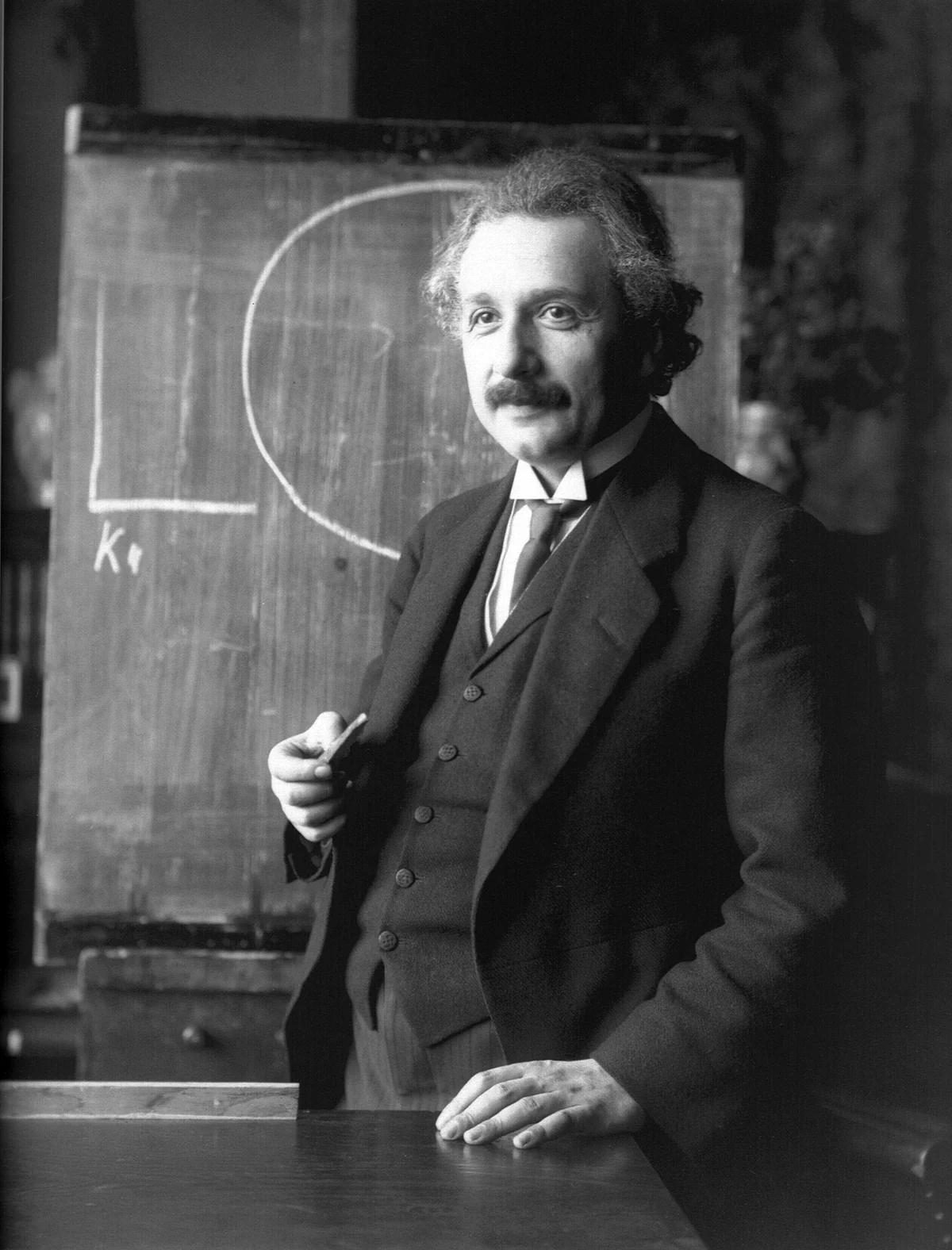
Ferdinand Schmutzer’s photograph shows Einstein during a lecture in Vienna in 1921. Its date and location make for a specific caption if it accompanies a general article about Einstein. For an image tied to the Caputh meeting, look for a catalogue entry for that encounter and check the rights for the exact item. The documentation for a general portrait describes the circumstances of that photograph, even when the surrounding article concerns a different place and year.
When a catalogue changes, update the field supported by the new evidence. A newly established date can sharpen a timeline entry. A revised portrait attribution can change the caption. A dated travel record that places Einstein in India would bear directly on the visit claim and should be checked against the relevant journey. Capture the institution, document or item number, and exact place and date so another reader can locate the same evidence.
- S. N. Bose National Centre for Basic Sciences: Bose Archive
- Einstein Archives | original records for the Far East and Palestine trip
- Caltech Einstein Papers Project | critical edition Vol. 17 editor on Tagore
- Max Planck Institute virtual Einstein exhibition | Caputh meeting record
- Institute for Advanced Study | Martin Vos portrait catalogue and rights record
- National Digital Library of India | Nehru archive Princeton meeting photograph
- Wikimedia Commons | Ferdinand Schmutzer photograph of Einstein in Vienna
Sources
- S. N. Bose National Centre for Basic Sciences: Bose Archive
- Indian National Science Academy: Bose Biographical Memoir
- Einstein Archives | original records for the Far East and Palestine trip
- Caltech Einstein Papers Project | critical edition Vol. 17 editor on Tagore
- Max Planck Institute virtual Einstein exhibition | Caputh meeting record
- National Gallery of Modern Art, New Delhi | institutional Tagore chronology
- Leo Baeck Institute | New York meeting archive
- Institute for Advanced Study | Martin Vos portrait catalogue and rights record
- S. N. Bose National Centre for Basic Sciences | research correspondence context
- National Digital Library of India | Nehru archive Princeton meeting photograph
- Wikimedia Commons | Ferdinand Schmutzer photograph of Einstein in Vienna
- Princeton University Press edition of the 1922–23 travel diaries
