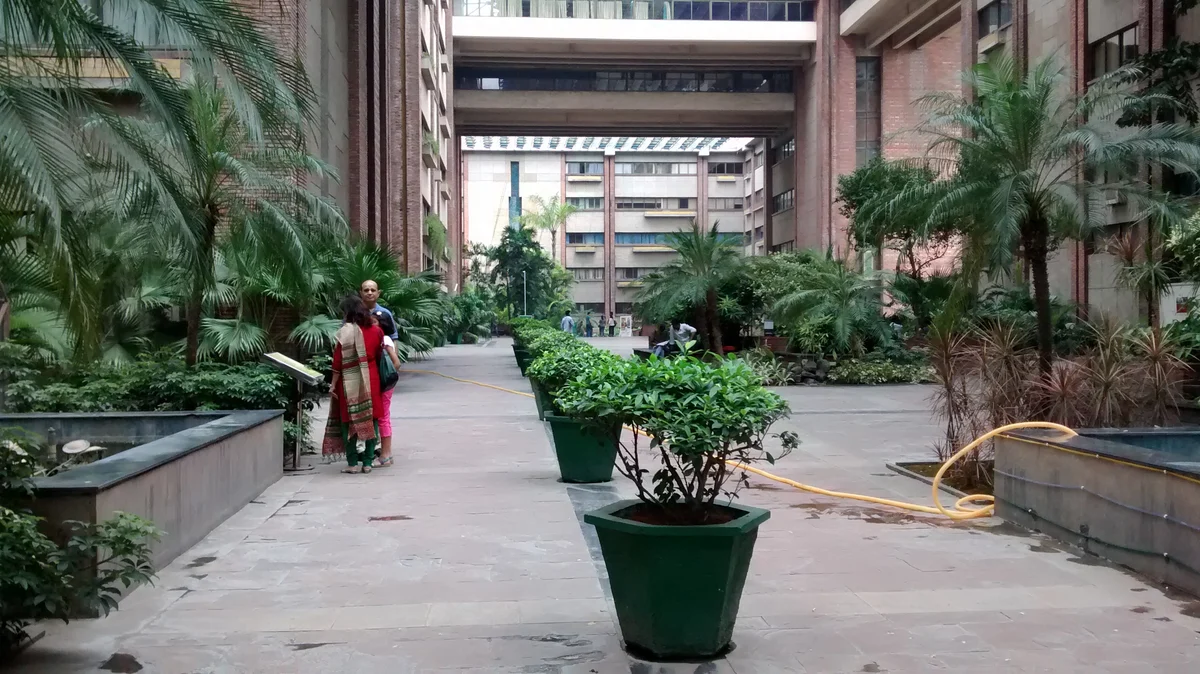
New Delhi office address and contact details
The ILO lists its India country office at India Habitat Centre, Core 4B, 3rd Floor, Lodhi Road, New Delhi 110003. The official India programme PDF gives delhi@ilo.org and +91 11 4750 9200, and the ILO India country page is the place to verify current contact details and visit arrangements.
Keep Core 4B and 3rd Floor in the address when arranging a meeting or preparing correspondence. India Habitat Centre identifies the complex, while the core and floor identify the office within it. If you already have a meeting, use the arrival instructions supplied with the appointment and ask your host to confirm any details the published address leaves open.
An address in a programme PDF is evidence of the address the ILO published with that document. Opening hours, visitor procedures and the availability of a particular staff member are separate details. Check the contact information on the India country page and ask the office directly about the date you intend to go, the entrance to use and any access arrangements you need.
For a country-office enquiry, put the subject and the action you need in the first lines. For instance, a researcher trying to identify the latest India publication on skills can name the report already found, give its publication year and ask for the current title or publication record. That gives the office a specific question it can route and helps distinguish an update from a different report on the same topic.
What the New Delhi office covers
The International Labour Organization is a United Nations specialised agency focused on labour and decent work. Its India country page is the public starting point for work in India, with routes to country programmes, publications, project updates, labour statistics and contacts. The New Delhi office also has a regional role through the Decent Work Technical Support Team for South Asia, which the ILO directory identifies as the DWT.
The Asia-Pacific directory lists eight countries in the New Delhi technical team’s scope. They are Afghanistan, Bangladesh, India, Iran, Maldives, Nepal, Pakistan and Sri Lanka. Use that list to establish the team’s regional remit. For a country-specific enquiry outside India, look for that country’s own entry in the directory, which lists country-office contacts separately where the ILO maintains an office.
This distinction matters when a document credits several ILO offices or names New Delhi alongside partners in another country. The office credit can identify the technical team involved, while the project description tells you where the work takes place. If you want to know whether an initiative includes India, check the project’s geographic description and any country information it provides before using the address in its credits to route your enquiry.
For an overview of work planned specifically for India, start with the India country programme. For the status of a particular activity, look for a project update or a related publication on the country page. A programme can establish the intended outcome over several years. To establish what happened in a particular place or period, look for a dated record that actually reports that activity.
| Country in the ILO regional directory | Scope of this entry |
|---|---|
| Afghanistan | Technical support team country coverage |
| Bangladesh | Technical support team country coverage |
| India | Technical support team country coverage |
| Iran | Technical support team country coverage |
| Maldives | Technical support team country coverage |
| Nepal | Technical support team country coverage |
| Pakistan | Technical support team country coverage |
| Sri Lanka | Technical support team country coverage |
Read the India Decent Work Country Programme
The Decent Work Country Programme for India covers 2023–2027. It sets out how the ILO intends to contribute to India’s decent-work agenda during those five years. The programme grew out of tripartite consultations involving government, workers and employers, with input from other stakeholders at national and state levels. That background explains why the document describes shared priorities and policy outcomes across institutions.
Use Table 3.1 in the full programme PDF when you need the wording of a priority or policy outcome. Its matrix lets you see how an outcome sits under a broader priority. In a proposal or briefing, record the programme title, its period and the table reference alongside the relevant wording. A colleague can then locate the same entry and see its context without having to search for a broad topic across the whole PDF.
If a training provider preparing a proposal finds a relevant policy outcome in the matrix, it can cite that outcome to explain how the proposal relates to the programme. Any claim about funding or eligibility needs a separate published opportunity that sets out who can apply and on what terms. The country programme itself is a co-ordination framework, so the fact that an activity fits a priority establishes a policy connection.
Check the India country page for later announcements if the timing matters to your work. Keep the programme period attached to any claim about intended outcomes, and use the date of a specific project update when discussing implementation. This lets a reader tell whether a sentence describes an objective for 2023–2027 or records a development documented during that period.
Find labour figures and interpret them correctly
Use the India Employment Report 2024 for analysis of youth employment, education and skills. The Institute for Human Development authored the report in partnership with the ILO. Use the India profile in ILOSTAT when you need a labour-market indicator and its metadata. The report gives its analysis in the context of the data used for its charts, while the profile directory offers series that can be updated.
Start with the chart or table that supports the exact statement you want to make. Record the survey reference year, the group measured and the denominator. The year in India Employment Report 2024 identifies the publication, so check the chart or its notes to find out when the underlying data were collected. For a chart covering several years, keep the reference year attached to each value you quote.
Suppose a briefing needs to explain youth unemployment alongside young people’s participation in the labour market. An unemployment rate uses the youth labour force as its denominator. A labour force participation rate uses the youth population in the specified age band. The figures answer different questions even if they refer to the same year. Name the denominator for each figure so a reader can tell which population the percentage describes.
In ILOSTAT, check whether the selected series contains observed data or modelled estimates. Read the indicator definition and confirm the age band and reporting period. When a figure from ILOSTAT differs from one in the report, compare these fields and the underlying source before attributing the difference to a change in employment. Keep a record of the series and filters used so a later reader can reproduce the lookup or identify a revision.
Look up India’s record on international labour standards
Use the India country profile in NORMLEX to verify India’s record on a specific international labour standard. The profile gives India’s ILO membership date as 28 June 1919 and provides routes to records on individual conventions and other standards. For a claim about a convention, look up its identifier and read the status shown for India. Membership and convention ratification are separate entries.
The convention number is especially useful when a briefing uses a shortened title or discusses several instruments on the same topic. Match the number to the formal title before recording the country status. If your question concerns follow-up, read the relevant supervisory record and note whose observation it is and what period it covers. A ratification entry records the status of the instrument, while a supervisory record may address particular questions about its application.
For instance, an editor checking a sentence that says India has ratified a convention should ask for the convention number, verify the India entry and carry the status into the sentence. If the next sentence makes a claim about duties under Indian law, it needs evidence for the national provision. Use the profile’s distinction between international standards, national legislation and supervision to keep each statement tied to the record that answers it.
Where a citation will be reused in a policy note or teaching material, preserve the country name, instrument number, status and date of the entry where shown. Add the specific follow-up document if you rely on one. This gives the next reader a precise lookup and makes it easier to spot a later development, particularly when the same instrument appears in discussions about several countries.
The India profile gives 28 June 1919 as the country’s ILO membership date. For a convention, use the separate ratification or entry-into-force record. Those dates can be decades later and differ by instrument. Keep the convention number and its status attached to any claim about what India ratified.
Find and verify ILO vacancies
Use the ILO careers portal for vacancies with the organisation. Open the individual posting and check its duty station, vacancy reference, application conditions and deadline. The New Delhi country office address helps with office correspondence, while the duty station in a vacancy tells you where that specific role is based. Read the posting’s application instructions to determine where and how to submit.
If a notice forwarded to you describes an ILO position in Delhi, search the careers portal using the vacancy reference. Compare the official title, duty station and closing date with the forwarded notice. If the reference is missing, use the title and duty station to search, and rely on the official posting for any application action. The ILO provides a job fraud warning in its own postings.
Read the application conditions before preparing documents. The public country page can help you understand the context of work in India, but the posting supplies the criteria and instructions for that recruitment exercise. That distinction also helps when a project update mentions another organisation. Look for the employer named in the vacancy and use that employer’s official recruitment information for a position it advertises.
Record the vacancy reference with any copy of the role description you keep. A title can recur, and roles with similar names can have different duty stations and closing dates. When returning to a saved notice, reopen the official record to check the deadline and application conditions before relying on an earlier copy.
Document checklist for enquiries and citations
Before writing to the office or citing an ILO resource, identify the record that would settle the question. If the question is about a specific figure, the table or indicator is the relevant record. If it is about a proposed visit, the current office contact information is the starting point. Saving the details below makes it easier to return to the same record as listings, data and contact information change.
| Task | Official record to consult | Details to save |
|---|---|---|
| Address a letter or arrange a visit | India country page and programme PDF contact section | Street address, core, floor, verified contact and any visit confirmation |
| Identify the office for another country | ILO Asia-Pacific office directory | Country, office name and contact listed for that country |
| Cite an India programme priority | India Decent Work Country Programme 2023–2027, Table 3.1 | Programme period and wording of the priority or outcome |
| Quote a youth employment finding | India Employment Report 2024 | Chart or table, survey year, age band and denominator |
| Compare labour indicators | India profile in ILOSTAT | Series, definition, reporting period, filters and observed or modelled status |
| Verify a convention’s status | India country profile in NORMLEX | Convention number, India status and any follow-up record cited |
| Apply for an ILO role | Individual vacancy on the ILO careers portal | Vacancy reference, duty station, eligibility, submission instructions and deadline |
For an enquiry tied to a document, include the full title and the page, table or record identifier. Describe the one point you need clarified and state how you intend to use it if that affects the answer. A request to confirm which series a chart draws on is easier to act on when the chart is identified and the uncertainty concerns a specific year, age group or measure.
For material that will be circulated later, keep the date you consulted the official record in your working notes. Check time-sensitive details again just before use, especially visit arrangements, vacancy deadlines and figures pulled from ILOSTAT. If two official records differ, preserve the wording and date of each and check the one maintained for that purpose. For a visit, ask the office to confirm the detail that affects your plans.
- ILO official India country page
- ILO Asia-Pacific regional country and liaison office directory
- ILO Decent Work Country Programme for India, 2023–2027
- ILO full programme PDF with priorities and official New Delhi address
- ILO and IHD India Employment Report 2024
- ILO labour data and continuously updated ILOSTAT profile directory
- ILO NORMLEX India country profile
- ILO careers and application information
Sources
- ILO official India country page
- ILO Asia-Pacific regional country and liaison office directory
- ILO Decent Work Country Programme for India, 2023–2027
- ILO full programme PDF with priorities and official New Delhi address
- ILO and IHD India Employment Report 2024
- ILO labour data and continuously updated ILOSTAT profile directory
- ILO NORMLEX India country profile
- ILO careers and application information
- India Habitat Centre independent photo
