Find a toilet you can use when you need it
For a public toilet in India, start with the Swachhata app’s SBM Toilet Locator or the transport operator’s amenities list, then confirm the entrance, opening hours and facilities you need. For drinking, brushing your teeth and making ice, use factory-sealed bottled water or adequately treated water whenever the local supply is uncertain.
| Need | Setting | Public source | What to verify before relying on it |
|---|---|---|---|
| Toilet | Indian city or town | Government’s Swachh Bharat toilet locator reference | Entry and hours, fee, accessible cubicle and handwashing. |
| Toilet | Rural village or road stop | Public sanitation programme’s facility explanation | The exact public or community facility, who can use it and whether it is open. |
| Refill or baby changing | Delhi IGI Airport | DEL Cares terminal amenities | Your terminal, passenger access, available fixture and any temporary outage. |
| Sealed drinking water | Rail premises and trains | Railway Board’s packaged drinking-water circular | Current printed MRP, sealed bottle and whether a named brand is available. |
| Tap-water reports | Rural government testing and reporting | Jal Jeevan Mission water-quality reporting system | Test date and the actual source or distribution point. |
The Government of India’s October 2026 feature on the urban toilet locator gives an example near a railway and temple visitor area in Tirupati. That makes the locator a useful starting point for a trip that combines a station arrival with sightseeing. Check where the actual entrance sits in relation to your route. A pin near the station may require an exit onto the street, which matters if you plan to use the toilet during a transfer.
Choose the questions that could change your stop. If you need a seated toilet, ask about the cubicle itself. If you need step-free access, ask about the approach from your arrival point as well as the accessible cubicle. You can also ask about paper, a handwashing point and any charge. When a facility is essential to the journey, identify a second stop you can reach if the first is closed or its entrance is impractical.
- Government of India — Swachh Bharat urban toilet locator, October 2026
- Department of Drinking Water and Sanitation — Rural sanitation FAQ
- CDC Yellow Book 2026 — India traveler health chapter
- Delhi International Airport — DEL Cares passenger amenities
- Railway Board — Packaged drinking-water retail circular 18 of 2025
- Jal Jeevan Mission — Government water-quality report lookup
Plan toilet stops on rural road and boat journeys
The Department of Drinking Water and Sanitation’s rural sanitation FAQ distinguishes public toilets intended for visitors or travellers from community facilities provided for groups of residents. The two can look like equally promising stops on a map. Ask whether the facility admits visitors and how you enter it. The FAQ also describes locally managed pay-and-use provision, so check the charge and payment method with the person who runs the stop if you expect to rely on it.
Ask your accommodation host or departure-point operator about a staffed public toilet before a long leg. Give them your departure time and ask about a specific place along your route. A host may be able to direct you to a facility serving travellers, while the operator can tell you whether an amenity at the departure point is available before boarding. That distinction helps if there is little time between arriving and getting on board.
Suppose you have an early boat departure and your trip notes mention a community toilet near the landing. Ask the operator whether passengers can use it before your departure. If access is still uncertain, use a confirmed facility at your accommodation or on the way to the landing. For the return trip, ask again if you’ll pass through at a different time. An answer about morning access only covers the morning stop.
Rural India travel, four village stays and day trips by regionHow to plan a trip to India
Check Delhi airport refill points and baby-changing facilities
Delhi International Airport publishes free drinking-water refill points across passenger terminal areas, including near lounges and gates. Look for the dedicated drinking-water sign and check that the point is operating. If you see an unmarked tap or are unsure which fixture the sign refers to, ask airport staff to direct you to a designated point. The airport’s listing establishes that it provides the amenity. Staff can help you locate one you can reach from your part of the terminal.
The airport also lists baby-changing facilities near washrooms and family zones. If you need to change a baby and refill a bottle before boarding, give staff your gate or current location and ask for the closest operating facilities. Each amenity has its own location, so check both before walking away from the gate area. If boarding is close, the distance to the facilities may determine which stop you can make.
Use the operator’s passenger amenities information for the terminal you’ll actually use, especially if your arrival and departure involve different parts of the airport. At another airport, look up that operator’s drinking-water and washroom information. The Delhi listings apply to Delhi International Airport, and they provide a model for the details to look for elsewhere, including whether the refill point is designated for drinking and where the changing facilities are located.
Buy sealed bottled water on trains and at stations
At a railway station or on a train, buy a factory-sealed bottle from an authorised seller when you are unsure about the water source. Check the seal and read the printed maximum retail price, or MRP, on the bottle you are offered. If the packaging is already open, ask for another bottle. Verify separately whether water is included with your fare or meal if you are counting on that provision.
| Sealed bottle size | Published MRP | Scope |
|---|---|---|
| 500 mL | ₹9 | Rail Neer or another eligible railway-shortlisted packaged brand at stations or on trains. |
| 1 litre | ₹14 | Rail Neer or another eligible railway-shortlisted packaged brand at stations or on trains. |
Railway Board circular 18 of 2025, issued on 20 September 2025, set maximum retail prices from 22 September 2025 at ₹14 for one litre and ₹9 for 500 mL. Its scope covered Rail Neer and other railway-shortlisted packaged drinking-water brands sold on railway premises or trains. Use those figures as a dated benchmark. For a journey now, check the latest Railway Board circular and the printed MRP. Ask the railway operator about availability if you need to decide whether to buy water before boarding.
The Food Safety and Standards Authority of India’s December 2025 direction confirms that the mandatory BIS certification-mark requirement for packaged drinking water and mineral water was removed. An FSSAI testing scheme applies from 1 January 2026. Older advice that treats the absence of a BIS mark as a reason to reject every bottle is out of date. For a purchase, focus on an intact factory seal and a retailer you can identify.
Decide which water to use for drinks, teeth and food
The CDC’s India guidance advises travellers to avoid untreated tap or surface water when the supply is uncertain. Its food and water guidance applies the same choice of factory-sealed bottled or adequately treated water to brushing teeth, making ice and preparing food. Keep enough of your chosen supply for the uses you will have between stops. A bottle you finish on arrival leaves you with the same decision again when you brush your teeth.
At an accommodation, ask which water the property provides for drinking and where it comes from. If staff point to a dispenser, ask whether it uses sealed containers or treats water on site, and which outlet draws from that supply. A drinking-water dispenser in the lobby and the bathroom tap are separate points of use. If the property can explain the dispenser’s supply but the room tap remains uncertain, use the confirmed drinking supply for brushing as well.
Treat ice as a separate question when ordering a drink. If you order a factory-sealed soft drink, then pour it over ice, the ice introduces another water source. Ask what water was used to make it and choose the drink without ice if the answer is unclear. The same reasoning applies when you prepare food with water at a self-catering stay. Set aside safe water for that use when you plan what to bring back from the shop.
Read local water reports for the actual supply
Start with the source your accommodation identifies, then look for a report that covers that supply. Delhi Jal Board publishes dated drinking-water records. One listed report covered 17–31 August 2026 and had a posting date of 4 September 2026. Read the sampling period as well as the posting date and check which supply was sampled. A premises tank, filter or tap can have different conditions at the point where you draw water.
For a rural stay, the Jal Jeevan Mission’s Water Quality Management Information System provides reports for tested source and delivery points. Match the state, district and source identity, then check the test or report date. Ask the host for the source name if you cannot identify the relevant entry. Use a matching record for the point and period it covers. If the view is empty or the only result is for a different nearby source, the status of your supply remains uncertain.
The mission’s definition of a functional rural household tap connection specifies regular long-term supply, 55 litres per person per day and prescribed water quality under BIS IS 10500. Those are household service criteria. For your stay, the relevant questions are where the water comes from, how it reaches the outlet and whether recent results or local notices cover that supply. The use of a BIS standard in this programme has a separate scope from the certification-mark rules for bottled water.
Follow current local contamination notices when they apply to the supply you plan to use. The CDC distinguishes treatment for germs from chemical contamination. If harmful chemicals are suspected, choose another safe supply, since boiling or disinfecting cannot make that water safe for this hazard. Clear-looking water still needs a source-specific check.
- CDC Yellow Book 2026 — India traveler health chapter
- CDC — Water treatment while hiking, camping and traveling
- Jal Jeevan Mission — Rural household tap-water service definition
- Jal Jeevan Mission — Government water-quality report lookup
- Delhi Jal Board — Dated water-quality records
- Jal Jeevan Mission | Rural tap-water programme
Plan for handwashing between stops
The CDC recommends washing your hands with soap and water after using the toilet and before eating. When checking a public toilet, ask whether the wash point is working and whether soap is available. A listing can tell you where the building is while leaving these details open. If your journey includes a meal stop, check whether there is somewhere to wash there too, especially if you expect to eat after another stretch of travel.
Pack a small supply of toilet tissue if paper availability matters to you, and follow the disposal directions posted at the facility or ask the attendant. Keep any supplies you expect to use in a bag you can reach without opening your main luggage. The CDC lists alcohol-based hand sanitiser containing at least 60% alcohol as a backup when a wash point is unavailable. Check the percentage on the label when buying it.
If you plan to eat a packed lunch on a train after a station transfer, work out where you can wash before opening the food. You may have time at the station or have access to a wash point on board. Check the facilities you will actually be able to reach, taking your departure time and luggage into account. Having sanitiser within reach gives you the CDC’s backup if the wash point you planned to use is unavailable.
Sources
- CDC Yellow Book 2026 — India traveler health chapter
- CDC Yellow Book 2026 — Food and water precautions for travelers
- CDC — Water treatment while hiking, camping and traveling
- Delhi International Airport — DEL Cares passenger amenities
- Railway Board — Packaged drinking-water retail circular 18 of 2025
- FSSAI — Packaged drinking water and mineral water direction, December 2025
- Jal Jeevan Mission — Rural household tap-water service definition
- Jal Jeevan Mission — Government water-quality report lookup
- Delhi Jal Board — Dated water-quality records
- Government of India — Swachh Bharat urban toilet locator, October 2026
- Department of Drinking Water and Sanitation — Rural sanitation FAQ
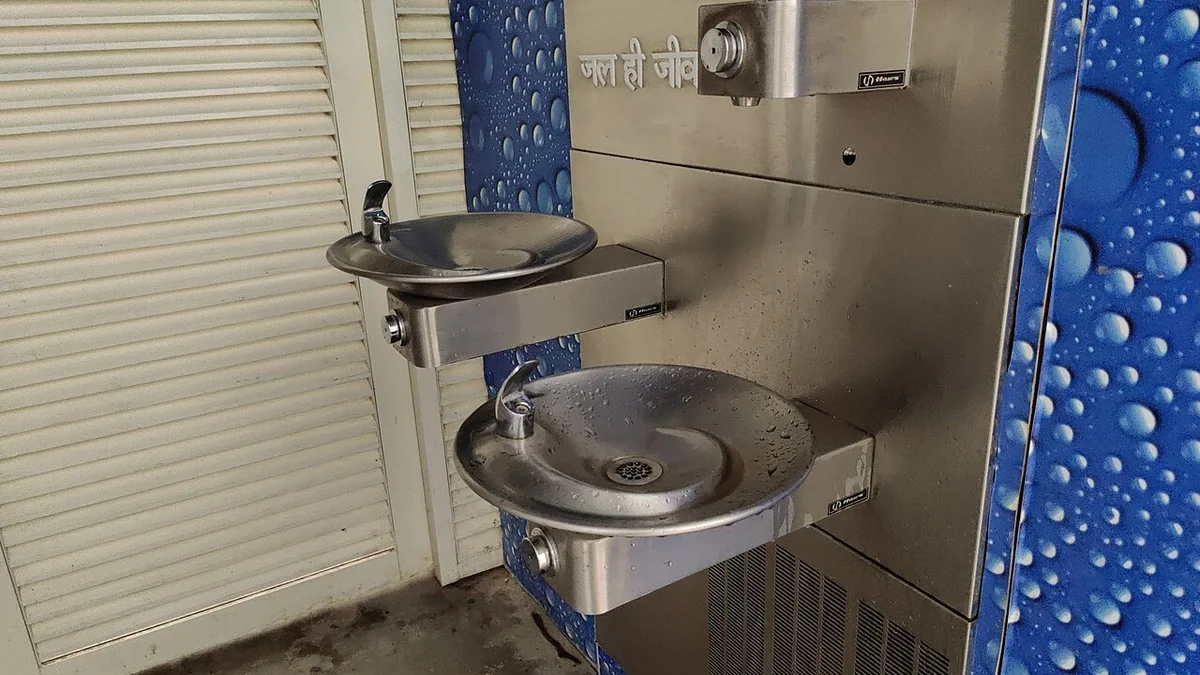
- Image — Drinking water fountain at Modi Nagar South RRTS by Ravi Dwivedi
- US CDC | Food and drink considerations while traveling
- Jal Jeevan Mission | Rural tap-water programme
