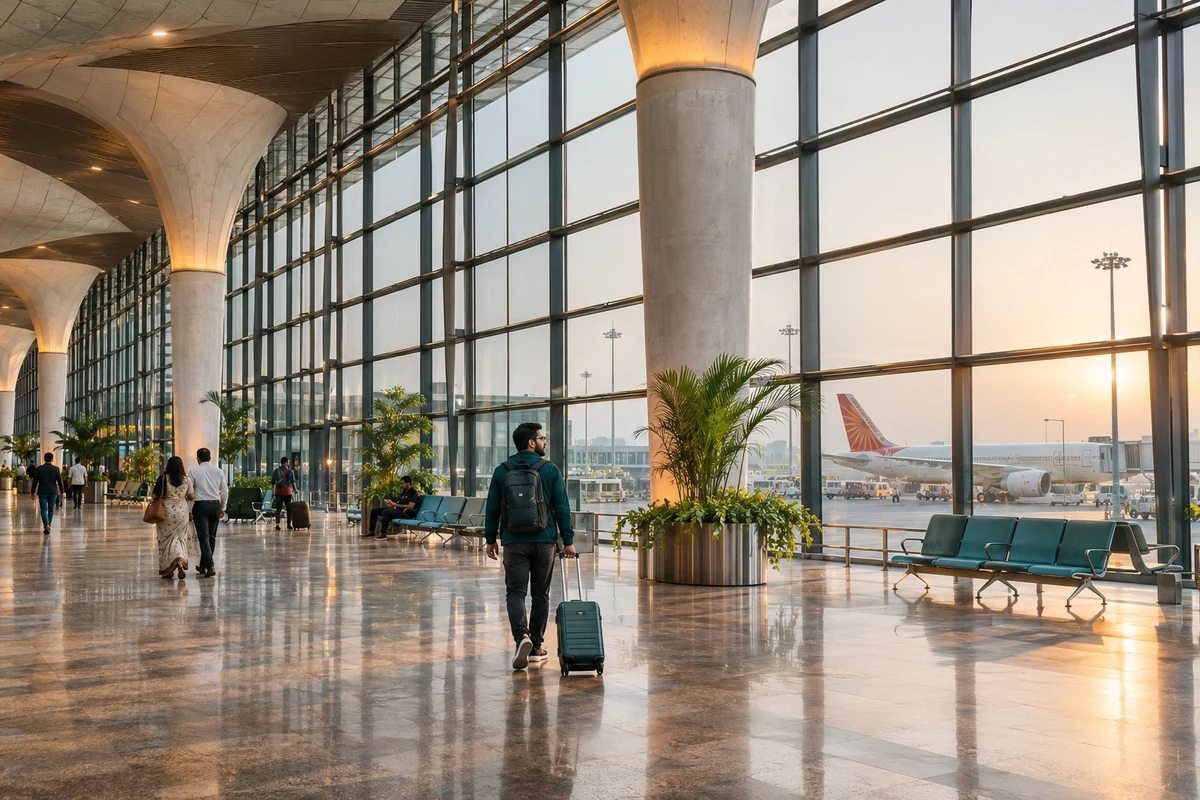
Choose an Indian departure and a US arrival
For flights from India to the USA, start with Air India’s announced nonstops from Delhi or Mumbai to JFK or Newark for the New York area, and check Delhi–San Francisco if you’re headed to the Bay Area. For a US city beyond those gateways, search from your actual Indian departure city to your final airport on your travel date, then check where the connection and US entry procedures fall.
For a New York-area trip, search JFK and Newark separately before comparing the results. JFK is in New York and Newark Liberty is in New Jersey. The two arrivals put you at different starting points for the journey to your address, so compare the ground leg for the actual arrival time. If someone will meet you, share the airport code as well as the flight number. A result headed “New York” can require a pickup in New Jersey.
Air India’s March network snapshot identifies Delhi, Mumbai and Bengaluru as gateways to its onward Indian network. That makes the Indian feeder flight part of the comparison for travelers starting elsewhere. Compare the departure time from home, the wait at the hub and the arrival date at your destination. A long-haul departure that looks convenient on its own can require leaving home considerably earlier once you account for the feeder flight.
For a trip with several US stops, price the route in the order you intend to travel. If San Francisco is your first destination and Chicago comes later, the Delhi–San Francisco option deserves its own search. A Delhi–Chicago itinerary through San Francisco serves a different purpose. It schedules the onward flight as part of the journey to Chicago.
Air India AI102 flight status and JFK–Delhi scheduleHow to plan a trip to India
Dated Air India schedule examples
Air India’s November 15, 2026 announcement listed daily Delhi–JFK and Mumbai–JFK service, four weekly Delhi–Newark flights and three weekly Mumbai–Newark flights. The carrier said it had restored nonstop operations after temporary technical stops on those New York-area routes. Use those frequencies to decide how broadly to search. Use the individual flight result to decide whether you can travel on a particular day.
| Route | Flight and routing | Date and comparison detail |
|---|---|---|
| Delhi–JFK | AI101 nonstop, Delhi T3 to JFK T4 | November 25–December 1 timetable showed dated nonstop options. Daily in the November 15 announcement. |
| Mumbai–JFK | AI119 nonstop, Mumbai T2 to JFK T4 | November 24–30 timetable listed a 16h 50m example. Daily in the November 15 announcement. |
| Delhi–Newark | AI105 published as a nonstop | Four weekly in the November 15 announcement. The November 25–December 1 public display returned zero results. Confirm the exact departure date in booking. |
| Mumbai–Newark | AI191 nonstop, Mumbai T2 to Newark Terminal B | November 25–December 1 timetable listed a 16h 45m example. Three weekly in the November 15 announcement. |
| Delhi–Chicago O’Hare | One stop through JFK on AI101/DL4915 or through San Francisco on AI183/UA1958 | Examples from the November 25–December 1 indexed listing. Check each flight pair for your date. |
Delhi–Newark illustrates why it helps to check more than one carrier view. The route overview names AI105, and some Mumbai–Newark results show a connection onto AI105 at Delhi. Yet the public Delhi–Newark timetable returned zero results in the displayed window. The announcement establishes the frequency Air India published. Availability for an individual traveler requires a booking result for the desired date. If the result is empty, search adjacent dates and check JFK separately.
The table records different display windows because they came from different route pages. A date range identifies the timetable sampled. It does not assign the flight to every day in that range. A listed duration belongs to the example shown. When arranging pickup, use the arrival date and local time on the selected itinerary. The Delhi–JFK timetable’s displayed clocks appeared to use UTC, making them unsuitable for coordinating a local pickup from the sample.
American Airlines also lists a Delhi–New York route search. Open the date-specific itinerary to identify the operating airline and the US airport before treating it as a comparable option. A carrier can sell a partner flight or a connecting itinerary under its own brand. The flight details supply both of those distinctions.
Air India Flight 101: Delhi to JFK status, terminals and baggage
- Air India newsroom | November 15, 2026 New York route update
- Air India November 15 2026 restoration of four New York nonstops
- Air India Delhi–New York carrier timetable
- Air India Mumbai–JFK carrier timetable
- Air India Mumbai–Newark carrier timetable
- Air India Delhi–Newark public route display
- Air India selected Delhi–Chicago dated alternatives
- Air India selected Delhi–San Francisco dated departure listings
- American Airlines, Delhi–New York route search
Check every stop in the flight details
Expand the flight details even when the city pair looks familiar. A nonstop has no intermediate landing. A technical stop involves an intermediate landing and can appear on a service that keeps the same flight number. A connection involves an onward flight. These distinctions affect which airports you pass through, how much time you spend traveling and which parts of the trip need separate terminal checks.
Mumbai–Newark gives a concrete comparison. The carrier timetable showed AI191 as a nonstop and also surfaced one-stop alternatives via Delhi onto AI105. For a traveler starting in Mumbai, both results reach Newark, but the Delhi itinerary adds an Indian domestic sector and a transfer before the US-bound flight. Compare the complete Mumbai departure and Newark arrival, including the wait in Delhi. The duration of the transatlantic sector alone leaves out part of the trip.
Check the departure city beside the long-haul flight number if you are comparing results across multiple tabs. An onward flight from Delhi can appear inside a search that began in Mumbai. Record the operating carrier for each segment, especially when an Air India search also returns a partner flight. You will need the specific flight and airport to confirm terminal details and identify the carrier handling the onward leg.
The same detail check applies to Delhi–San Francisco. Air India’s US-market route page can show AI183 nonstop alongside one-stop results. Inspect the expanded result before choosing a fare, especially if you have changed the departure date or reopened the search in another country edition of the booking site.
Compare connecting routes to Chicago
For Delhi–Chicago, the March 18 Air India network snapshot included Chicago O’Hare and Delhi, while the November map based on an October 23 snapshot omitted Chicago. The useful evidence for a late-November departure is the dated booking sample. The indexed listing for November 25 to December 1 showed one-stop choices through JFK and San Francisco. A separate sample for the week of November 24 showed a connection through Newark. The route maps describe different points in the network’s history, and the date-specific results show which routings appeared in those searches.
For a traveler choosing between the sampled JFK and San Francisco routings, compare the time from the international arrival to the domestic departure and the time the itinerary reaches O’Hare. Both connections put US entry procedures before the Chicago flight in the ordinary arrival process. A shorter total journey can leave less time for that transfer. The published flight pairs, AI101 with DL4915 and AI183 with UA1958, are specific enough to look up when they appear in a fresh search.
Check whether each option can be purchased as a single itinerary and read what the seller says will happen if a delay makes you miss the domestic leg. A separately purchased flight with the same flight number and departure time can carry different terms. Compare any separately priced option using the full ticket terms and the time available to reclaim and check a bag, especially when the second carrier has its own check-in deadline.
For an overnight or West Coast trip, check a through route that connects outside the United States alongside the examples above. Qatar Airways and American Airlines publish partnership itineraries between India and US cities, with the operating airline named by segment. Read where the long-haul connection occurs and check the first US landing independently. These details affect where you have time to transfer and where you will need to complete entry procedures.
- Air India | Delhi to Chicago schedule sample
- Air India | International route map dated March 18, 2026
- Air India November connectivity map, 23 October snapshot
- Air India selected Delhi–Chicago dated alternatives
- US CBP: first port of entry requirement
- Qatar Airways, India–US routes with American Airlines partner connections
Allow time for US entry and baggage collection
For most international arrivals connecting to a US domestic flight, Customs and Border Protection processes the traveler at the first US airport. For the sample Delhi–JFK–Chicago routing, that means the entry process takes place at JFK. On Delhi–San Francisco–Chicago, it takes place in San Francisco. The connection time shown on the itinerary includes the time you have to complete that process and reach the domestic flight.
CBP’s usual instructions for travelers with a checked bag are to collect it, take it through customs and hand it back to the airline for the domestic connection. An O’Hare baggage tag can still require collection and recheck at JFK. Ask where the bag goes after customs and whether the onward carrier accepts it at a transfer point. With carry-on only, you can omit the checked-bag steps and still need time for US entry and any onward screening.
Designated overseas US preclearance can move CBP processing to the departure airport for the segment into the United States. Verify the specific airport and flight if the itinerary goes through a third country. Preclearance at one airport gives you no basis for assuming the same process at another airport in that country. CBP also identifies exceptions to the typical baggage process. Apply an exception only when the carrier and airport confirm it for your itinerary.
Check the terminal on each flight. JFK’s directory lists Air India and Delta at Terminal 4 and places most JetBlue departures at Terminal 5. Even when both flights use Terminal 4, budget time for entry, baggage handling and the walk to the onward gate.
Abu Dhabi provides a concrete exception to the usual first US airport process. Etihad says that its US-bound flights have access to US Customs and Border Protection preclearance at Zayed International Airport. The airline says the facility closes one hour before flight departure and gives additional arrival guidance by cabin. Check the conditions for your booked flight, especially if Abu Dhabi is itself your connection. The airport carrying out preclearance is part of the itinerary and affects how much time to allow there.
Check the Indian transfer on the return
Review the return route as its own itinerary. The evidence for an India-to-US flight number, terminal or frequency describes the outbound direction. The return search supplies its own operating flights, terminals and days. This matters especially when you depart India from one gateway and come back through another, or when the final city on the return requires an Indian domestic flight.
Delhi Airport directs international arrivals through immigration, baggage collection and customs at Terminal 3. For a domestic connection that also leaves from Terminal 3, the airport says to follow the yellow wayfinding after customs. A domestic flight from Terminal 1 or Terminal 2 can require a terminal change. Delhi Airport lists a free interterminal bus and cabs. Check the arriving and departing flight details before deciding how much of the connection you will need for the terminal move.
For a traveler flying back to India through Delhi and continuing to Bengaluru, the domestic flight’s terminal can decide between two otherwise similar itineraries. Compare the time available up to any baggage drop or check-in deadline for the Bengaluru flight. The departure time by itself gives a more generous impression of how much time you can spend on immigration, baggage reclaim and the terminal transfer.
Use Delhi Airport’s instructions for an international arrival connecting to domestic. If your outbound trip starts with a domestic flight into Delhi, check the airport and airlines for the process in that direction. Ask where the airline will tag your bag and where you will next need to handle it on each journey.
Verify availability, cabin and fare before paying
Enter the exact airports, dates, cabin and passenger types in the carrier’s booking engine. Route descriptions can remain visible when a search returns a different itinerary or no seat for that combination. Use the selected booking result for the airport codes, flight numbers and stops, then confirm the local arrival day before paying. If an announced route disappears, an adjacent-date search can show whether shifting your departure gives you a usable option.
Compare prices at the same point in the booking process with the same passenger mix and currency. Check the baggage allowance, seat charges and change terms on the specific fare offered. On an itinerary with more than one airline, confirm which baggage rules the seller applies to the journey and where any checked-bag charge appears. This can change the comparison even when the headline prices are close.
Air India’s restoration announcement describes the Delhi flights to JFK and Newark as A350-900 services with 28 business, 24 premium economy and 264 economy seats. That is the aircraft layout described in the announcement. Cabin inventory and assigned equipment can change. If you need premium economy, check that the booking assigns premium economy to the long-haul leg. On a mixed itinerary, inspect each segment and check which seat options the carrier currently offers.
Once booked, use the carrier’s itinerary and flight status to recheck the arrival date, terminal and onward flight. Those details matter for a pickup and for coordinating a separately booked connection. If the airline changes the itinerary, confirm the baggage handoff and the available connection time against the replacement flights.
- Air India | U.S. departure booking and gateway guide
- Air India November 15 2026 restoration of four New York nonstops
- Air India Delhi–New York carrier timetable
- Air India Delhi–Newark public route display
- Air India selected Delhi–San Francisco dated departure listings
- US CBP: checked baggage and domestic connection
Sources
- Air India newsroom | November 15, 2026 New York route update
- Air India | Delhi to Chicago schedule sample
- Air India | International route map dated March 18, 2026
- Air India | U.S. departure booking and gateway guide
- Delhi Airport | International to domestic transfer
- Air India November 15 2026 restoration of four New York nonstops
- Port Authority JFK Terminal 4 directory
- Air India Delhi–New York carrier timetable
- Air India Mumbai–JFK carrier timetable
- Air India Mumbai–Newark carrier timetable
- Air India Delhi–Newark public route display
- Air India November connectivity map, 23 October snapshot
- Air India selected Delhi–Chicago dated alternatives
- Air India selected Delhi–San Francisco dated departure listings
- US CBP: first port of entry requirement
- US CBP: checked baggage and domestic connection
- Etihad, Abu Dhabi US immigration and customs preclearance
- Qatar Airways, India–US routes with American Airlines partner connections
- American Airlines, Delhi–New York route search