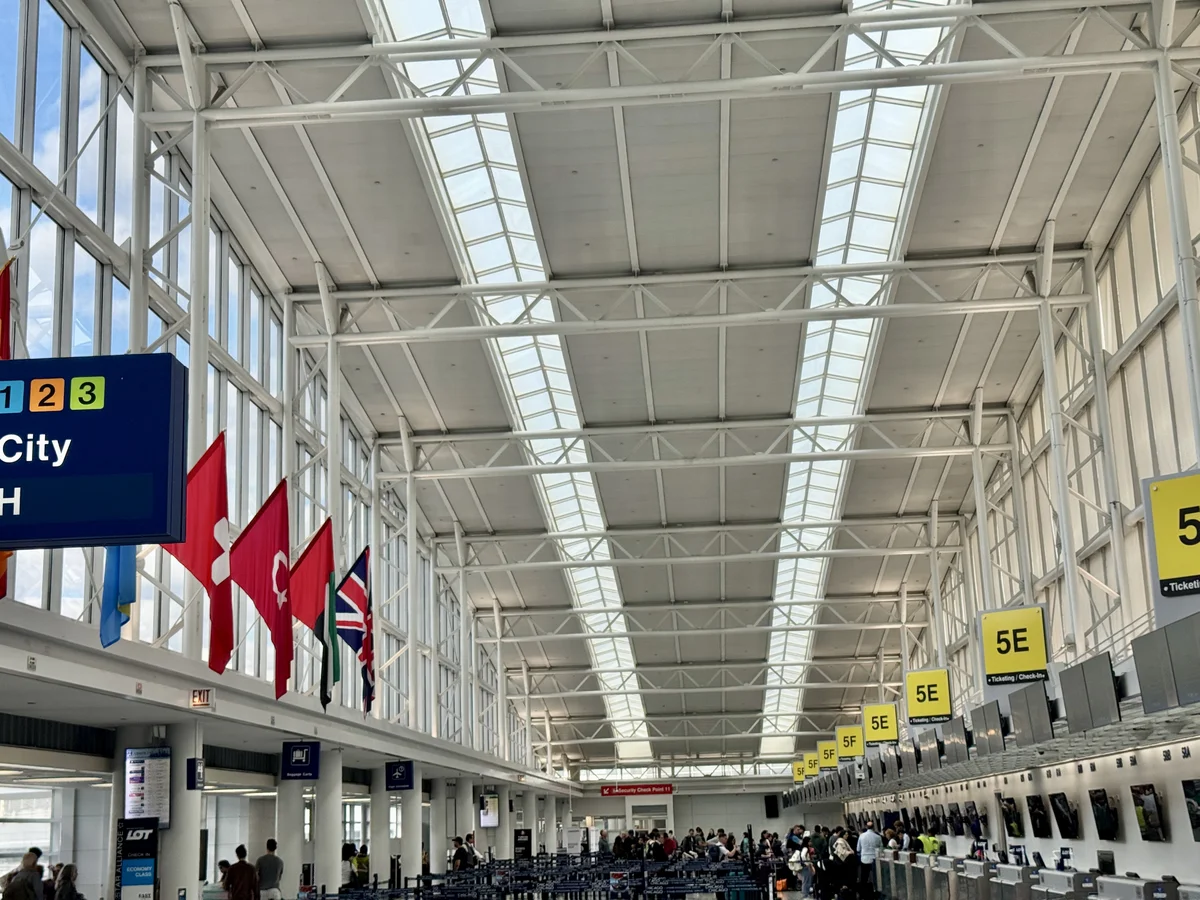
Air India from Chicago to Delhi
For Air India from Chicago to Delhi, search Chicago O’Hare (ORD) to Delhi (DEL) for your exact date and check the expanded itinerary before counting on a nonstop flight. Air India’s November 25 to December 1, 2026 schedule sample listed one-stop options via New York JFK and San Francisco (SFO), and Emirates markets a one-stop option via Dubai.
Air India’s route overview describes Chicago to Delhi as a direct market, says frequency varies and displays AI126 separately. A populated flight result answers the booking question. Open the flight details and check the operating date, operating airline and every airport where the aircraft is scheduled to land. For a nonstop journey, the result should show no intermediate landing between O’Hare and Delhi. An intermediate landing still counts as a stop if the flight number continues.
Search each date you could realistically depart, especially if avoiding a connection is your main priority. An overview that names AI126 and a dated result that shows two flight numbers give you different kinds of information. The overview gives you a flight number to look for. The dated result tells you what the airline is offering for that search. Reopen the selected result before payment if you change the date, cabin or fare.
| Routing | Published evidence | What to check for your trip |
|---|---|---|
| Air India ORD–DEL, possible nonstop | Generic route overview lists AI126 | Whether AI126 appears on your departure date and shows zero intermediate landings |
| ORD–JFK–DEL | Air India’s November 25 to December 1, 2026 sample displayed DL5666 and AI102 | Operating airlines, JFK layover and ticket coverage |
| ORD–SFO–DEL | The same Air India sample displayed UA2610 and AI184 | Operating airlines, total elapsed time and Delhi arrival date |
| ORD–Dubai–DEL | Emirates markets Chicago to Delhi through Dubai | Dated availability, Dubai layover and Delhi arrival time |
The route page showed a 19-hour 50-minute Chicago–JFK–Delhi example using DL5666 and AI102, and a 32-hour 30-minute Chicago–San Francisco–Delhi example using UA2610 and AI184. Those examples are drawn from the same late-November schedule window, and a different feeder can change the elapsed time substantially. Open the operating carrier and connection details for the flight you are considering before treating a displayed journey time as fixed.
Choose where to make your connection
The Air India listings through JFK and San Francisco put the connection in the United States, ahead of the flight to India. The Emirates routing puts the connection in Dubai, followed by a flight into Delhi. Expand each result to see when the longest flight starts, how long you spend at the connecting airport and when you reach Delhi. Those details are more useful for planning your day than a one-stop label shared by all three routings.
Compare the full elapsed journey and the local arrival date together. Two results with similar elapsed times can land at different hours because the flights leave Chicago at different times. The arrival hour can determine whether a pickup works, when to start a hotel reservation or whether there is a usable domestic connection that day. Enter the Delhi arrival date from the itinerary when you check any onward arrangements.
Say you find a shorter connection through JFK and an Emirates itinerary that gets into Delhi later, but your pickup can only meet you within a narrow window. First see which itinerary arrives during that window, then check how much flexibility the ticket gives you if the schedule changes. If the later flight requires arranging another ride, include that extra arrangement in the comparison. If Delhi is an intermediate stop on your journey, make the same decision using the time you reach your final airport.
New York to India flights from JFK and NewarkSan Francisco to India flights: Delhi, Mumbai and Bengaluru
Compare fares and check who operates each flight
The sampled Air India connection through JFK pairs a Delta flight number with an Air India flight number. The San Francisco listing pairs a United flight number with an Air India flight number. On a live result, read the operating airline shown beside each segment. Use the booking instructions to identify where you should check in at O’Hare and which carrier handles questions about your first flight. The name at the top of the search page may cover a journey involving several carriers.
Price the same itinerary through to the final payment screen for the same number of travellers, travel dates and cabin. Apply the baggage allowance you actually need and check the change and cancellation terms. On a multi-segment result, examine the cabin displayed for the long flight as well as for the feeder flight. The fare worth comparing is the amount that covers the journey and conditions you intend to buy. The published schedule samples establish routings without establishing current fares.
Check whether the itinerary is sold as one through ticket or as separate tickets. Read the seller’s terms for a missed connection, especially if the booking page mentions a self-transfer. Also check where you are expected to collect your bag and where to hand it back. Two flights displayed together can involve different ticket arrangements, and the practical question is what happens to the second booking if a delay on the first flight makes you miss it.
Check the return from India separately
Search Delhi to Chicago on the intended return date as its own leg. Air India’s November 25 to December 1, 2026 schedule sample displayed a JFK connection using AI101 and DL4915, plus San Francisco connections using AI183 with UA1958 or UA1971. A separate November 24 to 30 sample displayed a Newark connection using AI105 and UA1525. Each combination is a published example for its sampled week. Check that the exact flights appear when you search the date you want to buy.
The New York area airport code matters when you open those results. JFK and Newark (EWR) are different airports. Read the code at the end of the incoming flight and the code at the start of the onward flight. The sampled connections are each described through a single airport. If a live booking displays different codes across consecutive segments, find out whether it requires a ground transfer and allow for that when comparing it with the other results.
The publication dates explain why searches for this route surface different descriptions. Air India’s March 18, 2026 network map included Chicago O’Hare and Delhi. In May the airline announced a temporary Delhi–Chicago suspension through August 2026. That announcement describes a bounded period. To establish whether a nonstop operates on either leg of a later round trip, look for the actual segment and its physical stops in the corresponding dated search.
Compare Delhi with other gateways into India
If Delhi is a connection on the way to another Indian city, start by searching from ORD to the airport you actually want to reach. Then compare that result with a search ending at DEL and a separately priced onward flight. Air India lists Delhi, Mumbai and Bengaluru as gateways to its onward Indian network in its March 18, 2026 map. Use those gateway names to interpret the results you find. The dated map establishes where the carrier identified onward connections in its network.
Count the connections across the whole trip. A Chicago itinerary through a US or overseas hub to Delhi followed by an Indian domestic flight has two connections before the final airport. Delhi adds a specific set of arrival tasks because passengers transferring from an international flight to a domestic one go through immigration, collect baggage and clear customs at Terminal 3. Those steps belong in the comparison even if the flight search presents Delhi as just another layover.
For a trip ending in Bengaluru, compare a dated result all the way to Bengaluru with an ORD–DEL result and a separately booked Delhi–Bengaluru leg. If the full itinerary costs more, identify what that difference buys under its terms. It may cover onward travel under a single ticket, or deliver an arrival hour that suits your plans. If you price separate tickets, include any extra baggage charges and consider what you would have to rebook if you reached Delhi after the onward flight closed.
Check your airline and terminal at Chicago O’Hare
Use ORD in the booking search and on your ground transport plan. Chicago’s official summer 2026 O’Hare guide lists Air India, Emirates and Qatar Airways in the Terminal 5 Concourse M carrier directory. That directory establishes where the airport listed those carriers for that edition. Find the terminal for your specific departure in the operating airline’s trip details or O’Hare’s flight information before arranging your drop-off.
Start with the first segment when the ticket includes a US connection. A result sold by Air India may start with a flight to JFK or San Francisco, so use the Chicago departure details for that flight. Look up its operating carrier, terminal and any check-in or bag-drop deadline the carrier specifies for your booking. Use the flight number and departure date together if you need to reconcile the ticket with the airport’s listing.
Transfer from international arrivals at Delhi Terminal 3
Delhi Airport directs international arrivals through immigration, baggage collection and customs at Terminal 3. If your domestic flight leaves from Terminal 3, the airport directs transfer passengers to follow the yellow signs after customs. Check your onward terminal on the dated booking so you know whether to follow those signs or allow time to move to Terminal 1 or Terminal 2.
Delhi Airport lists a complimentary interterminal shuttle from near pillar 10 at Terminal 3. Its Terminal 3 transport page describes the service as running every 20 minutes around the clock for Terminals 1 and 2. It instructs passengers to follow the signs after collecting baggage and show a boarding pass at the kiosk for a shuttle coupon. The airport also identifies a pedestrian tunnel entrance near pillar 18 for Terminal 2 and lists taxis on the arrivals forecourt.
For a Terminal 1 departure on a separate ticket, work back from the domestic airline’s check-in or bag-drop cutoff. Before that deadline you need time for immigration, baggage collection, customs, getting to the shuttle and reaching the domestic terminal. After bag drop, you still need to get to the gate by the airline’s deadline. The listed shuttle frequency covers the interval between buses. The airport’s transfer and transport pages are the places to recheck the pickup point, service interval and walking access before travel.
Sources
- Air India | Chicago to Delhi booking
- Air India | Delhi to Chicago schedule sample
- Air India | International route map dated March 18, 2026
- Air India newsroom | 2026 summer route adjustments
- Emirates newsroom | U.S. gateway connections via Dubai
- Delhi Airport | International to domestic transfer
- Emirates Chicago–Delhi route
- Chicago O'Hare Terminal 5 passenger map
- Delhi Airport transfers from Terminal 3
- Air India US Delhi–Chicago schedule observations
- Chicago O'Hare Terminal 5 photograph by Warren LeMay
