Is India’s bullet train open?
The Mumbai–Ahmedabad bullet train has no verified passenger service yet. Akashvani News reported on 23 November 2026, citing Railway Ministry sources, that trials were targeted by May 2027 on Surat–Bilimora and first passenger service by the end of 2027 on Surat–Vapi.
The two targets cover different stretches of the same railway. Surat–Bilimora is a 50 km stretch where both running lines reached an electrical milestone in November. Surat–Vapi extends farther south into Gujarat and is the longer section named in the passenger target. The planned route runs about 508 km, from Mumbai’s Bandra Kurla Complex to Sabarmati beyond Ahmedabad station.
For a trip, the practical dividing line is the start of public service. A formal opening announcement should identify the section where passengers can board and give a start date. A bookable timetable then answers a different question, whether a particular train will run on the day you want to travel and serve both of your stations.
If you are planning to travel from Mumbai to Ahmedabad in late 2027, the reported first-service target offers little guidance for that itinerary. Both ends of the proposed initial service are in Gujarat, and Mumbai lies outside it. Keep your travel plans tied to services available for your dates and check the full corridor separately for any later opening announcement.
Confirmed milestones from foundation stone to energisation
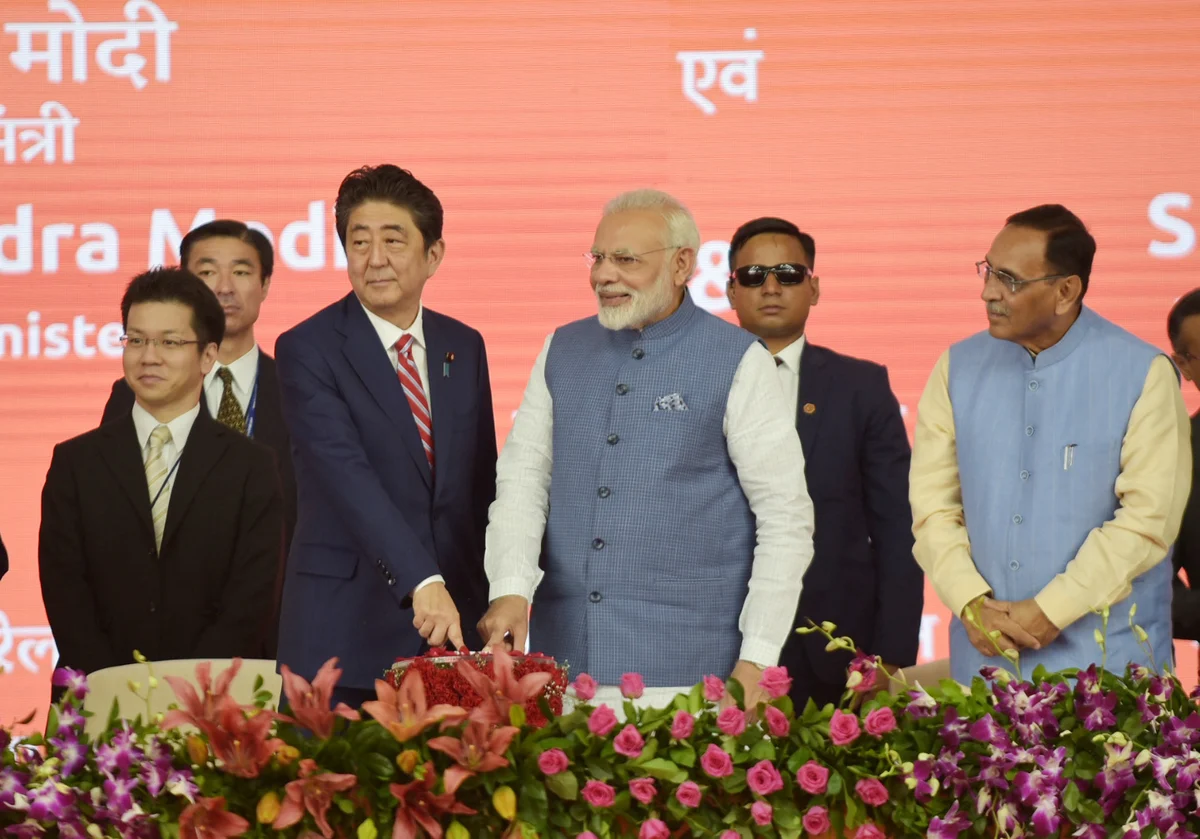
The foundation ceremony took place in Ahmedabad on 14 September 2017, when Indian Prime Minister Narendra Modi and Japanese Prime Minister Shinzo Abe jointly laid the foundation stone. It gives the tracker a confirmed public event at the start of the project timeline. The later records track physical work through dated measurements and announcements about individual systems.
Some official updates give both a measurement or event date and a publication date. NHSRCL published its April 2025 civil works figures on 21 April using data as of 18 April. The Ministry of Railways reported November energisation on the day after it happened. Use the underlying date to place the milestone in sequence and the publication date to find the original announcement.
| Event or snapshot date | Scope | What the official record confirms |
|---|---|---|
| 14 September 2017 | Ahmedabad | Narendra Modi and Shinzo Abe laid the foundation stone. |
| 18 April 2025 | Whole corridor | 293 km of viaduct construction reported in the NHSRCL update published 21 April. |
| 27 March 2026 | Whole corridor and Surat–Vapi | Rajya Sabha answer 3931 recorded civil and systems figures and a separate update for the 97 km segment. |
| 18 July 2026 | Thane Creek tunnel works | Ministry release reported that a second tunnel boring machine had begun excavation. |
| 22 July 2026 | Whole corridor | Ministry update described the traction design and work underway on lighting, traction and general infrastructure. |
| September 2026 | Whole corridor | NHSRCL published a construction video showing progress at the time of filming. |
| 1 November 2026 | BEML trainset in Bengaluru | Ministry release reported that manufacturing was underway. |
| 20 November 2026 | 50 km Surat–Bilimora segment | Overhead systems energised on both running lines, reported by the ministry on 21 November. |
The July tunnel announcement marks the start of excavation by the second machine. The planned Mumbai underground tunnel is about 21 km long and includes a shorter undersea section at Thane Creek. Keep that distinction when recording the work, since a headline about the undersea tunnel can refer to a milestone within the wider underground project.
A dated construction video provides a visual record of the sites and stages shown. Use the parliamentary answer or a measured NHSRCL release for kilometre figures. Those records give the scope of each measurement and make it easier to compare a later figure using the same definition.
- National High Speed Rail Corporation | Mumbai–Ahmedabad project overview
- Ministry of Railways | July 2026 bullet train electrification update
- National High Speed Rail Corporation | September 2026 project video
- Prime Minister's Office — 14 September 2017 foundation ceremony
- Ministry of Railways — Rajya Sabha answer 3931, project and station snapshot dated 27 March 2026
- Ministry of Railways — July 2026 undersea tunnel works milestone
- Ministry of Railways — November confirmed energisation milestone
- Ministry of Railways — Indian-manufactured trainset project update, 1 November 2026
- Railway Ministry notice listing the 50 km Surat–Bilimora section
What the construction figures measure
NHSRCL’s 18 April 2025 snapshot reported 293 km of viaduct construction, 375 km of pier works, 394 km of pier foundations and 320 km of girder casting. It also reported bridges completed on 14 rivers. Each kilometre figure measures a specific stage. A portion of the alignment can appear under foundations, piers and viaduct work, so adding the figures would count some stretches repeatedly.
The Railway Ministry’s 27 March 2026 parliamentary answer recorded 1,389.5 hectares acquired for the project. Its whole-corridor figures covered 430 km of piers, 341 km of girder works, 174 km of track bed and 153 km of overhead masts. Keep the source wording with the values. Even two figures that both mention girders may cover different activities when one measures casting and the other reports girder works.
The March answer separately reported completed civil works including river bridges on the 97 km Surat–Vapi segment, with 80% of its track bed laid. The denominator is the track bed for that segment. The full alignment includes other civil works, and commissioning also depends on track, electrical systems, signalling, telecommunications and trainset supply.
For a progress comparison, start with the same segment and the same named work stage in both updates. A newer corridor-wide total can provide context for an older segment figure, but the pair cannot show how much work advanced on that segment. When an update changes the measure or geographic scope, keep it as its own milestone.
How the 2027 targets have changed
A Press Information Bureau fact sheet dated 3 July 2026 said the first Surat–Vapi passenger section was expected in August 2027. A Railway Ministry release published through PIB on 4 July described first-phase service on Surat–Bilimora in 2027. Those statements named different stretches within a day of each other, which makes the segment and the publisher as important as the year in any record of the targets.
On 23 November, Akashvani News attributed two separate targets to Railway Ministry sources. The first was a trial run by May 2027 between Surat and Bilimora. The second was passenger service by the end of 2027 between Surat and Vapi. These are the latest sourced targets in the tracker. A signed commissioning timetable matching the report remains unverified.
The confirmed energisation of both running lines on Surat–Bilimora on 20 November belongs alongside those targets because it explains the stage the shorter section had reached. The ministry described energisation as progress toward further testing. A subsequent announcement that a train has run on that section would establish a trial milestone. Public opening requires its own evidence.
When a later announcement appears, check what the date describes. A first trial, the commissioning of a section and the first day of ticketed journeys answer different questions. Record the change with its announcement date and geographic scope so readers can see how an older headline relates to the latest published position.
- Ministry of Railways — Rajya Sabha answer 3931, project and station snapshot dated 27 March 2026
- Ministry of Railways — November confirmed energisation milestone
- Press Information Bureau — July 2026 first-passenger-service target
- Akashvani News — November 2026 update attributed to Railway Ministry sources
- Railway Ministry July 2026 first-phase target
Planned route and all 12 stations
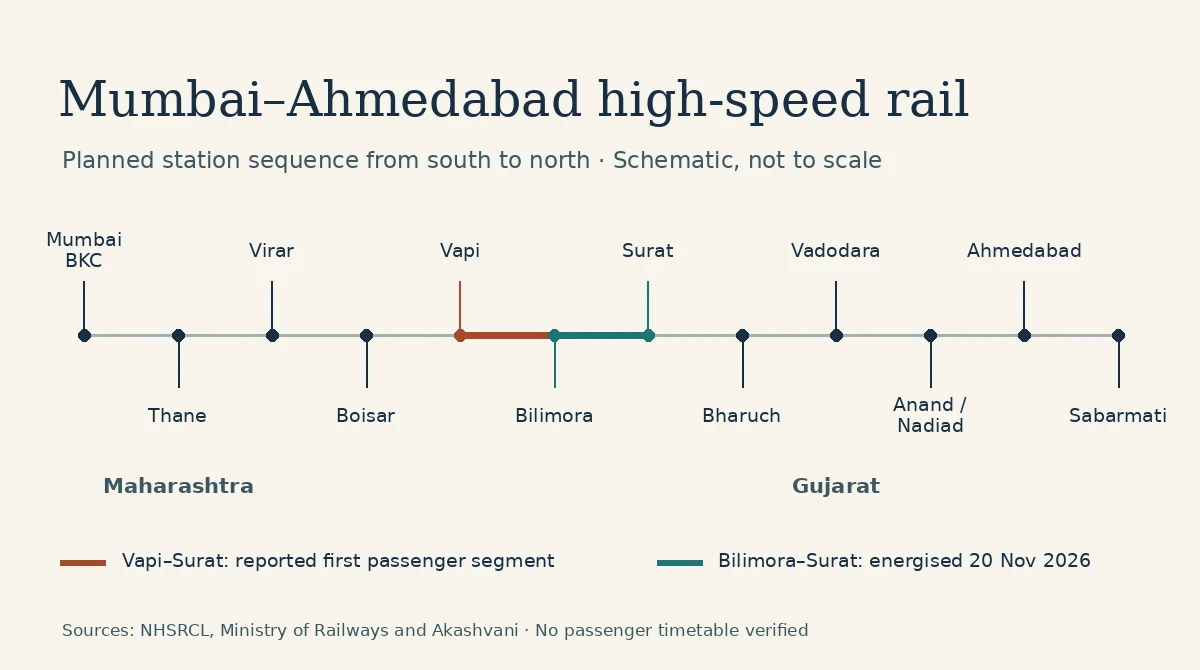
NHSRCL lists 12 planned passenger stations, with four in Maharashtra and eight in Gujarat. The corridor covers about 156 km in Maharashtra, 4 km in Dadra & Nagar Haveli and 348 km in Gujarat, using the operator’s rounded figures. The passage through Dadra & Nagar Haveli has no planned station. The table follows the line from south to north.
| Station | State | Relationship to the first reported segment |
|---|---|---|
| Mumbai (Bandra Kurla Complex) | Maharashtra | Outside the reported first passenger segment |
| Thane | Maharashtra | Outside the reported first passenger segment |
| Virar | Maharashtra | Outside the reported first passenger segment |
| Boisar | Maharashtra | Outside the reported first passenger segment |
| Vapi | Gujarat | Within the reported Surat–Vapi passenger target |
| Bilimora | Gujarat | Within the reported Surat–Vapi passenger target and at an end of the Surat–Bilimora electrified section |
| Surat | Gujarat | Within the reported Surat–Vapi passenger target and at an end of the Surat–Bilimora electrified section |
| Bharuch | Gujarat | Outside the reported first passenger segment |
| Vadodara | Gujarat | Outside the reported first passenger segment |
| Anand (Anand/Nadiad) | Gujarat | Outside the reported first passenger segment |
| Ahmedabad | Gujarat | Outside the reported first passenger segment |
| Sabarmati | Gujarat | Outside the reported first passenger segment |
The order helps explain the overlap between the early milestones. Travelling south from Surat, you reach Bilimora and then Vapi. The 50 km Surat–Bilimora stretch named in the trial target therefore sits within the 97 km Surat–Vapi section named in the later passenger target. The planned stations on a section give its geography. A future timetable will show which of them each train serves.
For a journey to Ahmedabad, pay particular attention to the two northern station names. Ahmedabad is followed by Sabarmati, the northern end of the corridor. Once service is published, compare the station on your itinerary with your onward journey. In Mumbai, the Bandra Kurla Complex location can anchor a preliminary map search, while verified operating entrances and public access information will determine where you actually need to arrive.
Anand and Nadiad can both appear when you read project updates. The station sits between Vadodara and Ahmedabad in the operator’s route sequence. Some project material uses Anand/Nadiad for the site. Check venue details for the named station when entrances are announced. At the northern end, Ahmedabad and Sabarmati are separate planned stops, so an announcement naming one station gives you a more precise location than the city name by itself.
- National High Speed Rail Corporation Limited — Mumbai–Ahmedabad project FAQs
- Ministry of Railways — Rajya Sabha answer 3931, project and station snapshot dated 27 March 2026
- Ministry of Railways — November confirmed energisation milestone
- Akashvani News — November 2026 update attributed to Railway Ministry sources
Speeds and journey times in the project plans
The July 2026 PIB fact sheet gives 350 km/h as the corridor design speed and 320 km/h as the planned operating speed. The Railway Ministry also describes the 2×25 kV overhead traction design for operation up to 320 km/h. Both releases describe specifications. Scheduled travel times depend on the service pattern and the trains assigned to it.
NHSRCL’s most directly comparable whole-journey estimates are about 2 hours 7 minutes with limited stops and 2 hours 58 minutes with all stops. That is a 51-minute difference between the two planning scenarios. The July PIB fact sheet gives a separate estimate of about 1 hour 58 minutes without a published timetable. Keep its attribution and use the NHSRCL pair when comparing the effect of stopping patterns.
The 1 November ministry update puts the BEML trainset being manufactured in Bengaluru at 249 km/h operating speed and 280 km/h maximum test speed. It describes an eight-car train about 202 metres long with room for around 557 passengers. These specifications apply to that trainset. The sources give separate figures for the long-term corridor operating design.
If you intend to board at Vadodara, a headline about the fastest end-to-end journey leaves your main question unanswered. Once a timetable is available, check which departures call at Vadodara and your destination, then compare elapsed times between those two stations. Allow separately for travel to the departure station and from the arrival station.
How to verify opening, bookings and station access
Start with NHSRCL and Railway Ministry announcements carried by PIB when checking a new opening claim. Match the publication date, endpoints and activity against the headline you saw. A source that says work is underway or testing is expected gives you a project update. For a travel decision, look for explicit confirmation of public passenger service and the date it starts.
Then check the operator’s published timetable and authorised booking channel for the day and station pair you need. Frequency, fares, ticket sale dates and visitor access remain unverified in the available record. Treat any number attached to an opening story as provisional until the operator publishes it for a named service, fare class or station.
Check station access on its own terms. A development update can name a station and show its building during construction, while a passenger notice should identify the usable entrance and when it is open. If you need to visit before service starts, look for a station-specific public access announcement before using the site as a destination. For an actual rail trip, use the station name on the booking alongside the operator’s access guidance.
- Public opening claim — check the official notice for the first passenger date, endpoints and stations served.
- Ticket price or sale date — check the operator’s booking information for the named train, travel date and fare class.
- Station entrance or visitor access — check the operator’s station-specific guidance for the relevant date.
- National High Speed Rail Corporation Limited — Mumbai–Ahmedabad project FAQs
- Ministry of Railways — Rajya Sabha answer 3931, project and station snapshot dated 27 March 2026
- Ministry of Railways — November confirmed energisation milestone
- Akashvani News — November 2026 update attributed to Railway Ministry sources
Sources
- National High Speed Rail Corporation | Mumbai–Ahmedabad project overview
- Ministry of Railways | July 2026 bullet train electrification update
- National High Speed Rail Corporation | September 2026 project video
- National High Speed Rail Corporation Limited — Mumbai–Ahmedabad project FAQs
- Prime Minister's Office — 14 September 2017 foundation ceremony
- Ministry of Railways — Rajya Sabha answer 3931, project and station snapshot dated 27 March 2026
- Ministry of Railways — July 2026 undersea tunnel works milestone
- Ministry of Railways — November confirmed energisation milestone
- Press Information Bureau — July 2026 first-passenger-service target
- Akashvani News — November 2026 update attributed to Railway Ministry sources
- Ministry of Railways — Indian-manufactured trainset project update, 1 November 2026
- Wikimedia Commons — Prime Minister’s Office photo of the bullet train foundation ceremony
- Railway Ministry notice listing the 50 km Surat–Bilimora section
- Railway Ministry July 2026 first-phase target
