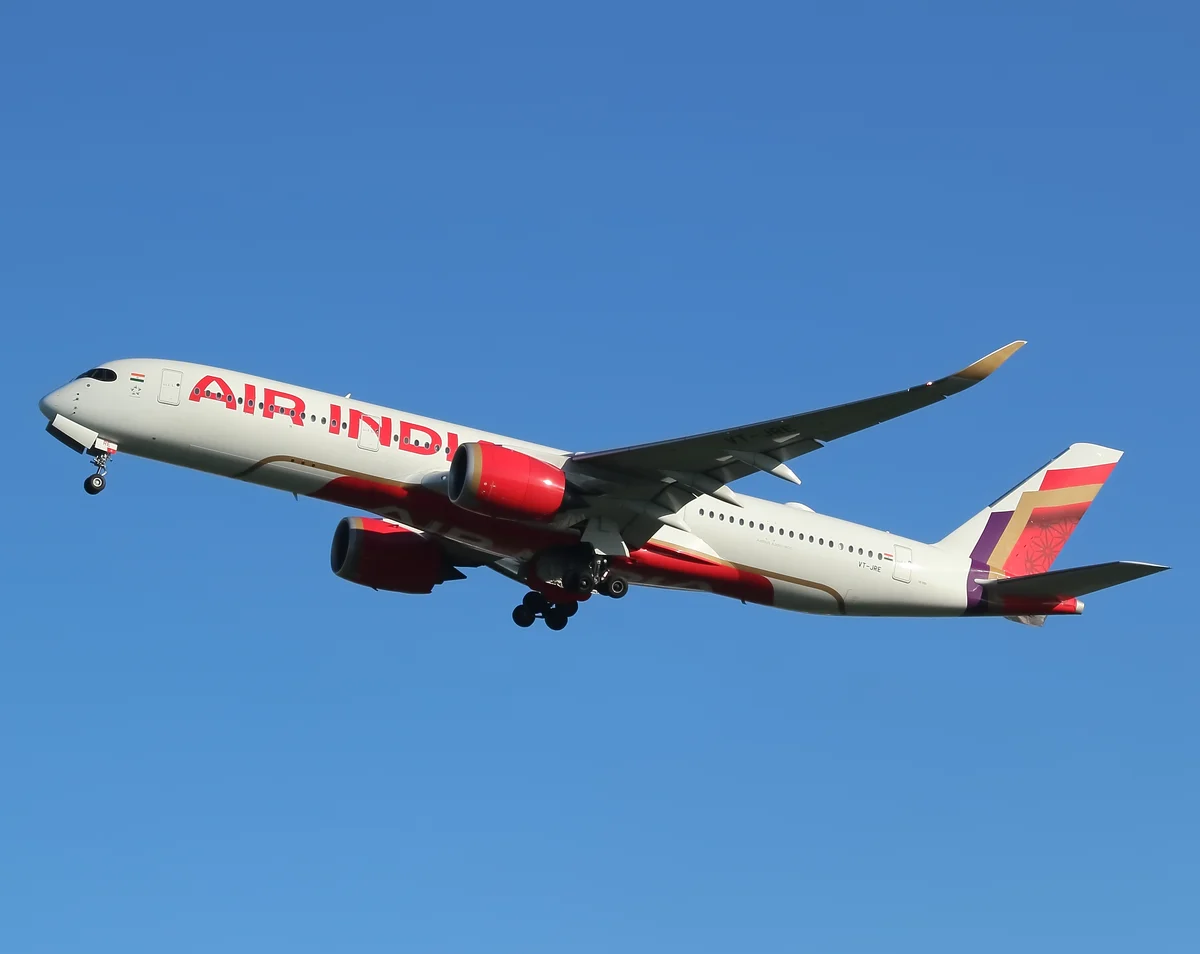
Start with the aircraft and dated seat map
Air India markets Economy, Premium Economy, Business and First across its network. The cabins available depend on the specific aircraft layout. Its A350-900 and its bespoke 787-9 have Business, Premium Economy and Economy. The upgraded 777-300ER used in several North American examples has First, Business and Economy. A legacy 787-8 can have only Business and Economy. Start with the operating carrier, flight number, travel date and cabin shown on your particular segment.
| Aircraft or published variant | Business | Premium Economy | First | Economy |
|---|---|---|---|---|
| Airbus A350-900 | 28, 1-2-1 | 24, 2-4-2 | None listed | 264 |
| First fully refitted 787-8, VT-ANT | 20, 1-2-1 | 25, 2-3-2 | None listed | 205 |
| Legacy 787-8, Delhi–Melbourne example | 18 | None listed | None listed | 241 |
| Bespoke 787-9 | 30, 1-2-1 | 28, 2-3-2 | None listed | 238 |
| 777-300ER, 4/35/303 map | 35, 2-3-2 | None listed | 4 | 303 |
| Upgraded 777-300ER, 8/40/280 map | 40, 1-2-1 | None listed | 8 | 280 |
A seat map can resolve a difference that an aircraft name cannot. Two Air India 787-8s can be sold with different seats and a different number of cabins. The airline’s first fully retrofitted 787-8 has 20 Business, 25 Premium Economy and 205 Economy seats. The legacy Delhi–Melbourne example from its June announcement has 18 Business and 241 Economy. The former has a small Premium Economy cabin. The latter has no separate one.
Check the passenger-facing seating diagram after you confirm the flight number. A 1-2-1 Business row gives an aisle route to all four seats. In a 2-3-2 row, a passenger at a window or in the centre position normally has a neighbour between the seat and an aisle. That difference can matter more than a small change in bed length if someone plans to move independently during an overnight flight.
What you get in each class
Economy supplies the main cabin seats. Within it, Air India may sell preferred positions such as front rows or positions with additional space on the seat map. The exact seat type and eligibility depend on the aircraft. An exit row has safety requirements and a paid preferred position can be charged separately for a connection. A seat upgrade within Economy leaves the passenger in the same cabin and fare family.
Premium Economy is a distinct cabin on layouts that offer it. Air India publishes the same 38-inch pitch on the A350-900, the first retrofitted 787-8 and the bespoke 787-9. The seat layout changes. The A350’s published diagram uses 2-4-2 and offers eight inches of recline. The two Boeing examples use 2-3-2 and give seven inches of recline. Pitch is the distance between comparable points on successive rows. Use the published width or seat map separately if the lateral space or a window pair matters.
Business is where the 777 layouts illustrate the largest difference. Air India publishes one 777-300ER map with 35 Business seats in 2-3-2 and another with 40 in 1-2-1. Its A350-900 Business map also uses 1-2-1. On the 787-8 refit the Business bed is published at 79 inches long, and the bespoke 787-9 gives the same length. Some suite features, including sliding doors on relevant aircraft, have a regulatory availability caveat. Check the feature and configuration on the segment where you intend to use it.
First is a dedicated cabin on selected 777-300ER configurations. The airline publishes a layout with four First seats and a different one with eight. The A350-900 map in this guide has no First cabin. If First is the reason for choosing a departure, verify that the cabin appears on your exact segment. An itinerary search can show a high cabin across a connection while the individual legs have their own available classes.
- Air India | First Full 787-8 Retrofit, VT-ANT
- Air India | Boeing 787-9 Bespoke Fleet and Seat Specifications
- Air India | New 787-9 Production Cabin Announcement
- Air India | A350-900 Seat Map and Specifications
- Air India | Multiple Boeing 777-300ER Cabin Configurations
- Air India | Preferred Seat Pricing and Substitution
Legacy aircraft, full retrofits and newly delivered cabins
The first full 787-8 retrofit, aircraft VT-ANT, returned with a three-class layout in April 2026. The airline specifies 1-2-1 for Business, 2-3-2 for Premium Economy and 3-3-3 for Economy. It gives 31 or 32 inches of pitch in that Economy cabin. The first newly manufactured bespoke 787-9, delivered in January 2026, is a different project. Its published configuration has 30 Business, 28 Premium Economy and 238 Economy seats.
The airline’s fleet inventory graphic identifies its own 7 May 2026 snapshot. It shows six A350-900s, 19 777-300ERs, eight 787-9s and 26 787-8s. Read the exact date written in the graphic instead of dating the counts to the PDF’s filename. Those are aircraft inventory figures. Cabin assignments and the number of completed retrofits require more specific records.
The programme announcements give targets for further Boeing work. The airline’s September 2025 update targeted mid-2027 for the 787-8 project and an early 2027 start with an October 2028 completion target for the full retrofit of 13 legacy 777-300ERs. The airline also advertises upgraded 777-300ER cabins on current routes. A deployment notice for an upgraded plane and a target for a future full refit describe two different stages. Use the dated layout you can see for the flight you are choosing.
For shorter domestic or regional legs, the same September 2025 announcement separately reported 27 refitted legacy A320neo aircraft. It described 104 A320-family aircraft in its new or upgraded category and planned work on 13 legacy A321 aircraft from 2026. Those figures describe the scope of that announcement. A domestic feeder flight and a widebody international flight can each use a different product, even when sold together. Use the layout offered by the short leg separately when selecting seats for a connection.
- Air India | Fleet Inventory Snapshot
- Air India | First Full 787-8 Retrofit, VT-ANT
- Air India | Legacy 787-8 Product Example on Delhi–Melbourne
- Air India | Boeing 787-9 Bespoke Fleet and Seat Specifications
- Air India | New 787-9 Production Cabin Announcement
- Air India | Retrofit Programme Milestones and Targets
North America examples by route and flight number
The 15 November 2026 Air India announcement describes the Delhi services to JFK and Newark on the A350-900. It describes Mumbai services to those airports with the upgraded 777-300ER carrying eight First, 40 Business and 280 Economy seats. On those published layouts, Delhi offers Premium Economy and the Mumbai 777 offers First. Use each airport code and origin when checking the reservation because Newark and JFK are separate airports and many search screens combine them under New York.
Toronto gives a useful example where the route is the same and the flight number changes the scheduled aircraft. Air India’s winter notice listed Delhi–Toronto AI187 daily on the new 787-9. Its AI189 ran on Wednesdays, Fridays and Sundays initially with the 777-300ER, with a planned change to the new 787-9 from January 2027. The notice also lists the seasonal Mumbai–Toronto route on the upgraded 777-300ER, as AI193 toward Toronto and AI192 on the return. Its published season runs from 25 October 2026 to 26 March 2027.
Those records describe the airline’s advertised schedules and cabin assignments. To choose a flight, look at the dated booking inventory first and compare the seat diagram with the published layout. Air India’s Conditions of Carriage permits operational aircraft substitution. Recheck the assigned seat before departure, especially if a changed aircraft removes a cabin, changes aisle access or places family members in different rows. Use the airline’s seat-selection rules if the paid assignment you purchased is affected.
Compare baggage and paid seat choices separately
Start with the checked allowance printed in the booking or e-ticket. In Air India’s India-origin US and Canada table, Economy Value generally shows one piece up to 23 kilograms. Economy Classic and Flex and Premium Economy Value and Flex generally show two pieces up to 23 kilograms each. Business Value and Flex and First are listed at two pieces up to 32 kilograms each. The route table includes an exception for Newark economy tickets. The actual applicability can change by date, fare, direction and operating carrier.
The airline’s standard carry-on table lists one cabin bag up to seven kilograms for Economy and Premium Economy and up to ten for Business and First. For that bag, the airline gives maximum dimensions 55 by 40 by 20 centimetres and a total of 115 centimetres. It separately describes an eligible under-seat personal item up to three kilograms and applicable security conditions. If a separate carrier operates a connection, check the allowance for that leg before packing for the entire booking.
If you are comparing fares, record what would change for your own bag and seat assignment. For example, an India-origin North America comparison involving Economy Classic and Premium Economy can show the same standard checked weight and piece count. The seating space and cabin environment may still change. A low Economy fare with a paid preferred seat is another price to calculate. Use the itemised total and exact flight pair so a baggage assumption does not determine a cabin purchase.
A booking check for an aircraft-specific cabin
Find the line on the itinerary showing the operating carrier for each leg, then save the date, flight number, origin and destination. Open the first leg’s seat map and count the visible seat grouping in the cabin you want. Compare the result with the aircraft table above. If the leg shows a Business seat in a 2-3-2 cabin and you want a direct aisle from every seat, examine another departure or select a suitable individual seat in the layout offered.
Check the offered room for the person travelling with you. A window pair in Premium Economy can exist on both the A350-900 and bespoke 787-9, while a centre group can have four seats in one and three in the other. A seat map shows where the row is and whether the seats are still open. The carrier’s allowance and exit-row rules need their own check before purchase.
Finally, compare the booking confirmation with the live information closer to departure. Keep the carrier’s refund and substitution terms with a paid-seat record. Air India describes attempts to offer a comparable assignment when equipment changes and provides terms for some refunds where it cannot honour a paid seat. The presence of a specific seat on the day depends on the aircraft actually operating your flight.
How to check in online with Air India
- Air India | Boeing 787-9 Bespoke Fleet and Seat Specifications
- Air India | A350-900 Seat Map and Specifications
- Air India | Flight Status by Flight Number and Date
- Air India | Conditions of Carriage on Aircraft Substitution
- Air India | Carry-On Baggage Allowance
- Air India | Preferred Seat Pricing and Substitution
Sources
- Air India | Fleet Inventory Snapshot
- Air India | First Full 787-8 Retrofit, VT-ANT
- Air India | Legacy 787-8 Product Example on Delhi–Melbourne
- Air India | Boeing 787-9 Bespoke Fleet and Seat Specifications
- Air India | New 787-9 Production Cabin Announcement
- Air India | A350-900 Seat Map and Specifications
- Air India | Multiple Boeing 777-300ER Cabin Configurations
- Air India | Retrofit Programme Milestones and Targets
- Air India | New York-Area Cabin Deployment, 15 November 2026
- Air India | Date-Specific Winter Toronto Schedule and Aircraft
- Air India | Flight Status by Flight Number and Date
- Air India | Conditions of Carriage on Aircraft Substitution
- Air India | Checked Baggage Allowance by Market and Fare Family
- Air India | Carry-On Baggage Allowance
- Air India | Preferred Seat Pricing and Substitution