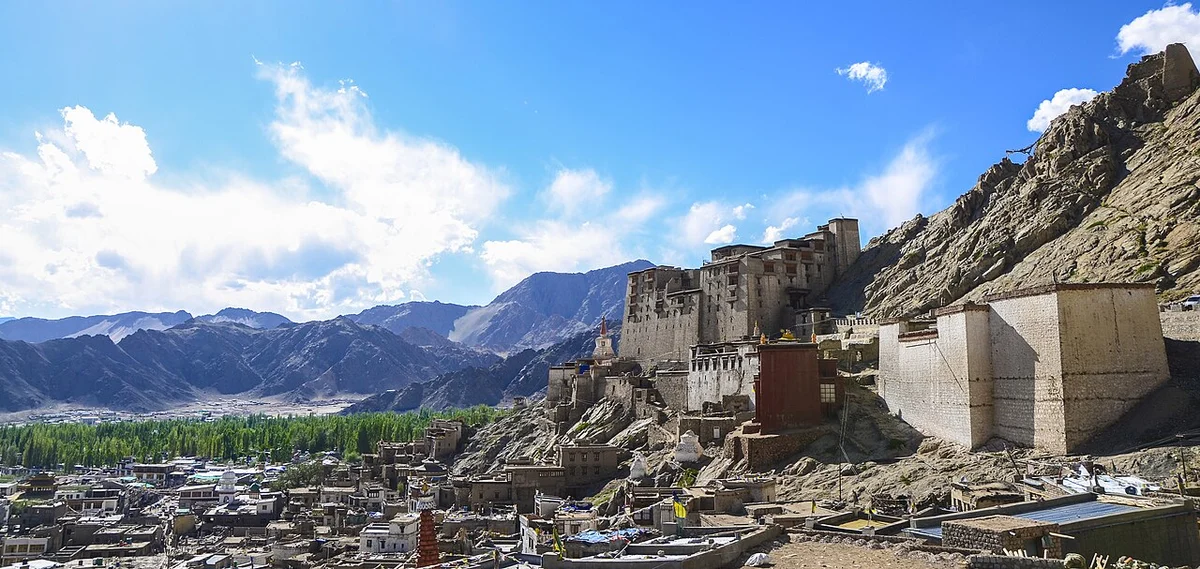
How to arrive in Leh
Reach Leh by air via Kushok Bakula Rimpochee Airport (IXL) or by a road approach confirmed for your travel date, then reserve at least 48 hours after arrival for rest and acclimatisation. Use Leh as your Ladakh base and schedule higher-elevation trips such as Khardung La and Pangong Lake after that window, subject to current road and permit checks.
Search for IXL when comparing flights, especially if you are piecing together separate bookings from overseas. Check the actual inventory for your date and read the arrival time on the itinerary. District Leh’s access page describes air and road approaches, but its carrier list contains superseded names. Use it to understand the ways into town, then use the airline’s booking information to establish whether your flight is available.
For an overland plan, establish where your road transfer begins and ask which segments the driver expects to use. Regional notices from Ladakh Tourism provide a starting point, and a current update on the individual approach can determine whether the journey is feasible on your dates. A mixed rail and road itinerary needs an explicit transfer outside Leh. The district’s access information describes no passenger-train arrival in Leh town.
Keep arrival time separate from the duration of the onward journey. For the first booking, you need an expected time at your accommodation and a way to get there from the airport or road drop-off. For the second, you need an agreed departure, the route, and an estimate that accounts for the stops you intend to make. Get each estimate from the people operating that part of the trip.
| Stage | Place or route | Published detail to use |
|---|---|---|
| Arrival | Kushok Bakula Rimpochee Airport (IXL) | Airport transfer to your Leh accommodation. |
| First 48 hours | Leh town base | District guidance requires at least 48 hours before higher-altitude travel. Ladakh Tourism calls for rest first. |
| After the rest period | Leh Palace and Old Town | ASI ticketed heritage site, uphill approach and conflicting public opening-hour listings. |
| After the rest period | Central Asian Museum and Main Bazaar | Separate institution near the bazaar, with its own access. |
| After the rest period | Shanti Stupa | Hill approach on Chanspa. Recheck the tourism hours. |
| Later day trips | Khardung La or Pangong Lake | Different destinations. Check the exact route and permit scope, health guidance and current conditions. |
- District Leh — 48-hour acclimatization instruction
- Airports Authority of India — Leh airport
- Ladakh Tourism | Travel advisory
- Ministry of Tourism Swadesh Darshan 2.0 — Leh destination master plan, iteration 01
- Tibet Heritage Fund — Central Asian Museum Leh
- District Leh — Shanti Stupa on Chanspa hill
- Union Territory of Ladakh — 24 August 2026 review of PAP and RAP
Count 48 hours from arrival
District Leh directs arriving tourists to spend at least 48 hours acclimatising before travelling to higher parts of the district. Its instruction distinguishes nearby town areas from higher-altitude destinations. Ladakh Tourism’s advisory calls for at least 48 hours of complete rest. Follow that rest-first wording when reserving the first part of the stay and leave climbs, hill visits and onward excursions out of the fixed schedule.
Count elapsed hours, including the time you actually arrive. With a Tuesday arrival at 2 pm, 48 hours have elapsed at 2 pm on Thursday. A Thursday morning departure would fall inside the window even though you have booked two nights. If the excursion you want has a morning departure, Friday is the first morning that fits this example. A late arrival moves the end of the rest period by the same amount.
The minimum interval sets the earliest point at which an onward trip can fit in the calendar. Use the latest Ladakh Tourism advisory for local guidance before departure. Allow room for a longer stay in town if you need it, particularly when the first onward booking also commits you to accommodation elsewhere. An itinerary can account for elapsed time and booking flexibility. Questions about individual readiness belong with a qualified health professional.
Build a market and Old Town visit
After the rest period, use Leh Main Bazaar and Old Town to anchor a town visit. The Central Asian Museum sits at Tsas Soma, Chutayrangtak, near both areas. Its focus on historic caravan routes and local cultural collections gives the visit a clear purpose for readers interested in how Leh developed as a trading town. It is a separate venue from Leh Palace, so its opening and access need a separate check.
The Tibet Heritage Fund’s site plan marks approaches from Main Bazaar and Old Town. Use those labels to identify the museum and ask which entrance is in use. The plan establishes how the site relates to the neighbourhood, while the operator or local staff can confirm the current entrance, opening hours and any entry charge. Keep that distinction in mind when a map pin appears to lead to a different side of the site.
Decide whether the collection is the reason for the outing or an addition to time in the market. If the museum is your priority, confirm a visiting window before arranging transport or building the rest of the day around it. If the market and Old Town are your priority, the museum can be an optional stop once entry is confirmed. This makes the plan workable even when the only museum information you can find is archival.
The district’s 48-hour instruction governs the order of the itinerary. Put arrival and rest ahead of uphill town outings and trips to higher elevations. If you do head out after that window, the Central Asian Museum near the bazaar and the higher approach to Leh Palace have different access conditions. Check the operator and how much uphill walking your group intends to do.
Plan Leh Palace around access and entry
Leh Palace is a nine-storey former royal residence associated with Sengge Namgyal. It stands north of the market and the Ministry of Tourism master plan identifies it as an Archaeological Survey of India ticketed site. Confirm which parts of the building can be visited before making the palace the centrepiece of a town day. The building’s height describes the monument. The operator can tell you which floors are currently open.
Published hours differ. The destination master plan gives 10 am to 5 pm, and Incredible India gives 7 am to 4 pm. Their shared 10 am to 4 pm window is a conservative starting point for a provisional itinerary. Ask the operator for the opening and last admission on your chosen day, plus the ticket amount. Those details matter separately, since an opening window alone cannot establish how late a visitor can enter.
The master plan records a narrow access road and limited parking. It also places the Leh Taxi Stand and New Bus Stand within about two kilometres of the palace. That proximity helps with orientation. For a practical access decision, ask where a vehicle can drop you, what remains between that point and the entrance, and where you can be collected afterwards. A straight distance between landmarks gives little information about the final approach.
Give Shanti Stupa its own stop
Shanti Stupa sits on Chanspa hill in Leh. District Leh dates the Peace Pagoda to 1991 and describes two levels and clockwise circumambulation. Give it a separate slot after the initial rest period. The hill approach and the layout matter to anyone arranging transport or deciding how much ground to cover, even though the monument is within town and can be planned independently of the longer mountain excursions.
Incredible India lists a 5 am to 9 pm visiting window. Confirm current opening and last entry before committing to a visit at either end of that range, particularly if you are arranging a return pickup. Ask about any entry charge and whether the areas you want to see have step-free access. A driver’s description of the road approach and staff information about access within the site answer different parts of the same visit.
When you have one confirmed town slot, choose it according to what you want to see and the conditions of entry. A visitor chiefly interested in the pagoda can spend that slot in Chanspa and keep the palace for another day. With a fixed palace ticket or confirmed admission window, place the stupa in a later opening you have checked. Working from the confirmed visit helps you avoid rushing between two sites whose published hours may change.
The ministry destination planning document and the Incredible India palace page show different opening hours. A trip that depends on a late entry needs a current gate confirmation. For planning, record the source name and date alongside any hour rather than assuming both descriptions apply to the same admission schedule.
Check onward roads, times and permits
For Khardung La, Pangong Lake or another extension from Leh, start with the full itinerary you intend to drive. Record intermediate stops and the return leg as well as the destination. Himalayan road connectivity depends on season and conditions, and a regional advisory may leave the status of your individual segments unresolved. Ask your transport provider to confirm the complete route against current notices close to departure.
When comparing travel times, ask whether the estimate is for a single leg, driving in both directions, or the whole outing including stops. Compare those figures before choosing between a return to Leh and an overnight extension. Ask what change in current road conditions would alter the pickup or return estimate. This gives you a usable planning range for that trip without relying on a fixed duration from a general destination description.
For notified areas, check the precise route and the traveller’s nationality status against current official permit guidance. The Union Territory’s August 2026 review distinguishes Protected Area Permits and Restricted Area Permits. Process changes discussed there were proposals, so use the current permit instructions to establish what applies. An Indian citizen and a US passport holder on the same booking should each check the requirements that apply to their own travel status.
If the current guidance leaves an intermediate stop or crossing ambiguous, contact District Tourist Information with the route and the relevant traveller details before committing to the extension. Apply the answer to the itinerary you actually verified. If a road change leads the operator to suggest a different approach, recheck the permit implications for the revised route. Keep the city visits available as a fallback while those particulars are being resolved.
| Decision | What to verify | Where to check |
|---|---|---|
| Earliest departure | Actual arrival time and the end of the 48-hour window | District Leh instruction and Ladakh Tourism advisory |
| Road access | Usability of each planned segment, including the return | Current regional notices and your transport provider |
| Day trip or overnight | Total outing time, including planned stops and the projected return | Your transport provider |
| Eligibility for notified areas | Current requirements for the full route and each traveller’s status | Current official permit guidance or District Tourist Information |
Fit Leh into a short or longer Ladakh stay
Build the itinerary around the usable time between the end of the rest period and the return journey. For a short stay, mark the first available town slot and choose one visit with a confirmed entrance or opening time. If there is only part of a day left, the market and Old Town can form the town plan, with the museum added when admission fits. This gives the city visit space without borrowing time from the rest period.
With a longer stay, keep a town day and an onward day movable until you know the excursion can run. The palace fits best where you have verified a workable admission and approach. Shanti Stupa can occupy another slot when its approach and pickup suit the day. An excursion belongs in a window long enough for the operator’s full estimate, with the route and any applicable permission already checked.
A traveller arriving late on Monday and leaving on Thursday morning has most of Wednesday before the minimum rest window ends. If the outbound transfer is early on Thursday, this is a short Leh stay with little time for a post-rest attraction. Adding a later departure or another night creates an actual visiting window. Whether that extra time supports a town visit or an onward excursion depends on its length and the confirmed operating conditions.
- District Leh — 48-hour acclimatization instruction
- Airports Authority of India — Leh airport
- Ministry of Tourism Swadesh Darshan 2.0 — Leh destination master plan, iteration 01
- Tibet Heritage Fund — Central Asian Museum Leh
- District Leh — Shanti Stupa on Chanspa hill
- Union Territory of Ladakh — 24 August 2026 review of PAP and RAP
- Ladakh Tourism | Travel advisory
Sources
- District Leh — 48-hour acclimatization instruction
- Airports Authority of India — Leh airport
- Ministry of Tourism Swadesh Darshan 2.0 — Leh destination master plan, iteration 01
- Tibet Heritage Fund — Central Asian Museum Leh
- District Leh — Shanti Stupa on Chanspa hill
- Union Territory of Ladakh — 24 August 2026 review of PAP and RAP
- Wikimedia Commons — Leh Palace Landscape.jpg
- Ladakh Tourism | Travel advisory
