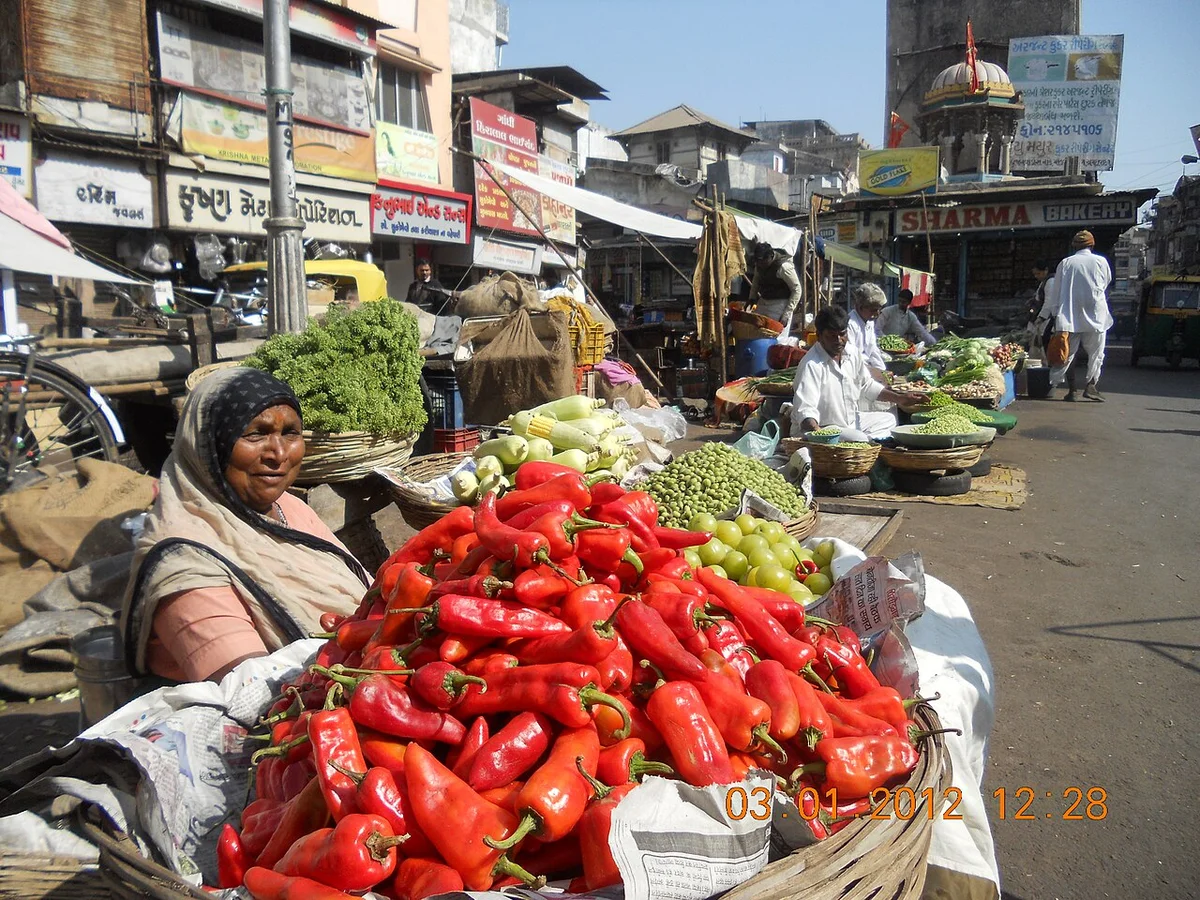
Three street scenes, three local stories
Three dated photographs document vegetable trading at Manek Chowk in Ahmedabad, second-hand books at a College Street stall in Kolkata, and the approach to the Mattuthavani integrated flower market in Madurai. Read them alongside local records to see how a square accommodates different trades, how a book district reaches the pavement, and how a named market fits into a city’s wider flower trade.
The photographs were taken over a span of more than ten years. Ahmedabad's dates to 3 January 2012, Madurai's to 15 June 2013, and Kolkata's to 8 June 2022. That difference matters when looking at a stall, an entrance or the way space was used. Each date belongs to the scene it accompanies. A visitor comparing the pictures with the street today has three distinct points of reference.
The pictures also work at different scales. The wide Manek Chowk scene puts a vegetable market in its square. The College Street photograph brings the story down to books at one stall, where the scale of the display makes browsing a concrete subject. The Madurai photograph shows the market exterior and public approach. Its caption can help a reader place the venue, while the account of flowers and jasmine draws on separate documentation.
- Incredible India — Market and street food at Manek Chowk, Ahmedabad
- Incredible India — Kolkata's College Street and Boi Para
- Incredible India — Madurai flower market and jasmine tradition
- Image — Ahmedabad's Manek Chowk vegetable market by Rajtrivedi2001
- Image — College Street second-hand books by Yogabrata Chakraborty
- Image — Mattuthavani flower market, Madurai, by Nileshantony92
Manek Chowk and the vegetable trade
Rajtrivedi2001 photographed the Manek Chowk vegetable market on 3 January 2012. The wide scene gives the square a specific use on a specific date. A caption can name Ahmedabad, Manek Chowk and the vegetable trade in one line. In the text, the larger question is how a space seen holding a vegetable market fits within an area known for several kinds of commerce.
India's tourism department describes Manek Chowk as a multi-use market with daytime vegetable trading and jewellery, textile and street-food uses. This helps explain why descriptions of the same place can emphasise different goods. The photograph documents one of those uses. Keep the other trades in the surrounding account so each claim has a clear basis. The tourism description supplies the broader mix of commerce, and the photograph gives the vegetable trade a date and a setting.
The Historic City of Ahmedabad Urban Heritage Atlas and the city's nomination documentation give the square a wider setting in the walled city, where public squares and specialised bazaars form part of the historic fabric. The atlas also maps residential features, including gated pols. Those names are useful when the subject is the area around the square. For the vegetable-market image itself, Manek Chowk is the precise place name. A more specific claim about a nearby lane or pol would need a location match of its own.
For a visitor deciding between produce and street food, the most useful question is which trade is active on the intended day and at the intended time. Ask a local market contact or a trader about that activity, and check when the information was confirmed. A dated observation of vegetable trading answers a question about that period. The same square can still require a separate check for food service.
College Street at the scale of a bookstall
Yogabrata Chakraborty's photograph records second-hand books at a College Street stall in Kolkata on 8 June 2022. The subject is specific enough to anchor a story about how readers browse. With books offered at the pavement, browsing can begin in the course of walking along the street. The photograph provides a place to start looking at that relationship between movement and shopping, with a single stall as its documented example.
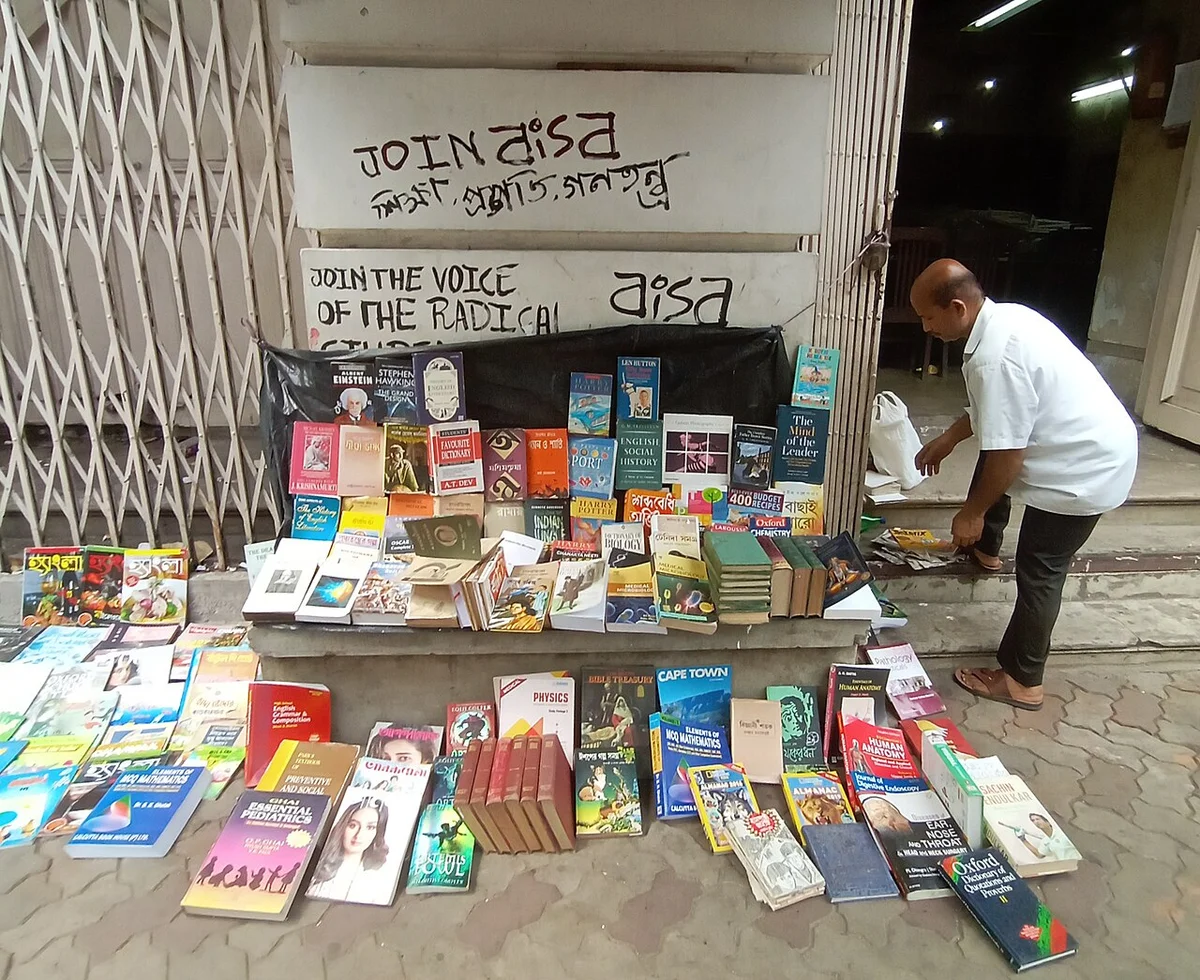

India's tourism department calls the central Kolkata book district Boi Para and names the nearby Indian Coffee House. Its book-shopping guide locates College Street from Bowbazar to the Mahatma Gandhi Road crossing and points readers to College Square. Those references give readers a sense of the district's extent and landmarks. In a caption, College Street is the supported location for the photographed books. The landmarks belong in the surrounding account unless the stall's position relative to them can be established.
If you're looking for a particular second-hand edition, separate the question of where to browse from the question of whether a copy is available. The district description helps with the first choice. For the second, ask a bookseller about the title and edition before making a trip around a single purchase. The image records second-hand trade in June 2022, and each seller's stock calls for its own check.
The credit identifies the photographer. The caption can stay with the books and the stall, which carry the story without naming anyone in the frame. A new account of what customers seek or how sellers acquire books would need reporting with the people involved. It would also give the essay material beyond the image, such as a seller's description of which editions customers ask for and how the seller distinguishes different printings.
Mattuthavani's market entrance and Madurai Malli
Nileshantony92 photographed the exterior and public approach of Madurai's Mattuthavani integrated flower market on 15 June 2013. The frame shows the venue from outside. The useful caption identifies that viewpoint and gives the date. Flower stalls fall outside the frame, so the accompanying story about the flower trade comes from the documented role of the market and the wider context for jasmine in Madurai.
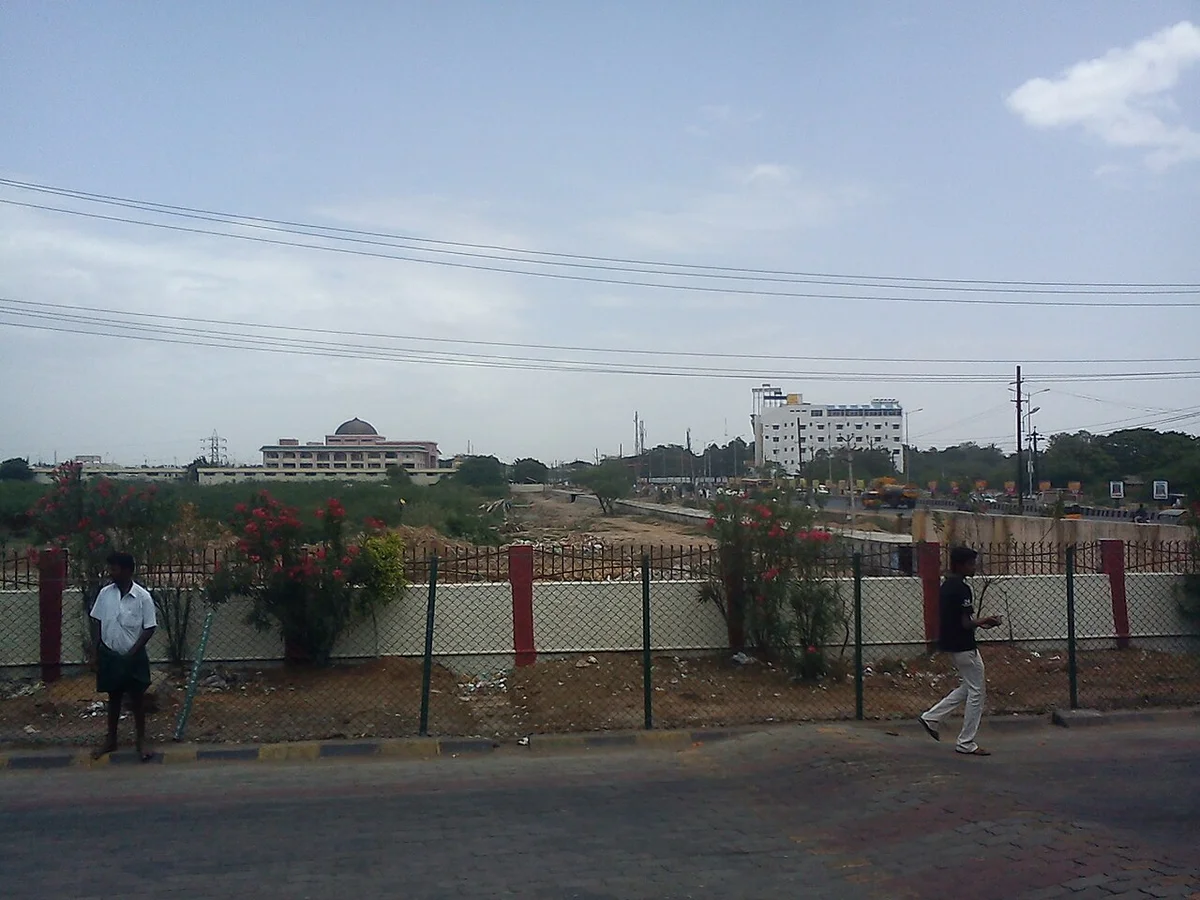

India's tourism department describes Madurai's flower market and the city's association with Malligai jasmine. Intellectual Property India's register records Madurai Malli as a registered agricultural geographical indication in Tamil Nadu. These details answer different questions. Mattuthavani identifies a market venue, Malligai is the jasmine name used in the tourism account, and Madurai Malli is the specific registered name. The register is the source for that last claim.
For a reader interested in seeing flower trading, the practical next check concerns entry and activity at the venue. Ask a current market contact where visitors enter and when trading is active. A reader interested in the registered product has a different question and can ask a seller to identify the flowers and explain their origin. The exterior photograph helps orient the venue story. The tourism account and the register supply context for asking more precise questions about what is sold.
A new interior photograph could extend the story from the approach to a documented transaction or stall display. To caption a flower by name, record who identified it and what that identification establishes. A trader's description of a particular batch provides evidence specific to that batch. The geographical indication entry establishes the registered name, and any claim connecting the batch to that name needs evidence about the flowers being photographed.
The GI register numbers the Madurai Malli application 238 and gives 15 January 2013 as the certificate date. The same entry puts the registration in agricultural class 31 and names the Madurai Malli Farmers Association as the applicant. The photograph is dated five months after the certificate. Their dates can appear in the same market story as long as the registration supports the name and the image supports the exterior view.
What the street layout can tell you
The location a reader needs depends on the scene. At Manek Chowk, a named square is the setting for one documented market use. On College Street, a stretch of road and its landmarks give context for a photograph of one stall. At Mattuthavani, the venue name matters alongside the viewpoint, because the approach and the trading floor would illustrate different parts of the story. Use the smallest place name the photograph's record can support, then widen the geography in the prose.
Jaipur offers a useful comparison for reading street form. The UNESCO World Heritage record identifies gridded streets and bazaars as features of the walled city's planned layout. Ahmedabad's UNESCO atlas can help a reader place gated pols and residential fabric within its own walled city. A named bazaar street in Jaipur and a gated residential pol in Ahmedabad point to different features. The specific term carries information that a broad description of historic streets would lose.
A heritage record can establish the layout and explain why it matters. A particular photograph still needs its own location evidence. A row of shops along a straight Jaipur street could illustrate the planned layout once the photographer's location record ties the frame to the walled city. Any account of what a person is selling or doing would come from the image documentation or local reporting. This lets the reader follow the evidence from city plan to individual scene.

| Place or subject | Date or period | What the record documents |
|---|---|---|
| Manek Chowk, Ahmedabad | 3 January 2012 | Vegetable trading in the market square |
| College Street, Kolkata | 8 June 2022 | Second-hand books at a single stall |
| Mattuthavani, Madurai | 15 June 2013 | Exterior and the public approach of the integrated flower market |
| Madurai Malli | 15 January 2013 | Agricultural geographical indication certificate date |
| Jaipur’s walled city | World Heritage record | Grid and bazaars of the planned city |

- UNESCO Urban Heritage Atlas: Historic City of Ahmedabad
- UNESCO World Heritage Centre: Jaipur City
- Incredible India — Market and street food at Manek Chowk, Ahmedabad
- Incredible India — Kolkata's College Street and Boi Para
- Incredible India — Madurai flower market and jasmine tradition
- Intellectual Property India, Madurai Malli registration no. 238
Dates, credits and changes to the photographs
Put the place and capture date beside each photograph where a reader can see them at a glance. A date kept only in image metadata can disappear when the file is converted for the web. The caption should describe the scene on that date. Give any later reporting its own date in the article, especially when a new observation concerns access, the location of stalls or the kinds of goods on offer.
The two market photographs, Manek Chowk by Rajtrivedi2001 and Mattuthavani by Nileshantony92, are listed under CC BY-SA 3.0. Yogabrata Chakraborty's College Street photograph is listed under CC BY-SA 4.0. Keep the creator, source, licence version and any change notice with the corresponding image. For a resized or converted copy, describe the changes the published file actually underwent. Check the applicable ShareAlike terms for any adaptation.
A copyright licence covers copyright reuse under its terms. The permission needed to photograph inside a shop or a privately managed venue is a separate matter, as is consent for a prominent portrait. A wide documentary image can keep attention on the place and the trade without bringing an individual into the story by name. For a new photograph, seek permission where the framing singles someone out, agree access before entering private space, and leave room for people to work and pass.
A crop can also change the editorial claim. At Mattuthavani, the public approach is part of the documented view. A crop tight enough to remove it would leave less visual context for a caption about entering the market. At Manek Chowk, the wide view lets the square carry part of the story. Before using a smaller version, read its caption against that version and check that the framing still supports the detail the words direct the reader to see.
Sources
- UNESCO Urban Heritage Atlas: Historic City of Ahmedabad
- UNESCO World Heritage Centre: Jaipur City
- Incredible India — Market and street food at Manek Chowk, Ahmedabad
- Incredible India — Kolkata's College Street and Boi Para
- Incredible India — Madurai flower market and jasmine tradition
- Wikimedia Commons — Photo reuse, attribution and personality rights
- Image — Ahmedabad's Manek Chowk vegetable market by Rajtrivedi2001
- Image — College Street second-hand books by Yogabrata Chakraborty
- Image — Mattuthavani flower market, Madurai, by Nileshantony92
- Intellectual Property India, Madurai Malli registration no. 238