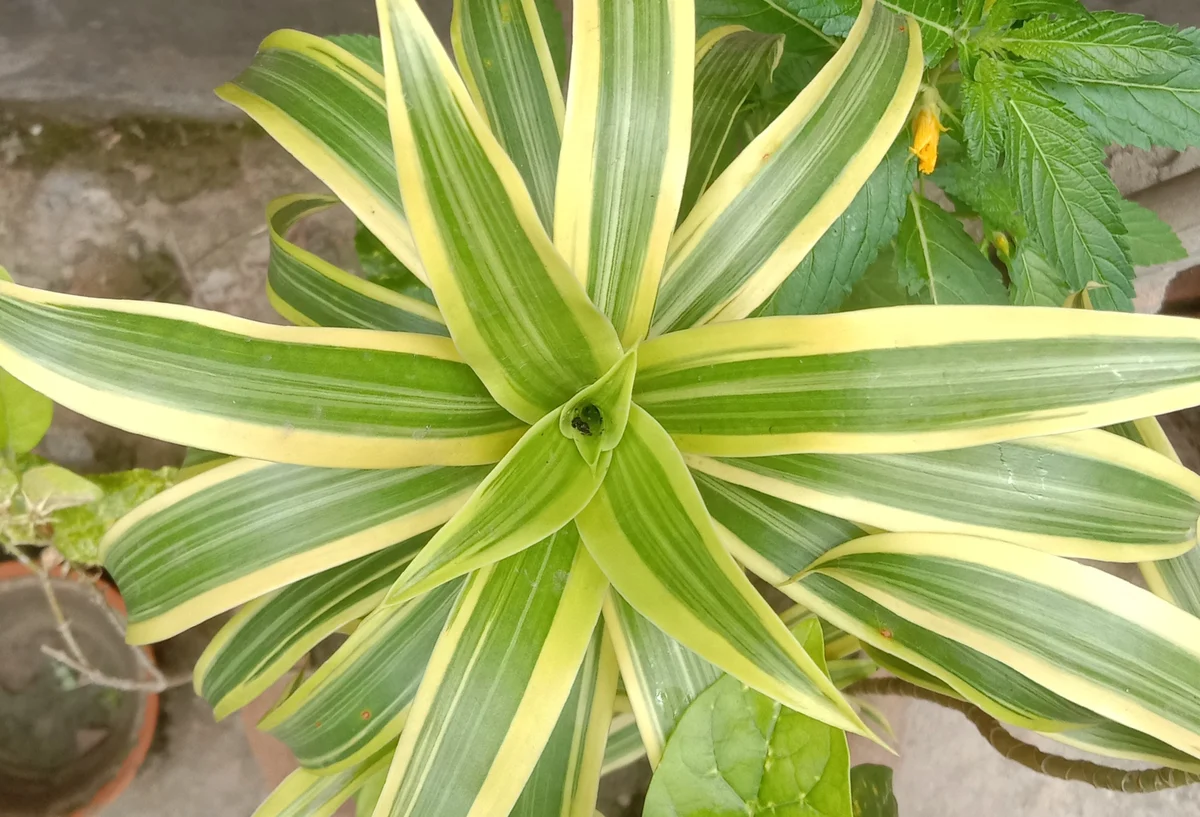
How to identify the Song of India plant
Song of India is a variegated form of Dracaena reflexa. Look for green leaves edged in yellow or cream, crowded near the tips of upright or branching stems. Give a potted plant bright filtered light, a pot with drainage holes and a watering routine based on how quickly its mix dries. The same plant may be sold as Song of India, Dracaena reflexa Variegata or under the older genus name Pleomele.
Singapore’s National Parks Board identifies the cultivar as Dracaena reflexa Song of India. Kansas State University’s guide uses Dracaena reflexa Variegata for the plant with yellow-edged leaves. The University of Florida lists Song of India separately from Song of Jamaica. When comparing plants at a shop, check the leaf pattern and full label. In a variegated plant, the contrasting margin repeats across many healthy leaves. Irregular yellowing on an otherwise green leaf calls for a different inspection.
The name also appears in Indian public records. The President of India’s horticultural inventory lists Song of India as Dracaena reflexa and the Delhi Development Authority uses the common name on a nursery list. Those listings can help when matching a local label. Kew gives the species’ native range as northeastern Mozambique and the western Indian Ocean. The Indian common name and its use in nurseries describe how the ornamental is known locally, while Kew’s record describes the species’ native range.
At the nursery, compare the youngest open leaves with the mature leaves lower down. On a healthy plant of this cultivar, the pale edge is part of the overall pattern. A group of pale patches, torn tips or browned areas is a separate condition to examine. Ask whether the plant came from a shaded greenhouse or an outdoor bed. That gives you a starting point for matching its old light exposure while you find an appropriate spot at home.
- Singapore NParks exact cultivar Dracaena reflexa 'Song of India'
- Kansas State University Research and Extension on Song of India identification and container care
- University of Florida IFAS interiorscape Dracaena cultivar guide
- Kew Plants of the World Online accepted name and native range
- Indian Institute of Science JCB Herbarium Dracaena reflexa species record
- President of India horticultural inventory common-name listing
- Delhi Development Authority nursery plant list
- Photograph of a Song of India plant in West Bengal
Choose light indoors or on a balcony
For a plant in a room, start by a bright window with direct hot midday or afternoon sun screened by a curtain or set back from the leaves. Kansas State and NC State recommend bright light without strong direct sun for container-grown dracaena. A place near the window can be much brighter than a shelf deeper in the room, even when both look well lit to your eyes. Observe how the light falls at the actual height of the plant.
For a balcony, start in a sheltered position where the pot has bright light for much of the day and avoids the strongest heat. Singapore’s NParks lists semi-shade and full sun in its tropical landscape profile. An established plant in the ground can experience that light differently from a recently bought plant in a small pot. Introduce any extra exposure gradually and monitor the leaves facing the sun, especially beside a hot wall or reflective glass.
Check the pattern before moving the plant. A pale or dry patch mostly on the side facing the window after a move can point toward exposure. Damage that appears all over the plant needs a wider check of the mix, watering and pests. When changing the position, keep the other conditions as steady as possible for a while and follow the next leaves. Existing leaf damage remains a record of earlier conditions.
Water by checking the pot and potting mix
Use a pot with open drainage holes and a mix that holds some moisture while draining after a thorough watering. Check below the surface with a clean finger or wooden skewer before the next watering. Kansas State advises letting a container partially dry before watering again without letting the entire root ball become dry. If the mix below the surface is still wet, give it more time and check again. Empty the saucer or outer pot after watering.
Pot size and exposure change the result. A small pot in warm moving air can dry quickly, while a large container in a humid room can stay wet long after its surface looks dry. A decorative cover without a drain can keep the nursery pot sitting in water. Lift the inner pot to check for pooled water. Fixing that problem can help more than changing the nominal day you water.
Adapt to your part of India and the place the plant actually occupies. A covered balcony during heavy rain may receive little direct rainfall but stay humid. An exposed container can instead take on extra water from rain. In a bright, dry room it can lose moisture faster than a sheltered outdoor pot. Check the mix after a period of monsoon rain, a heat wave or a move indoors and adjust the interval to the observed drying.
When you repot, move to a container that fits the root ball with room to grow and has working drainage. NC State mentions perlite or sand as amendments that can improve aeration in a suitable mix. A lighter mix is useful when the current one stays dense and wet. If water rushes around a hard dry core and exits below while the centre stays dry, check how evenly the existing root ball is being wetted.
The RHS uses moderate watering while the plant is actively growing and less water when growth slows. Observe the plant and temperature where you live before changing the routine. A plant beside an air conditioner or in a cool room may use water more slowly than one spending the same week on a warm sheltered balcony. If you depend on someone else to water while you travel, show them how to check the pot below the surface and how to empty the saucer.
Diagnose yellow leaves, brown tips and pests
Start with where the symptom appears. Check the oldest and newest leaves, the side facing the window, the points where leaves meet stems and the underside of several leaves. Then check the root zone and recent changes in location or watering. Yellow leaves can follow either too much or too little water, so change the watering interval only after checking how the mix actually feels.
Dry tips and margins have several possible causes. The University of Florida’s commercial Dracaena guide describes salt, boron and fluoride injury patterns as well as light-related stress. A brown tip alone identifies none of those causes. Check whether the pot has drained, whether the mix recently dried completely, and whether fertiliser or a different water supply was introduced. If leaf edges keep deteriorating after a change in feeding, review how and when you apply it before adding more.
Inspect for visible pests before treating. NC State names spider mites, scale, mealybugs and thrips among the problems to check. Cottony clusters, fine webbing or attached bumps give you different clues. Move a suspect plant away from nearby pots while you inspect it. Look with a light or lens because a stem or leaf joint can hide early signs. If several plants share the same symptoms, also look for an environmental change they experienced together.
A leaf problem can have taken hold before you bring the plant home. Take a photograph of the affected leaves and note whether they are old or part of new growth. Use the same viewing angle a week or two later. Compare the spread of fresh damage and the condition of emerging leaves. That record can help you identify whether a change in care addressed the problem, even while the old brown or pale areas remain visible.
| Symptom | Possible explanation to check | First check |
|---|---|---|
| Yellow leaves | Overwatering or extended dryness | Check moisture below the surface and look for water left in a cover pot |
| Bleached or scorched patches | Hot, direct sun after a move | Compare sun-facing and shaded leaves, and check exposure at midday |
| Dry brown tips | Moisture swings or mineral or fertiliser stress | Check recent watering, food and water changes, then monitor new leaves |
| Cottony clusters or bumps | Possible mealybugs or scale | Inspect leaf joints and stems and move the pot away from others while checking |
| Fine webbing or stippling | Possible spider mites | Inspect the undersides of several leaves with a light |
Prune or propagate a healthy plant
Song of India tends to carry foliage near branch tips. The stems can keep marks where older leaves fell. If your plant has become top-heavy, first check that it is getting adequate light and that its pot sits securely. Pruning can reduce the height of a healthy specimen, but a plant with active root or pest trouble benefits from addressing the immediate problem before removing healthy growth.
The Royal Horticultural Society describes semi-ripe cuttings for Dracaena reflexa. Choose a healthy shoot and use the linked cutting guide for the preparation and rooting environment. Record which plant the cutting came from and the starting date. Shape, stem colour and leaf margins are useful visual reminders when several similar dracaenas are being propagated at once.
Move a rooted cutting into a small draining container when it has sufficient roots. Bright filtered light and modest moisture give it different conditions from a mature plant in a large pot. If the small plant seems slow to grow, note its actual warmth and light before deciding whether it needs food. The extension and horticulture references describe conditions and methods, while the pace varies with the cutting and its environment.
Check whether this plant suits a home with pets
ASPCA Animal Poison Control lists Dracaena reflexa, also called Song of India or Pleomele, as toxic to dogs, cats and horses. For a home with a cat or dog that chews plants, avoid placing it where the animal can reach it or reach fallen leaves. A high shelf may still be accessible to a climbing cat. Inspect the floor around the pot after moving or pruning it.
If an animal may have chewed the plant, contact a veterinarian promptly and tell them the plant name. Keep a photo of the label and the plant, including an intact leaf and its margin, so the veterinary team can check the identification. Also tell them when you noticed the exposure and any symptoms you observed. The horticultural records are useful for identifying the plant and the poison-control record concerns the animal exposure.
Before choosing a display spot, combine the two requirements. The plant needs appropriate light and drainage, and the spot needs to keep it away from pets that could chew it. A bright room that can be kept closed may solve both. Where a pet visits every suitable space, choose a different plant with a veterinary source confirming its identification and pet status. Common names alone can refer to more than one plant.
Sources
- Singapore NParks exact cultivar Dracaena reflexa 'Song of India'
- Kansas State University Research and Extension on Song of India identification and container care
- NC State Extension on Dracaena reflexa variety indoor care and signs of stress
- University of Florida IFAS interiorscape Dracaena cultivar guide
- Royal Horticultural Society Dracaena reflexa care profile
- Kew Plants of the World Online accepted name and native range
- Indian Institute of Science JCB Herbarium Dracaena reflexa species record
- President of India horticultural inventory common-name listing
- Delhi Development Authority nursery plant list
- ASPCA animal poison control, Dracaena reflexa (Song of India)
- Photograph of a Song of India plant in West Bengal
