Add up your dealer quote
Enter amounts from the quote using rupees. Leave a field blank when the dealer includes it elsewhere. The calculator totals your entries and runs on this device.
Model guide + price and trim table
Compare Kia Sonet ex-showroom starting prices by trim, find the engine and gearbox you want, and check an itemised on-road quote for your city.
Compare Sonet trims on Kia IndiaEnter amounts from the quote using rupees. Leave a field blank when the dealer includes it elsewhere. The calculator totals your entries and runs on this device.
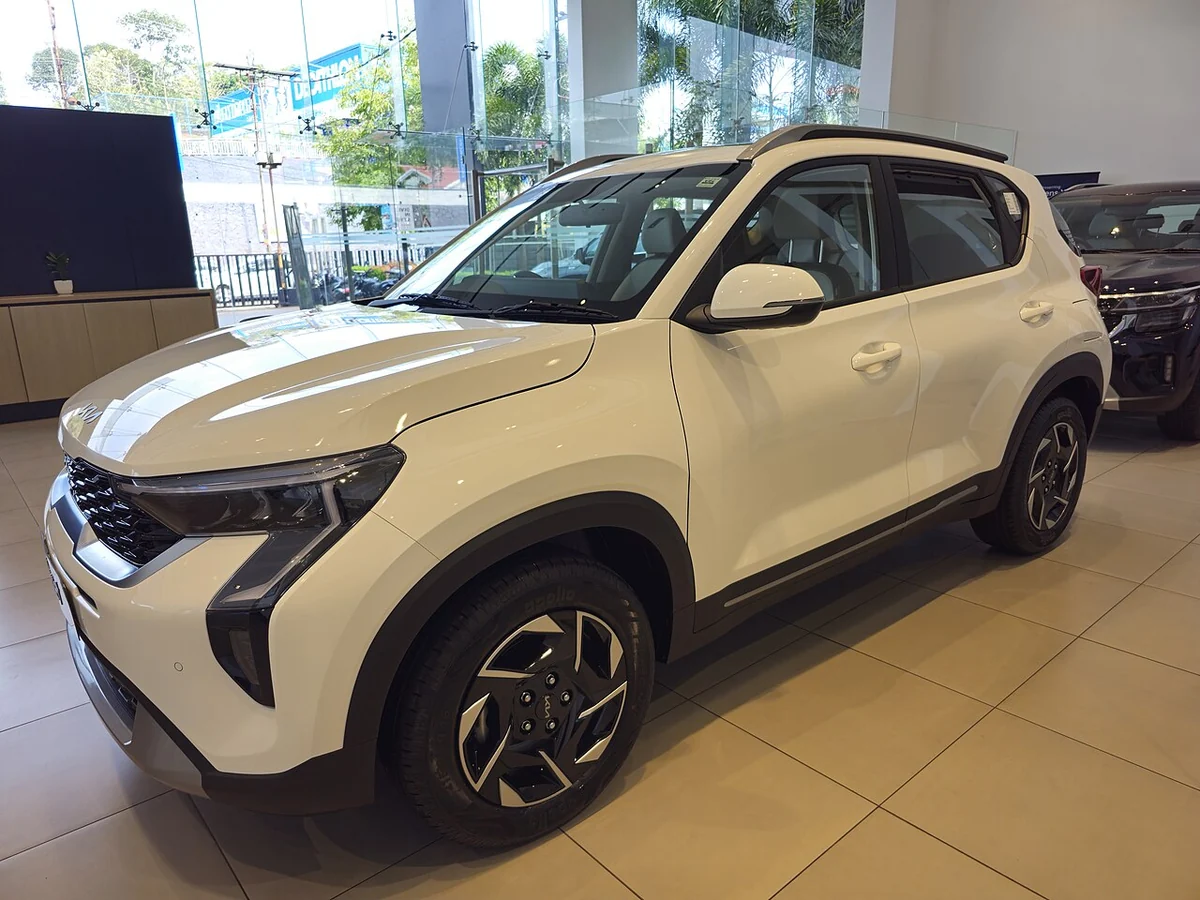
The Kia Sonet starts at ₹7,44,900 ex-showroom in India for the HTE with a 1.2-litre naturally aspirated petrol engine and a five-speed manual gearbox. In Kia India’s 2026 comparison, published trim starting prices run up to ₹13,88,900 for the X-Line, and your on-road price depends on the exact configuration and the charges in your city.
The HTE is the easiest price to interpret because Kia lists just one engine and gearbox for it. Once you move to a grade with multiple powertrains, the starting figure applies to the grade as a whole. A diesel automatic may appear in the same grade as a petrol manual, with both sitting under a single starting-price header. To budget for either car, match the amount to the exact configuration before comparing it with another quote.
The X-Line figure also describes a starting price. Treat it as the highest published starting figure in the comparison, with the price of a specific build still to be confirmed. Kia’s showroom FAQ and the HTE header agree on the entry figure. If a search result gives you a different figure, open the showroom and comparison themselves. A search snippet can retain an older amount even after the manufacturer updates the price on its site.
Use the table to find the grades worth checking within your ex-showroom budget. Each amount comes from the relevant trim header in Kia India’s 2026 comparison. The HTK appears by name in the comparison, but its header gives no amount. Its position between HTE(O) and HTK(O) in the list supplies too little information to estimate what a dealer will charge or to establish whether it can be ordered.
| Trim | Starting ex-showroom price |
|---|---|
| HTE | ₹7,44,900 |
| HTE(O) | ₹7,87,900 |
| HTK | — |
| HTK(O) | ₹8,88,900 |
| HTK+ | ₹9,27,900 |
| HTK+(O) | ₹9,75,900 |
| HTX | ₹11,59,900 |
| GTX+ | ₹13,74,900 |
| X-Line | ₹13,88,900 |
Kia’s comparison lists the HTK grade but leaves its starting price blank in the view checked on 26 November. The dash marks that missing amount. Ask for the HTK price with the exact engine and gearbox on the quote.
HTK+ and HTK+(O) illustrate why the suffix matters. Their starting figures are ₹48,000 apart. That calculation gives you a sense of how far apart the two grades begin. To work out the cost of moving up for a feature you want, first find a shared engine and gearbox, if there is one, then compare actual prices and equipment for those two configurations. The feature may sit in an equipment package alongside other changes.
A budget ceiling works best as an initial filter. A grade whose entry price exceeds your ex-showroom ceiling can drop off the shortlist at the published price. A grade below the ceiling remains a candidate until you price your chosen powertrain. If your ceiling covers the entire purchase, use the table to start the search and leave room for the applicable registration and insurance charges in the final comparison.
Kia’s comparison pairs the 1.2-litre naturally aspirated petrol engine with a five-speed manual, shown as 5MT. It lists the 1.0-litre turbo petrol with a six-speed iMT or a seven-speed dual-clutch transmission, shown as 6iMT and 7DCT. The 1.5-litre diesel is listed with a six-speed manual or a six-speed automatic, shown as 6MT and 6AT. Each pairing appears only in selected grades, so check the row for the grade on your shortlist.
The distinction that matters in traffic is who chooses the next gear. With an iMT, the driver moves the gear lever and the car operates the clutch. With a DCT or AT, the car can choose the gears itself. If you want to move a gear lever but prefer to avoid operating a clutch pedal, look at the iMT. If you want the car to handle both tasks, filter for the DCT on turbo petrol or the AT on diesel.
Suppose two people will share the car and one wants it to shift gears for them on the commute. The HTK(O) comparison gives them two configurations to ask about within the same named grade, the turbo petrol 7DCT and the diesel 6AT. The grade starts at ₹8,88,900, so they need specific prices for both cars. Keeping the grade fixed helps make the quotes easier to read, and checking each configuration’s equipment tells them whether the two builds are otherwise comparable.
| Engine | Transmission | Shifting | Grades with a published match |
|---|---|---|---|
| 1.2 petrol | 5MT | Driver-operated clutch | HTE, HTE(O), HTK, HTK(O), HTK+ and HTK+(O) |
| 1.0 turbo petrol | 6iMT | Driver chooses the gear, clutch is automated | HTK(O) and HTK+(O) |
| 1.0 turbo petrol | 7DCT | Automatic | HTK(O), HTK+(O), HTX, GTX+ and X-Line |
| 1.5 diesel | 6MT | Driver-operated clutch | HTE(O), HTK(O), HTK+, HTK+(O) and HTX |
| 1.5 diesel | 6AT | Automatic | HTE(O), HTK(O), HTK+, HTK+(O), HTX and GTX+ |
The HTE(O) is useful to check if your shortlist includes diesel. Its ₹7,87,900 starting header covers a grade whose matrix lists the 1.2 petrol 5MT and the 1.5 diesel with either 6MT or 6AT. A request for an HTE(O) quote on its own could therefore produce a price for a different car from the one you intend to buy. Put the engine and gearbox on the same line as the trim when contacting a dealer.
HTK(O) brings all three engines into the same grade. Kia lists the 1.2 petrol 5MT, both turbo petrol gearboxes and both diesel gearboxes there. HTX, with a starting price of ₹11,59,900, lists the turbo petrol 7DCT and the diesel 6MT or 6AT. If you want a turbo petrol with an iMT, those two entries in the matrix point you to HTK(O). If you want the turbo petrol DCT, both grades give you a configuration to price.
Once you identify two grades with the same powertrain, use the 2026 brochure to check the equipment that affects your decision. For a turbo DCT comparison between HTK(O) and HTX, find both configurations and check the status of each feature you care about. Separate standard equipment from package-specific options before calculating the price difference. A feature shown on a showroom vehicle is a good reason to ask which build you are looking at, since the display car may have a different package.
Maruti Grand Vitara price and variants in IndiaToyota Urban Cruiser Hyryder price in India: Delhi variant table
Kia’s national starting figure is ex-showroom. For an on-road amount you can use, ask for a written quote for the city where you plan to register the car. Have the dealer specify the model year, exact trim, engine, gearbox and exterior selection. Ask for the ex-showroom amount, registration, insurance and any optional items on separate lines, where applicable, with the total clearly marked. The showroom FAQ supplies no nationwide on-road figure.
If two dealers quote different totals for the same diesel automatic, compare the ex-showroom lines first. Then check whether the quotes use the same registration city and specify equivalent insurance coverage. Look at any accessories or optional packages separately. One dealer might include accessories in its headline total while another prices them separately. Once you know which items both totals include, the difference gives you a clearer basis for deciding where to buy.
Ask the dealer to date the quote and confirm how long the quoted terms apply. Where the total includes a discount or a conditional offer, ask for the condition and the amount to appear on the quote. Keep both the published starting price and your dealer’s ex-showroom line labelled when recording the numbers. That way you can tell whether a later change came from the manufacturer’s listing, the selected configuration, the local charges or the dealer’s offer.
The 2026 brochure gives the Sonet an overall length of 3,995 mm, a width of 1,790 mm and a wheelbase of 2,500 mm. Length and width are useful first checks if you park in a tight garage. Measure the usable space and the narrowest part of the approach. Check mirror clearance, the space needed to open the driver’s door and room to manoeuvre separately. Those details determine whether you can use a bay comfortably even when the car’s listed dimensions fit inside it.
Equipment takes a more specific check than dimensions. Read the brochure entry for the grade and powertrain you intend to buy, then look for any package qualifications. Carry the features that matter into the quote request so there is a written record of the specification you expect. If an item appears as a separate charge, ask the dealer to identify whether it is an accessory or part of a package for the selected build.
If you are choosing a grade because parking assistance matters in your building, confirm the exact equipment on the configuration you can buy. A photograph can help you recognise the facelift body, but it provides an incomplete view of the equipment and can show a different grade. If the dealer has a display car with the system you want, ask which grade and package it has and match those details against the quoted car.
Kia announced the facelift on 12 January 2024 with an introductory entry price of ₹7.99 lakh. That figure belongs to the launch announcement. The 2026 comparison is the relevant manufacturer publication for the trim starting prices above. When a listing cites the launch figure alongside photographs of a facelift Sonet, use the date and the seller’s exact specification to establish which price list the listing is drawing from.
A current Kia India listing identifies a grade in the manufacturer’s published range. Local inventory and the ability to order a particular configuration still need dealer confirmation. If a dealer offers a grade or combination you cannot match to the current matrix, ask whether the offer is for an earlier model year or a car already in stock. If the grade’s production status matters, ask for confirmation before describing it as discontinued. A missing price or a single dealer’s stock result leaves that question open.
An imported Sonet needs to be assessed against the specification and written terms for that individual vehicle. The prices here describe Kia India’s published range. A familiar trim name on a seller’s listing gives you a starting point for identification, while the original-market specification and vehicle paperwork establish what the seller has. Check what local warranty and service coverage the seller can document before comparing that offer with a car supplied through Kia India.
When checking a figure again, open Kia India’s Sonet showroom for the entry price and its trim comparison for the grade you want. Read across to the engine and gearbox cells to see whether the pairing still appears. Then open Kia India’s public configurator and select the Sonet, engine, transmission and other available choices. Record any ex-showroom figure alongside the complete selection. The configurator’s generic ex-showroom field gives you too little information to price a specific automatic.
If the configurator stops short of displaying a price for your selections, get a written quote that names the complete build. If its price differs from the comparison header, check which choices the configurator has retained. A trim floor and the price of a selected build can both be current. The dealer can confirm the amount for the car it can actually supply, together with the expected model year and exterior choice.
Use the same approach when equipment changes between publications. Check the model year on the brochure and ask the dealer to match the promised feature to the actual configuration being offered. Keep the date of the quote and the date you saw the manufacturer’s listing with your notes. If you return to the purchase after a gap, those details help you identify whether you need a refreshed local total, a new specification check or both.
