What fell near Changanasserry on 25 July 2001
Red rain fell in part of Changanasserry, in Kerala’s Kottayam district, on 25 July 2001. The investigators who studied water from the town attributed the colour to spores of the alga Trentepohlia, and their report left open how so much material entered the air at once.
The first account in the Centre for Earth Science Studies and Tropical Botanic Garden and Research Institute report came from Morkulangara, a locality in Changanacherry. The Eos follow-up places the fall around 8:30 a.m. The official report and the Eos article spell the town differently. Both refer to the town in Kottayam district. Try Changanacherry and Changanasserry when searching contemporary records.
The researchers collected water that residents had retained from the shower. They recorded reddish-brown sediment at the bottom of a container. That trace of the event made it possible to investigate the material responsible for the colour after the rain had stopped. The November report goes on to distinguish the detailed investigation of the first locality from shorter examinations of samples taken elsewhere.
The phrase “blood rain” describes a startling colour. The evidence for the colour comes from the contents of the collected water. In the report’s account, the principal pigment-bearing particles were linked to a terrestrial alga, and the investigators had material from local lichens against which to compare them. The report identifies the algae at genus level in its explanation of the event.
From the first report to the November investigation
Researchers from the Centre for Earth Science Studies visited the town on 26 July, the day after the initial report. They collected retained water and spoke to residents. On 29 July they returned to survey the sequence of events as people recalled it. Those dates mark visits after the red shower. The table puts them alongside the two later publication records.
| Date | Record type | What the record shows |
|---|---|---|
| 25 July 2001 | Observation | Red rain reported from Morkulangara. Eos gives around 8:30 a.m. |
| 26 July 2001 | Field visit | Researchers visited Changanacherry and collected retained water. |
| 29 July 2001 | Field visit | They returned to survey residents about the circumstances. |
| July–September 2001 | Other observations | The report’s appendix lists locations and observation dates across Kerala. |
| November 2001 | Institutional report | CESS and TBGRI issue their account and identification. |
| 2002 journal issue | Journal article | Eos article reporting the Changanasserry observation and Trentepohlia genus. |
| 2006 journal issue | Research article | Louis and Kumar publish a separate compilation of 124 reports and an origin hypothesis. |
| 2015 journal issue | Research article | Bast’s team identifies a later, separate Anandapally tree-bark specimen to species level. |
The report covers incidents recorded during July, August and September. Its own November date marks completion of the investigation. If you find a November 2001 label attached to the event, check whether the caption is using the report date, the date of a photograph or the date of the weather it depicts. The report identifies the Morkulangara observation as 25 July.
Earlier descriptions in the same report include a newspaper account from 1896 as well as recollections of coloured rain before 2001. They show that the investigators searched more widely than this cluster of reports. Those references belong in a chronology of observations and recollections. For individual particle findings, begin with which event actually produced a sample that was examined.
How the researchers linked the colour to Trentepohlia
Trentepohlia is a genus of green algae. Members of the group can be conspicuous in shades of orange and red, and may occur in association with fungi in lichens. That combination explains how an organism classified among green algae could produce particles that make water appear reddish. The colour of a visible patch and the biological classification describe different features of the same organism.
The 2001 team examined the particles in the original samples and studied material that grew from them. The investigators reported Trentepohlia in material obtained from the rain. They also found lichens around the affected locality and compared growth from local material with growth from the collected rain. The similarities led the authors to judge a local origin most probable for the Changanacherry particles.
Microscopy and comparison with local lichens did two jobs. The first described what was present in the water. The second offered a plausible source within the landscape of the observed event. The report’s broad conclusion describes lichen-forming algae. Its evidence for the detailed identification comes chiefly from Changanacherry, where the team recorded its fullest study.
The relevant scientific name for the 2001 write-up is Trentepohlia, the genus. A species is a finer classification and requires evidence from an identified specimen. You may see Trentepohlia annulata in coverage of red rain. The source for that species-level finding is a different study with a sample of a different kind.
- Eos: Colored Rain Falls in Kerala, India
- CESS and TBGRI: Report on Coloured Rain, November 2001
- CESS and TBGRI, November 2001 report CESS-PR-114-2001, archival copy
- Sampath and colleagues, Eos article and July 2001 observation
- Bast and colleagues, 2015 Anandapally specimen, Central University of Punjab repository
How the reports from other Kerala towns compare
The November investigation names Valanchuzhy in Pathanamthitta district and Meenachil, Elikkulam and Ettumanoor in Kottayam among the places from which it obtained more material. The authors found microorganisms that looked similar under the microscope. They say those samples received less detailed study than the one from Changanacherry. That qualification should follow the place names if you use them in a report or a map.
The appendix also records observations from places that lie outside that set of examined samples. Kasaragod’s Madikai is one entry, with a report dated 1 August. Kollam’s Pathanapuram appears with a 28 July date. A table of observations can plot both locations alongside Changanacherry. A map of laboratory identifications needs tighter boundaries, since a listing by district provides a different kind of evidence from a specimen report.
A frequently cited count of 124 comes from Godfrey Louis and A. Santhosh Kumar’s separate compilation. Its rows represent reports collated from newspapers and other sources. Use that wording with the number. Many reports can document the geographic spread of observations, while comparatively few specimens document what was collected and studied. The official team’s scope and the later compilation can sit next to one another when each retains its units.
Appendix B of the institutional report gives district, place, a more specific location and a date, with approximate times where available. Some entries give an evening or another approximate period. A researcher reusing the list can preserve those labels as recorded and leave missing times blank. Sorting by date then reveals the sequence without giving the observations a precision their original entries did not have.
The meteor, dust and transport claims
Some Changanacherry residents told researchers they heard a loud sound before the red shower. A few recalled a flash. The institutional report includes those accounts and discusses possible explanations for the sound. The field interviews provide evidence about what people heard or saw. Establishing an atmospheric event and connecting it to the rain would require additional observations.
The CESS and TBGRI team considered ordinary mineral sources while investigating its sample. The report says the sediment did not support an origin in meteor material, volcanic dust or desert dust. The team instead found evidence for the algal source of the colour. That conclusion concerns the examined material and the explanations tested against it.
Louis and Kumar later published an extraterrestrial-origin hypothesis in Astrophysics and Space Science. Their paper gives readers a record of that proposed explanation and the reported distribution of the rain. The original local comparison of rainwater and lichen remains the more direct evidence for what coloured the sample from Changanacherry. The existence of a possible-origin paper tells you what its authors considered, and their proposed source requires evidence that specifically links it to the particles.
The mechanism by which so many particles entered the air remains the narrower open question from the institutional report. Their discussion mentions humid conditions and extensive lichen growth and says information on the local microclimate was insufficient to settle what prompted the event. A source close to the shower gives a starting point. An account of the transport would still need to explain what happened at the scale of the affected locality.
Why the 2015 species paper answers a different question
Felix Bast and colleagues published a species-level identification in 2015. Their paper describes an algal sample taken from rubber tree bark at Anandapally, Kerala, a place the authors associate with reports of red rain. They identified their specimen as Trentepohlia annulata. That finding establishes the identity of the specimen they studied.
The sample description controls what can be inferred. A later specimen collected from a tree in a region associated with coloured rain can document where the alga occurs. To name the species in a bottle from July 2001, look for a confirmed identification tied to that bottle or another recorded sample from the shower. The date of the 2015 paper cannot supply that link by itself.
The researchers also offered an interpretation of how related specimens came to occur in geographically distant places. Species similarity, geographic history and the immediate source of one local shower are different questions. When an article joins them, track whether the evidence comes from the rain event, another observation in the region or a broader comparison among specimens.
- Eos: Colored Rain Falls in Kerala, India
- CESS and TBGRI: Report on Coloured Rain, November 2001
- CESS and TBGRI, November 2001 report CESS-PR-114-2001, archival copy
- Louis and Kumar, geographical case compilation and proposed origin, 2006
- Bast and colleagues, 2015 Anandapally specimen, Central University of Punjab repository
Find and cite the record that matches your claim
For the event, carry three pieces of information into your search. Use 25 July 2001, Changanasserry or Changanacherry, and Kottayam. For the original investigation, use the report identifier CESS-PR-114-2001 and look for the November cover. Older copies of the report use the full names Centre for Earth Science Studies and Tropical Botanic Garden and Research Institute. The title and report number make it easier to find the complete copy with both appendices.
For the genus identification, use the researchers’ original report and their Eos article. The Eos page may display a later date for online publication. Volume and citation information put the article in its 2002 issue. A clean chronology records the observation, report, journal issue and electronic posting as separate details when relevant.
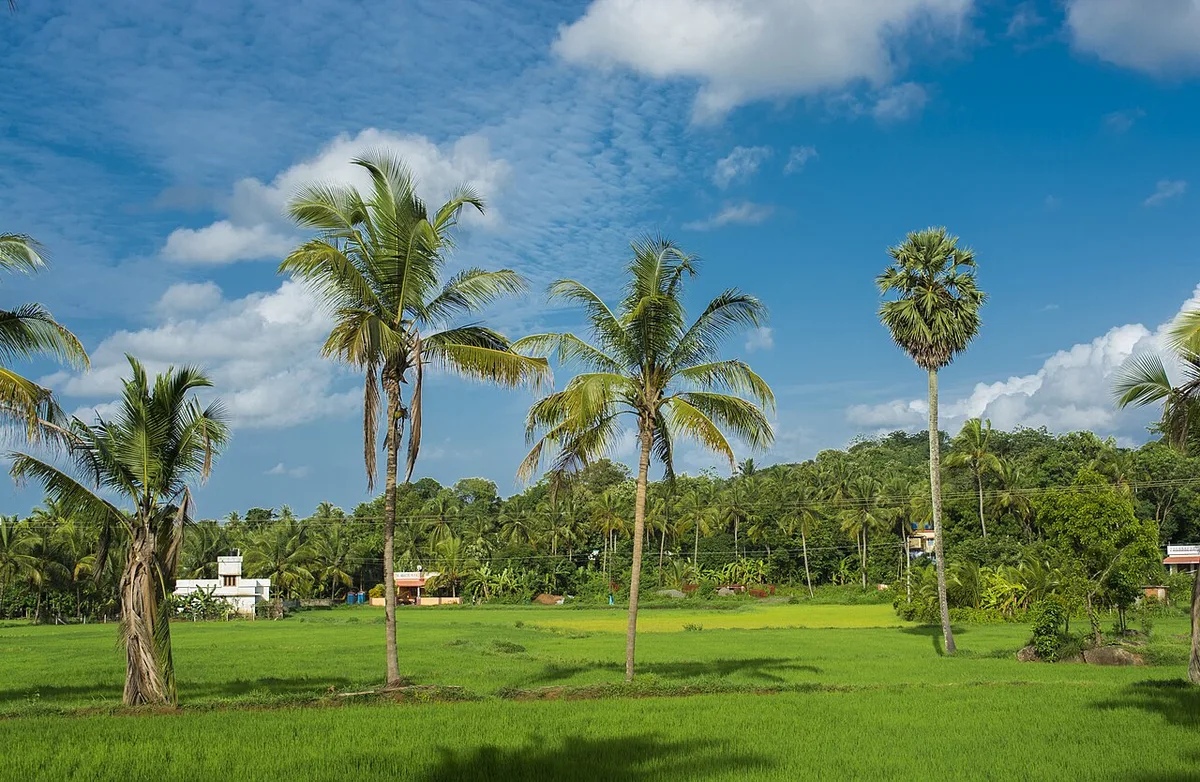
For an image or a new claim, check which event it is dated to and whether anyone identified the sample. A paddy field during the Kerala monsoon supplies regional context, while a dated sample photograph or image from the actual shower would need its own provenance. Likewise, colourful rain in a different year is its own observation. Compare the records and match the conclusion to the event and specimen that support it.
Landscapes of India in photographs, five places and six views
- Eos: Colored Rain Falls in Kerala, India
- CESS and TBGRI: Report on Coloured Rain, November 2001
- CESS and TBGRI, November 2001 report CESS-PR-114-2001, archival copy
- Sampath and colleagues, Eos article and July 2001 observation
- Louis and Kumar, geographical case compilation and proposed origin, 2006
- Bast and colleagues, 2015 Anandapally specimen, Central University of Punjab repository
Sources
- Eos: Colored Rain Falls in Kerala, India
- CESS and TBGRI: Report on Coloured Rain, November 2001
- CESS and TBGRI, November 2001 report CESS-PR-114-2001, archival copy
- Sampath and colleagues, Eos article and July 2001 observation
- Louis and Kumar, geographical case compilation and proposed origin, 2006
- Bast and colleagues, 2015 Anandapally specimen, Central University of Punjab repository