What is the most common last name in India?
No public, reproducible official count was verified that establishes the most common surname among all residents of India. The same evidence gap applies to the most common given name in India.
Singh, Devi, Kumar and Yadav are among the labels in an original study that compares recorded surnames across several Bihar samples. Those labels are documented examples, and their frequencies vary across the study groups. Naming an all-India winner would require a source with national coverage and an explicit rule for deciding which part of each recorded name counts as the surname.
The Census of India’s 2011 training guide shows that enumerators collected an individual’s name. Section 15 of the Census Act, 1948 restricts inspection of underlying census records. A published aggregate would answer a different question about the records, and the existence of the name field or the restrictions in Section 15 cannot tell you whether a particular aggregate has been published.
If a list supplies an answer, read the description of the people counted before reading the rank. A list might cover registered voters, a particular group in Bihar or records assembled by a commercial publisher. Each scope changes what readers can conclude. Also look for the exact category heading. A name appearing as a surname in one dataset may appear within the given-name field in another record.
Regional examples and what each source shows
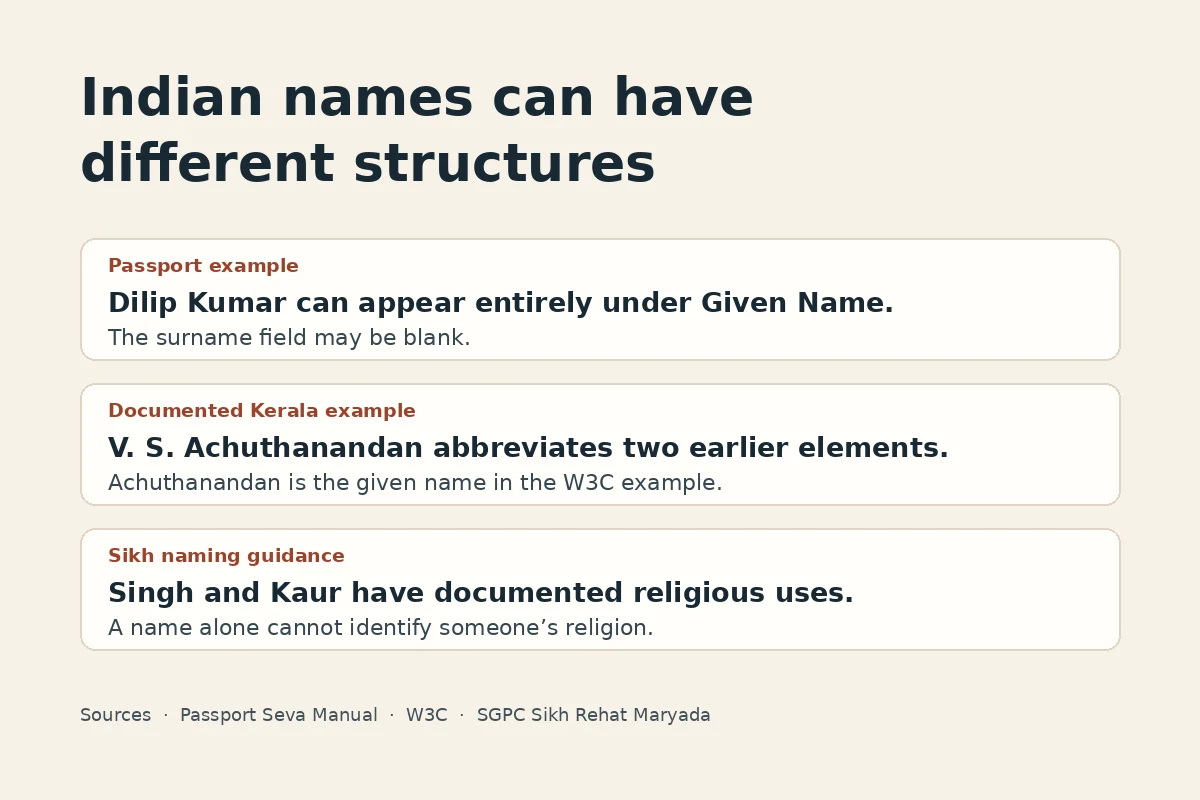
The regional evidence describes several ways that name elements can be arranged. In its discussion of Tamil Nadu, Andhra Pradesh and Telangana, the Passport Seva Manual gives cases in which an initial or an early element represents a father’s given name. In its discussion of Maharashtra, it describes cases where a father’s name appears in the last position. A reader who assigns a surname by looking only at the first or final word can misread either structure.
The Kerala entry in the table comes from a documented individual example. It shows what the initials mean in that particular name. The Bihar entry comes from research samples and shows which written forms appeared under the study’s recorded surname category. The Sikh entry describes a religious practice and supplies no state boundary or frequency. Each example can answer a different question about usage.
For a family-history search, try a documented full form and a documented abbreviated form as separate search terms. In the Kerala example, a search for V. S. Achuthanandan and a search for Velikkakathu Sankaran Achuthanandan can surface records indexed under different versions of the name. Use details from the records themselves to establish whether references belong to the same person. Similar initials or a shared given name leave room for several matches.
| Region or context | Documented example | What the evidence establishes |
|---|---|---|
| Tamil Nadu, Andhra Pradesh and Telangana | An initial or early name element can represent a father’s given name | Passport Seva discusses this arrangement in examples from these states. |
| Kerala | Velikkakathu Sankaran Achuthanandan, also V. S. Achuthanandan | The W3C identifies the family name, father’s name and given name in that order for this individual. |
| Maharashtra | A father’s name can occupy the final position | Passport Seva documents cases in which the final position carries that role. |
| Bihar | Singh, Devi, Kumar and Yadav | These labels appear in a study comparing several distinct Bihar samples. |
| Sikh naming ceremony | Singh and Kaur | Article XVII of the Sikh Rehat Maryada describes their addition in the naming ceremony. |
- Ministry of External Affairs — Passport Seva Manual released under RTI, name fields and examples
- W3C Internationalization and Library of Congress — personal-name structure and cataloguing
- Shiromani Gurdwara Parbandhak Committee — Sikh Rehat Maryada, Article XVII
- Bhupatiraju and colleagues — original study of Patna High Court and Bihar comparison populations
When the final word belongs to the given name
The Passport Seva Manual gives the example DILIP KUMAR, with both words entered as the given name and the surname field left blank. The form instructions describe the given-name field as including first and middle names. In the manual’s example, a tally that automatically counts the last written word as a surname would add one occurrence of Kumar that the original form classifies under given names.
Kumar also appears among the surname labels in the Bihar comparison study. These two uses show why the same written form can turn up in discussions of both given names and surnames. When you read a frequency table, check whether its categories came from fields in the original records or from a researcher’s rule for splitting a name. Both can be described as surname counts, even though they can count different things.
Library catalogues add another distinction. The Library of Congress describes giving precedence to the given name when cataloguing certain Kannada, Malayalam, Tamil and Telugu names without a documented surname. A catalogue entry shows how that institution indexes the person. If you’re using it to find other records, check which version of the name the catalogue displays and how the original work credits the person. The position of the search heading alone leaves the underlying name roles unresolved.
What Singh and Kaur tell you in context
Article XVII of the Sikh Rehat Maryada, published by the Shiromani Gurdwara Parbandhak Committee, describes adding Singh or Kaur during a Sikh naming ceremony. That gives the two forms a specific, documented context. It leaves open how often either occurs in a particular state, how often either appears in a surname field and how individuals use the forms in other records.
Singh also appears in the Bihar study’s surname categories. A source about a naming ceremony and a source about names recorded in selected populations can both document Singh while answering different questions. The ceremony gives context to a practice. The study measures how recorded categories appear within its samples. Neither source establishes a person’s religion, caste, gender, family relationships or exact state from a written name alone.
In a caption or article about a person whose displayed name ends in Singh or Kaur, use the full name as that person or the source presents it. For shortened references, look for the person’s own usage or an editorial source with a clear basis for its choice. Where a reference entry discusses the ceremony itself, attribute the practice to the Sikh Rehat Maryada and keep geographic prevalence claims tied to separate evidence.
Why the Bihar samples give different frequencies
Figure 3 in the study by Bhupatiraju and colleagues compares registered farmers, government employees, court respondents and court petitioners. The figure presents distinct distributions of recorded surnames for these Bihar samples. A group defined by employment, registration or participation in court proceedings has its own route into the records. Those routes affect which people contribute to each count.
Suppose a local history note asks whether Yadav appears in the study’s comparison. Figure 3 supports saying that the label appears. If the note instead asks whether Yadav is the most common surname among Bihar residents, the study groups lack the coverage needed to answer that question. Even a precise reading of every bar would leave the population question unresolved. Combining the groups would still produce a figure built around the study’s selected records.
When checking a claim attributed to this paper, locate Figure 3 and read the caption alongside the description of the samples. Keep the group label attached to any finding. If you need to quote a numerical percentage, look for an explicit value in the research materials and confirm which sample it uses. The bar chart can show that distributions differ, while its visible bar lengths alone give an uncertain basis for quoting precise values.
How to read a surname percentage by state
Dhingra and Sood’s Instate research uses electoral-roll records, English transliteration and a rule that extracts surname strings. The researchers lowercase retained strings and remove certain very short or rare strings. The lookup documentation covers 35 state and union territory strata. These choices define which spellings and people enter the calculation. An exact lookup gives an observed aggregate within that processed corpus. An estimate for a string absent from the lookup comes from a model.
A table can ask what percentage of records with a particular surname come from Maharashtra, or what percentage of Maharashtra records carry that surname. The first calculation divides by records for the surname across the covered areas. The second divides by the covered records in Maharashtra. A state can supply a large share of a surname’s records while that surname makes up a small share of the state’s records. If a column says only “percentage”, find the denominator before comparing it with another table.
The v2026.10 Onomaverse surname dataset describes its country percentage as a fraction of surname records in its corpus. For an India claim based on that product, check that the release actually contains the relevant India rows and trace their geography, reference period and compiler. The version identifies the data release. Determining when the underlying names were recorded requires provenance for those rows.
| Record | Population or source frame | What a reader can compare |
|---|---|---|
| Civil Registration System | India national annual publication | Aggregates for vital events within its published scope |
| Instate research corpus | Transliterated electoral-register records | Named corpus and documented extraction method |
| Bihar population examples | Four distinct samples in one paper | How recorded surname patterns can vary by study population |
| US Census name files | U.S. Census 2020 published files | A separate U.S. population and its published name counts |
Language map of India, 2011 mother tongues by state and areaLanguages of India, from Hindi to the 22 scheduled languages
How to check a claim about India’s most common given name
Start by asking whether “most common name” refers to people of all ages or names given to babies during a defined period. India’s national Civil Registration System report for 2024, published on 1 July 2026, describes registered births, deaths, infant deaths and stillbirths, with demographic breakdowns. No national given-name ranking was found in that published series. Section 14 of the Registration of Births and Deaths Act, 1969 provides for adding a child’s name to a birth registered without one. A usable baby-name table would need to explain how it treats records awaiting a name and whether later additions enter its totals.
A name table for another country can help you recognise what a well-defined release looks like. The U.S. Census Bureau’s 2020 release tabulates first and last names separately at a threshold of 100 occurrences. England and Wales publish a given-name series for registered live births with its own spelling conventions. Those publications answer questions about their specified populations. Finding an Indian name in either leaves its frequency among residents of India unknown.
To verify a changing claim, look for the latest official release or a documented aggregate and open its methodology alongside its data. Check the population, reference period, geographic coverage, occurrence threshold and treatment of spelling variants. A documented first-name lookup such as Naampy also distinguishes observed output from estimates. If the highest row depends on an estimate, or the publisher leaves the population undefined, describe the result only as far as the release supports it.
- Office of the Registrar General — Civil Registration System 2024 national report
- Dhingra and Sood — Instate paper and published aggregate lookup documentation
- Onomaverse — documented public licensed surname-frequency dataset v2026.10
- U.S. Census Bureau — frequently occurring first and last names in the 2020 census
Sources
- India Code: Census Act, 1948, Section 15
- Census of India: Population Enumeration Training Guide
- Office of the Registrar General — Civil Registration System 2024 national report
- Ministry of External Affairs — Passport Seva Manual released under RTI, name fields and examples
- W3C Internationalization and Library of Congress — personal-name structure and cataloguing
- Shiromani Gurdwara Parbandhak Committee — Sikh Rehat Maryada, Article XVII
- Dhingra and Sood — Instate paper and published aggregate lookup documentation
- Onomaverse — documented public licensed surname-frequency dataset v2026.10
- Bhupatiraju and colleagues — original study of Patna High Court and Bihar comparison populations
- U.S. Census Bureau — frequently occurring first and last names in the 2020 census
- India IRL source-based original visual — documented structures, not popularity ranking