Which notes lost legal tender status
India’s 2016 demonetisation removed legal tender status from the old ₹500 and ₹1,000 banknotes from 9 November, subject to temporary arrangements in the government’s notification. The Reserve Bank of India later verified that about 99.3% of the affected notes’ outstanding face value had come back.
The phrase ‘specified bank notes’ identifies the currency covered by the measure. The November notification applied to banknotes from the earlier ₹500 and ₹1,000 series. The 2017 law defined the specified notes by their denominations, their series and their existence on or before 8 November 2016. A ₹500 note issued in a later series therefore falls outside the scope of this withdrawal. The number printed on a note is only one part of identifying it.
The Ministry of Finance used section 26(2) of the Reserve Bank of India Act, 1934, as the authority for the November notification. In practical terms, someone holding an affected note faced two questions from 9 November. Could they still use it for a payment covered by a temporary provision, and could they tender it through a bank under the deposit arrangements? The answer depended on the transaction and the rules in force on the relevant day.
From the November notification to the 2017 Act
The government issued the notification on 8 November 2016 and made the legal tender change effective on 9 November. The initial notice provided a route for people to tender specified notes at bank branches through 30 December. Successive notices changed some operational terms. When checking an account of what a bank would accept on a given day, start with the relevant RBI circular and check for amendments effective by that date. The first circular establishes the starting arrangements.
On 30 December the President promulgated the Specified Bank Notes (Cessation of Liabilities) Ordinance, 2016, numbered 10 of 2016. From 31 December it ended the RBI’s liability and the Central Government’s guarantee for the specified notes, subject to the ordinance’s arrangements. Liability and guarantee describe what the issuer and government owed on the notes. The November notification had already changed the notes’ status for payment. The two measures explain why records identify separate dates for the changes.
The Specified Bank Notes (Cessation of Liabilities) Act, 2017, received presidential assent on 27 February and appeared in the Gazette dated 28 February. Section 1 treats it as having come into force on 31 December 2016. Section 13 repealed the ordinance and preserved actions taken under it. For a chronology, use the date that fits the event being described. February dates the assent and publication of the Act, while 31 December dates its commencement under the text.
| Date | What happened |
|---|---|
| 8 November 2016 | The Ministry of Finance issued Gazette notification S.O. 3407(E). |
| 9 November 2016 | The specified notes lost legal tender status subject to the notification’s provisions. |
| 30 December 2016 | The ordinary branch tender period reached its original end date and the President promulgated Ordinance No. 10 of 2016. |
| 31 December 2016 | The ordinance ended RBI liability and the government guarantee, subject to its provisions. The later Act specifies this date for commencement. |
| 27–28 February 2017 | The President assented to Act No. 2 of 2017 on 27 February and the Gazette published it on 28 February. |
How the RBI calculated the 99.3% return rate
The RBI’s 2017–18 annual report gives the verified figures in Chapter XII. On 8 November 2016, the specified notes outstanding had a reconciled face value of ₹15,417.93 billion. The RBI recorded returns of ₹15,310.73 billion. Dividing the second figure by the first and multiplying by 100 gives about 99.305%, conventionally rounded to 99.3%. Both amounts describe the affected series and the unit is rupees of face value.
Parliamentary figures show how the outstanding value divides between the two denominations. There were 17,128.91 million old ₹500 notes, worth ₹8,564.45 billion at face value, and 6,853.48 million old ₹1,000 notes, worth ₹6,853.48 billion. Adding the published rupee values gives the report’s denominator. These counts describe the notes outstanding at the start. To calculate a separate return rate for either denomination, a reader would also need the value returned for that denomination.
A separate parliamentary answer gives ₹17,974.60 billion for all currency in circulation on 4 November 2016. If a chart uses that number under the returned amount, the division produces roughly 85%. It answers how large the returned sum was relative to all currency on that earlier date. The 99.3% figure answers how much of the reconciled specified-note value came back. Check both the date and the category when comparing percentages that use the same returned sum.
| Measure | Face value, ₹ billion | Role in the calculation |
|---|---|---|
| Specified notes in circulation on 8 November 2016 | 15,417.93 | Denominator |
| Specified notes returned from circulation | 15,310.73 | Numerator |
| Published outstanding less published returns | 107.20 | Difference, about 0.695% of the denominator |
| Old denomination | Number in circulation, million | Face value, ₹ billion |
|---|---|---|
| ₹500 | 17,128.91 | 8,564.45 |
| ₹1,000 | 6,853.48 | 6,853.48 |
The Lok Sabha’s denomination breakdown gives the outstanding number and face value for each of the two old denominations. Their face values sum to the RBI denominator. The reconciled annual report gives one total for returns. That total alone supplies no division of the returned value between denominations. This is why the return percentage describes rupees across the full specified series, while the denomination table answers a separate question about how many notes were initially outstanding.
- Reserve Bank of India: Annual Report on Specified Notes
- RBI Annual Report 2016–17, Chapter XII — provisional count at 30 June 2017
- RBI Annual Report 2017–18, Chapter XII, section XII.5.2(ii) — verified note returns
- Parliamentary answers on reconciled denominations and total currency — Ministry of Finance
Why the RBI published two different totals
The RBI initially estimated that it had received ₹15.28 trillion as at 30 June 2017. Its 2016–17 annual report identified the figure as provisional because numerical and authenticity checks were still pending. The report discusses processing constraints involving currency chests. Receiving bundles into the banking system and completing verification were separate stages, so a figure published after the deposit period could still change when counting and reconciliation were complete.
The RBI accounts dated 29 August 2018 record completion of verification and a return total of ₹15,310.73 billion, equivalent to ₹15.31073 lakh crore. When two articles give slightly different amounts, look for the financial year of the underlying report, its reporting date and any language about pending checks. An account written from the 2016–17 report can faithfully reflect the information available then. Use the 2017–18 figure when describing the completed count.
Subtracting the verified returns from the outstanding face value leaves ₹107.20 billion, or ₹10,720 crore. The RBI reported this amount as unpaid as of 30 June 2018 and described transferring it from its Notes Issued account to a designated account under other liabilities. The balance records a difference in face value. Determining how much represented illicit wealth would require evidence about ownership and origin. Measuring any fiscal effect would require its own accounting evidence.
What the return figure says about the stated objectives
The government’s November announcement set out objectives concerning undisclosed wealth, counterfeit notes and the use of counterfeit notes to finance unlawful activity. The return rate directly answers a narrower historical question about how much outstanding face value stayed outside the completed count. With around 0.7% of the reconciled value unpaid, the amount that remained outside the banking return process was small relative to the stock affected by the measure.
Consider a deposit that later attracts tax scrutiny. Its value would already be in the return total once the notes were verified and reconciled. A subsequent investigation could establish whether the funds had been disclosed, and any resulting assessment or collection would be recorded through a different process. The published total gives no breakdown by those outcomes. To evaluate a claim that the withdrawal helped uncover undisclosed wealth, look for a defined set of cases, their disposition and the period covered.
Counterfeit currency and unlawful financing call for different evidence again. A count of suspect notes detected during processing would need a stated coverage period and some basis for comparison to show whether detection patterns changed. An assessment of financing would need evidence connecting any observed disruption to the relevant activity and tracking how long it lasted. The government’s announcement establishes the objectives against which such evidence could be assessed.
What researchers found about the cash shortage
A 2020 study by Gabriel Chodorow-Reich, Gita Gopinath, Prachi Mishra and Abhinav Narayanan used differences across Indian districts to estimate the effects of the cash shortage. The researchers compared exposure to cash replacement and drew on employment surveys, satellite night lights, banking data and electronic payment measures. This gave them a way to examine whether districts facing different degrees of cash scarcity experienced different economic changes during the same national policy episode.
The researchers estimated that the cash shortage reduced employment growth and night-light-based output growth by at least two percentage points in the fourth quarter of 2016 relative to a modelled path without the shortage. Satellite light measures serve as a proxy for output. The estimate concerns growth over a particular quarter and uses a counterfactual, meaning an estimate of the path the economy would have taken without that shortage. A citation should retain the measure, the quarter and the basis of comparison.
The study also found faster adoption of electronic payment instruments in more exposed areas. Payment adoption and employment growth describe different outcomes, so both can move in the reported directions during the same period. A claim about permanent changes in payment habits would need evidence extending beyond the short-run response. A claim about official GDP would likewise need a measure and method appropriate to GDP.
What the Supreme Court decided in 2023
On 2 January 2023, a five-judge Constitution Bench of the Supreme Court upheld the 8 November 2016 notification by four votes to one in Vivek Narayan Sharma v. Union of India. The majority accepted the use of section 26(2) of the Reserve Bank of India Act in this case and held that the notification did not violate proportionality. The ruling addressed the validity of the legal instrument that put the withdrawal into effect.
Justice B. V. Nagarathna dissented on the process and the legal route for a proposal originating with the Central Government. When verifying a claim about who could initiate the measure and under what authority, check the majority reasoning and the separate dissent in the judgment. A description of the case should preserve the division between the opinions. Evidence about whether the measure achieved a particular policy objective comes from records and studies that measure that outcome.
How the ₹2,000 withdrawal differed
On 19 May 2023 the RBI announced that it was withdrawing ₹2,000 notes from circulation and expressly said they would continue as legal tender. In November 2016 the government’s notification expressly removed legal tender status from the specified earlier ₹500 and ₹1,000 notes, subject to the provisions it set out. The word ‘withdrawal’ appears in descriptions of both events. The operative language in each announcement tells readers what happened to the notes’ status at the time.
For a historical comparison, identify the denomination and series, then read the status clause and effective date together. For a present-day status question, check the latest RBI release or FAQ for the relevant note and confirm its publication date. The May 2023 release establishes what the RBI said at announcement. Any later change would need to be verified against a subsequent notice.
Sources
- Reserve Bank of India: Specified Bank Notes FAQ
- India Code: Specified Bank Notes (Cessation of Liabilities) Act, 2017
- Reserve Bank of India: Annual Report on Specified Notes
- Gazette notification S.O. 3407(E), 8 November 2016 — Ministry of Finance
- Specified Bank Notes (Cessation of Liabilities) Ordinance, 2016, No. 10 of 2016 — Gazette archive
- Specified Bank Notes (Cessation of Liabilities) Act, 2017, No. 2 of 2017 — original Gazette
- RBI Annual Report 2016–17, Chapter XII — provisional count at 30 June 2017
- RBI Annual Report 2017–18, Chapter XII, section XII.5.2(ii) — verified note returns
- Parliamentary answers on reconciled denominations and total currency — Ministry of Finance
- Vivek Narayan Sharma v. Union of India, 2 January 2023 — Supreme Court judgment
- Cash and the Economy: Evidence from India's Demonetization — original 2020 study
- ₹2,000 withdrawal announcement, 19 May 2023 — Reserve Bank of India
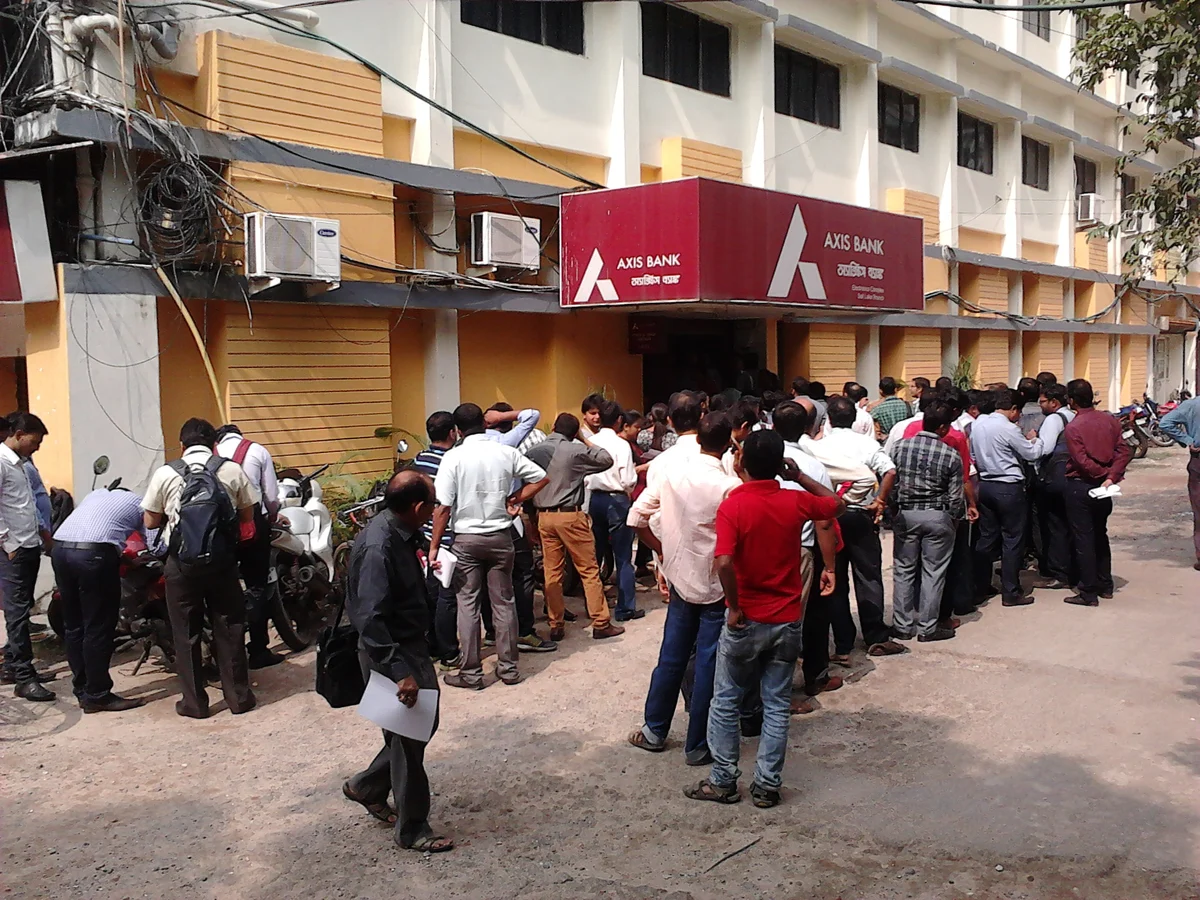
- Bank queue in Salt Lake, 10 November 2016 — documentary photograph by Biswarup Ganguly
